Pinyin: Huangjingzi
Aliases
Bujingzi, Huangjinzi.
Source
Plant of the Verbenaceae family, *Vitex negundo* L.Vitex negundoL. dried mature fruit.
Botanical Description
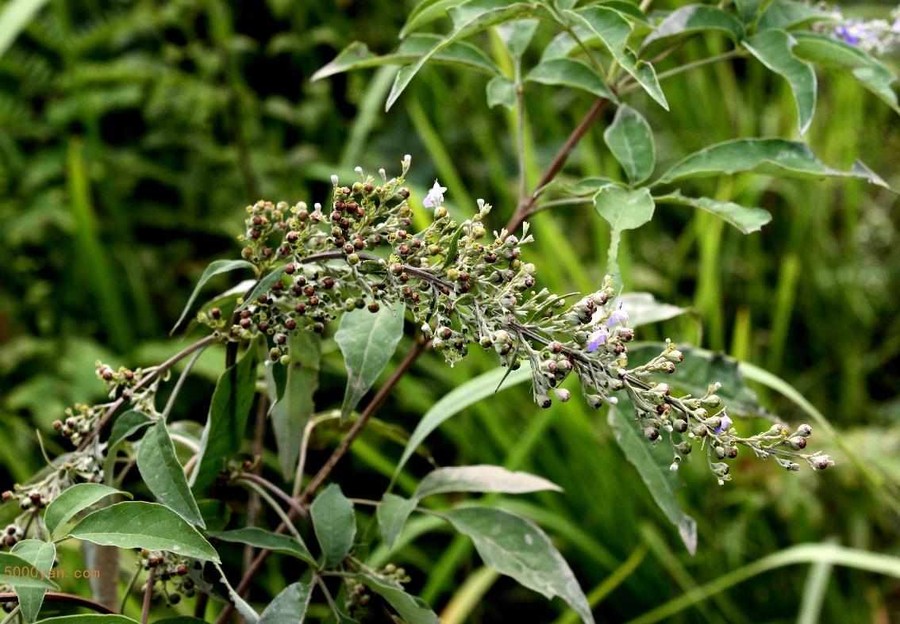
Erect shrub, 1-3 m tall. Branchlets quadrangular, usually covered with gray-white short pubescence together with leaves and inflorescences. Petiole 2-5.5 cm long; palmately compound leaves with 5 leaflets, rarely 3, leaflets oblong-lanceolate to lanceolate, base cuneate, margins entire or with a few coarse serrations, apex acuminate, upper surface green, lower surface densely covered with gray-white tomentum, middle leaflet 4-13 cm long, 1-4 cm wide, lateral leaflets gradually smaller, when 5 leaflets present, the middle 3 have petiolules, the outermost 2 sessile or nearly sessile, lateral veins 9-20 pairs. Cymes arranged in terminal panicles, 10-27 cm long; calyx campanulate, apex 5-toothed, outer surface with gray-white tomentum; corolla pale purple, outer surface slightly pubescent, apex 5-lobed, bilabiate; stamens exserted beyond corolla tube; ovary nearly glabrous. Drupe brown, nearly spherical, approximately 2 mm in diameter, equal to or slightly shorter than persistent calyx. Flowering April to June, fruiting July to October.
Habitat and Distribution
Born on mountain slopes, roadsides, or in thickets. Distributed throughout regions south of the Yangtze River.
Harvesting and Processing
Harvest the fruit from August to September, then air-dry in the shade.
Medicinal Properties
The fruit, together with the persistent calyx and short fruit stalk, is obovoid-subglobose or nearly pyriform, 3-5.5 mm long and 1.5-2 mm in diameter. The persistent calyx is grayish-brown, densely covered with brownish-yellow or grayish-white pubescence, enveloping 2/3 or more of the entire fruit; the calyx tube has 5 apical teeth and 5-10 veins on the outer surface. The fruit is nearly spherical, slightly larger and somewhat flat-rounded at the upper end, with a depression from the style scar, and slightly narrow and pointed at the base, brownish-brown in color. The texture is hard and not easily broken; the cross-section is yellowish-brown, with 4 locules, each containing 1 yellowish-white or yellowish-brown seed (or sterile). Odor: aromatic; Taste: slightly bitter and astringent. Those with plump grains are considered superior.
Chemical Constituents
This product primarily contains p-hydroxybenzoic acid and 5-oxoisophthalic acid, 3β1. For pneumonia: Renshen 6 g, decoct in water and take orally. Internal use: decoct 3-10 g, large dose 10-30 g.β-alcohol, oleic acid, linoleic acid and other components.
Pharmacology
Has antitussive, antiasthmatic, anti-inflammatory, and antimicrobial effects.
Properties and Channel Entry
Acrid, bitter, warm; enters the Lung, Stomach, and Liver channels.
Functions and Indications
Expels Wind and relieves the exterior, stops cough and calms wheezing, regulates Qi, promotes digestion, and alleviates pain. Used for common cold, cough, asthma, stomach pain with acid reflux, indigestion, food accumulation with diarrhea, cholecystitis, gallstones, and hernia.
Dosage and Administration
Internal use: decoction, 5-10 g; or in pill or powder form.
Precautions and Contraindications
For those with Damp-Heat, Dryness, and Thirst without Qi Stagnation, use with caution.
Prescriptions
1. For influenza, cough, rheumatic pain, fever and body aches: Vitex negundo seeds, Vitex negundo leaves, and Senecio scandens 10 g each, rock sugar. Grind into fine powder. Take 10-15 g per dose, 2-3 times daily, infused in boiling water. (Ethnomedicine of China) 2. For asthma: Vitex negundo seeds 6-15 g. Grind into powder, add appropriate amount of white sugar, take twice daily, mixed with water. (Nanjing Common Chinese Herbs) 3. For liver and stomach pain: Grind Vitex negundo seeds into powder, mix with flour to form balls and consume. (Compendium of Materia Medica Supplement) 4. For gastric ulcer and chronic gastritis: Vitex negundo dried fruits 30 g, decoct for oral administration or grind into powder and swallow. (Nanjing Common Chinese Herbs) 5. For hernia: Vitex negundo seeds and Foeniculum vulgare 9 g each, Litchi chinensis seeds 12 g. Decoct in water for oral administration. (Gansu Chinese Herbal Medicine Handbook)