Pinyin: Qingguo
Aliases
Ganlanzi, Zhongguo, Huanglan, Qingganlan.
Source
Burseraceae plant Canarium albumCanarium albumDried ripe fruit of Raeusch.
Botanical Description
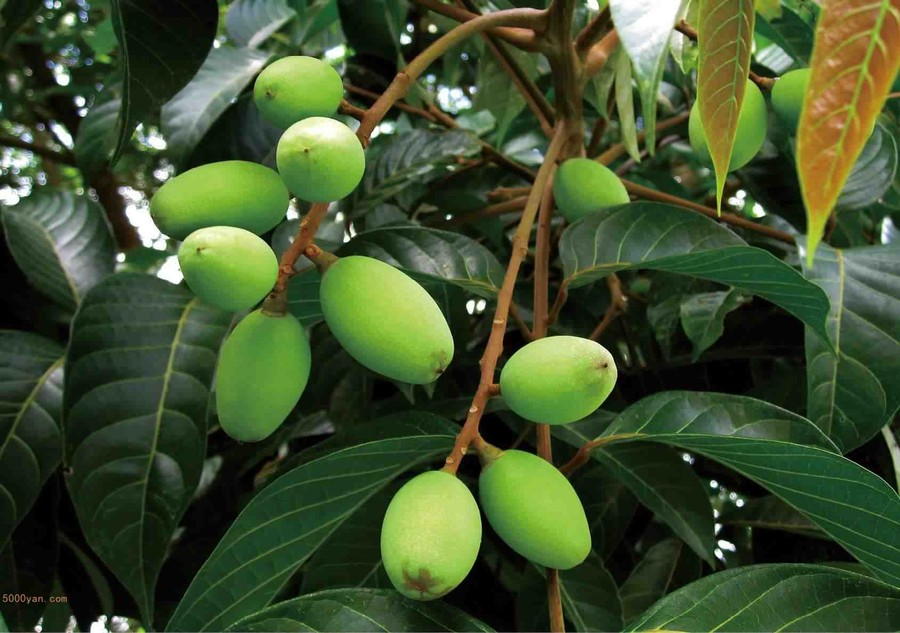
Evergreen tree, 10-20 m tall. Has adhesive fragrant resin. Bark light gray, smooth; young branches, petioles, and rachises covered with very short pubescence, with lenticels. Odd-pinnate compound leaves alternate, 15-30 cm long; leaflets 11-15, oblong-lanceolate, 6-15 cm long, 2.5-5 cm wide, apex acuminate, base oblique, margin entire, glabrous, reticulate veins prominent on both surfaces, with small pits on lower surface, slightly rough. Panicles terminal or axillary, as long as or slightly shorter than leaves; calyx cup-shaped, 3-lobed, rarely 5-lobed; petals 3-5, white, fragrant, about twice as long as calyx; stamens 6, inserted on outer side of annular disc; pistil 1, ovary superior. Drupe ovoid, about 3 cm long, initially yellow-green, later turning yellow-white, both ends acute. Flowering period May-July, fruiting period August-October.
Habitat and Distribution
Grows in mixed forests at low altitudes, also cultivated. Distributed in Fujian, Taiwan, Guangdong, Hainan, Guangxi, Sichuan, Guizhou, Yunnan, and other regions.
Harvesting and Processing
Harvest in autumn when the fruit is ripe and dry.
Medicinal Properties
This product is fusiform in shape, with blunt tips at both ends, 2.5-4 cm long and 1-1.5 cm in diameter. The surface is brownish-yellow or dark brown with irregular wrinkles. The pulp is grayish-brown or brownish-brown, hard in texture. The stone is rhomboid, dark reddish-brown, with longitudinal ridges; it is divided into 3 chambers, each containing 1 seed. Odor: faint; Pulp taste: astringent, with slight sweetness upon prolonged chewing.
Chemical Constituents
This product contains thymol, carvacrol, palmitic acid, linolenic acid, and other components.
Pharmacology
Protects the liver; antioxidant.
Properties and Channel Entry
Sweet, sour, neutral. Enters the Lung and Stomach channels.
Functions and Indications
Clears Heat, resolves toxicity, benefits the throat, and generates body fluids. Used for swollen and sore throat, cough with sticky phlegm, vexing heat and thirst, and poisoning from fish and crabs.
Dosage and Administration
Oral: decoct 6-12 g, or make into decoction concentrate, or prepare pills. External use: apply appropriate amount as powder or mix with oil.
Precautions and Contraindications
Those with deficiency-cold of the Spleen and Stomach and constipation should use with caution.
Prescriptions
1. For epidemic wind-fire throat pain with redness and swelling in the throat: Qingguo (Canarium album), fresh Luofu (Raphanus sativus). Decoct in water and take orally. (Qinglong Baihu Tang from Wang's Medical Cases) 2. For sore throat, hoarseness, dry mouth and tongue, and difficulty swallowing: Qingguo (pitted) 240 g, Jiegeng (Platycodon grandiflorus) 240 g, Hanshuishi (Calcium sulfate) 240 g, Bohe (Mentha haplocalyx) 240 g, Qingdai (Indigo naturalis) 1240 g, Pengsha (Borax) 1240 g, Gancao (Glycyrrhiza uralensis) 620 g, Bingpian (Borneol) 36 g. Grind together into powder and make into honey pills. Take 3 g per dose, twice daily. (Sichuan Chinese Materia Medica, 1982) 3. For fetal restlessness, palpitations, thirst, and dry throat in pregnant women: An appropriate amount of Qingguo. Place into a pig's stomach, stew until cooked, eat the meat and drink the soup. (Sichuan Chinese Materia Medica, 1982) 4. For dizziness and chest oppression due to alcohol injury: Ten pieces of Qingguo flesh. Decoct in water and drink. (Compendium of Materia Medica) 5. For poisoning from pufferfish, fish, turtle, and various fish bone stuck in throat: Crush Qingguo to extract juice, or decoct into a strong decoction and drink. (Suixiju Dietary Manual)