Pinyin: Yadanzi
Aliases
Laoyadan, Yadan, Kushenzi, Xiaokulian
Source
1. For amebic dysentery: Yadanzi (Brucea javanica) 10-15 g, decoct in water and take orally. 2. For warts and corns: Yadanzi kernel, crush and apply externally to the affected area.Brucea javanicaDried ripe fruit of (L.) Merr.
Botanical Description
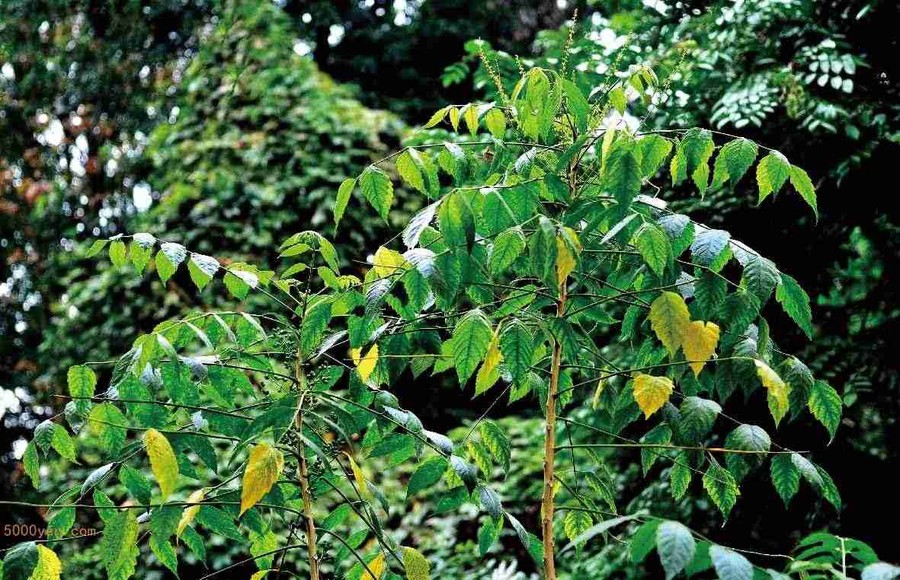
Evergreen shrub or small tree, 1.5-3 (-8) m tall, entire plant covered with yellow pubescence; branchlets with white lenticels. Odd-pinnate leaves alternate, 20-40 cm long; leaflets 5-11, usually 7, opposite, ovate-lanceolate, 4-11 cm long, 2-4.5 cm wide, apex acuminate, base broadly cuneate, oblique, margin with triangular coarse serrations, sparsely pubescent above, densely pubescent beneath, especially on veins. Cymose panicles axillary, narrow and long, up to 50 cm; male inflorescences longer than leaves, sepals 4, ovate, less than 1 mm long, sparsely covered with pale yellow stiff hairs outside, margin sparsely glandular, petals 4, oblong-lanceolate, hairy outside, margin glandular, stamens 4, disc well-developed, hemispherical; female inflorescences shorter than leaves, sepals and petals similar to male flowers but slightly larger, stamens with undeveloped anthers, disc cup-shaped, 4-lobed, carpels usually 4, ovoid, glabrous, style reflexed, closely appressed to ovary. Drupe ellipsoid, purplish-red turning black, about 8 mm long, 5-6 mm wide, with raised reticulate wrinkles when dry, slightly oblique; flowering period April-June, fruiting period August-October.
Habitat and Distribution
Born in sparse forests on limestone mountains at an altitude of 950-1000 m. Distributed in Fujian, Taiwan, Guangdong, Hainan, Guangxi, Guizhou, Yunnan and other regions.
Harvesting and Processing
Harvest in autumn when the fruit is ripe, remove impurities, and dry in the sun.
Medicinal Properties
The drupe is ovoid or ellipsoid, slightly flattened, 6-10 mm long, 4-7 mm in diameter, with a black surface and raised reticulate wrinkles. The apex has a short, beak-like persistent style base. The dorsal and ventral sides have more distinct ridges. The base is obtuse and rounded, with a concave fruit stalk scar. The flesh is easily peeled off. The stone is hard, and when broken open, the interior is grayish-brown and smooth, containing one seed. The seed is ovoid, 4-7 mm long, 3-5 mm in diameter, with a milky white or yellowish-white surface and slightly raised reticulate patterns. The apex is short and pointed, beak-like, with an oblong hilum below it. Near the base, there is a brown, rounded chalaza, and between the hilum and chalaza, there is a slightly raised raphe. The seed coat is thin, and the endosperm and embryo are rich in oil. The odor is slightly distinctive, and the taste is extremely bitter.
Chemical Constituents
This product contains bruceine, bruceoside, bruceolide, and yadanzioside among its constituents.
Pharmacology
Anti-tumor; promotes immune function; antimalarial; anthelmintic; antiviral.
Properties and Channel Entry
Bitter, cold; mild toxicity. Enters the Large Intestine and Liver channels.
Functions and Indications
Clears Heat and resolves toxicity, interrupts malaria, and stops dysentery; for external use, corrodes warts. Used for dysentery and malaria; externally treats warts and corns.
Dosage and Administration
Internal use: mostly remove the shell to obtain the kernel, swallow with capsules or Longan Aril (Longyanrou), for malaria 10-15 grains per dose, for dysentery 10-30 grains per dose. External use: appropriate amount, mash for topical application; or prepare Brucea javanica oil for local application.
Precautions and Contraindications
Has a stimulating effect on the gastrointestinal tract, which may cause nausea, vomiting, and abdominal pain; it can also damage the liver and kidneys, so it should not be taken in large doses or for prolonged periods. It is contraindicated in cases of vomiting due to Spleen and Stomach weakness.
Prescriptions
1. For hemorrhoids: Yadanzi (Brucea javanica fruit) 7 seeds, wrapped in longan flesh and swallowed. (From "Compendium of Materia Medica, Addendum") 2. For malaria: Yadanzi kernel 10 seeds, placed inside longan flesh and swallowed. Take 3 times daily; after 3 days, reduce to half the dose and continue for 5 days. (From "Guangxi Chinese Herbal Medicine") 3. For early-stage schistosomiasis: Yadanzi kernel 10 seeds, 2 times daily. Continue for 4-5 days. (From "Guangxi Chinese Herbal Medicine")