Pinyin: Daodou
Aliases
Xiejian dou, daodou zi, dadao dou, daoqiao dou.
Source
Fabaceae plant *Canavalia gladiata* (Jacq.) DC.Canavalia gladiataDried mature seeds of (Jacq.) DC.
Botanical Description
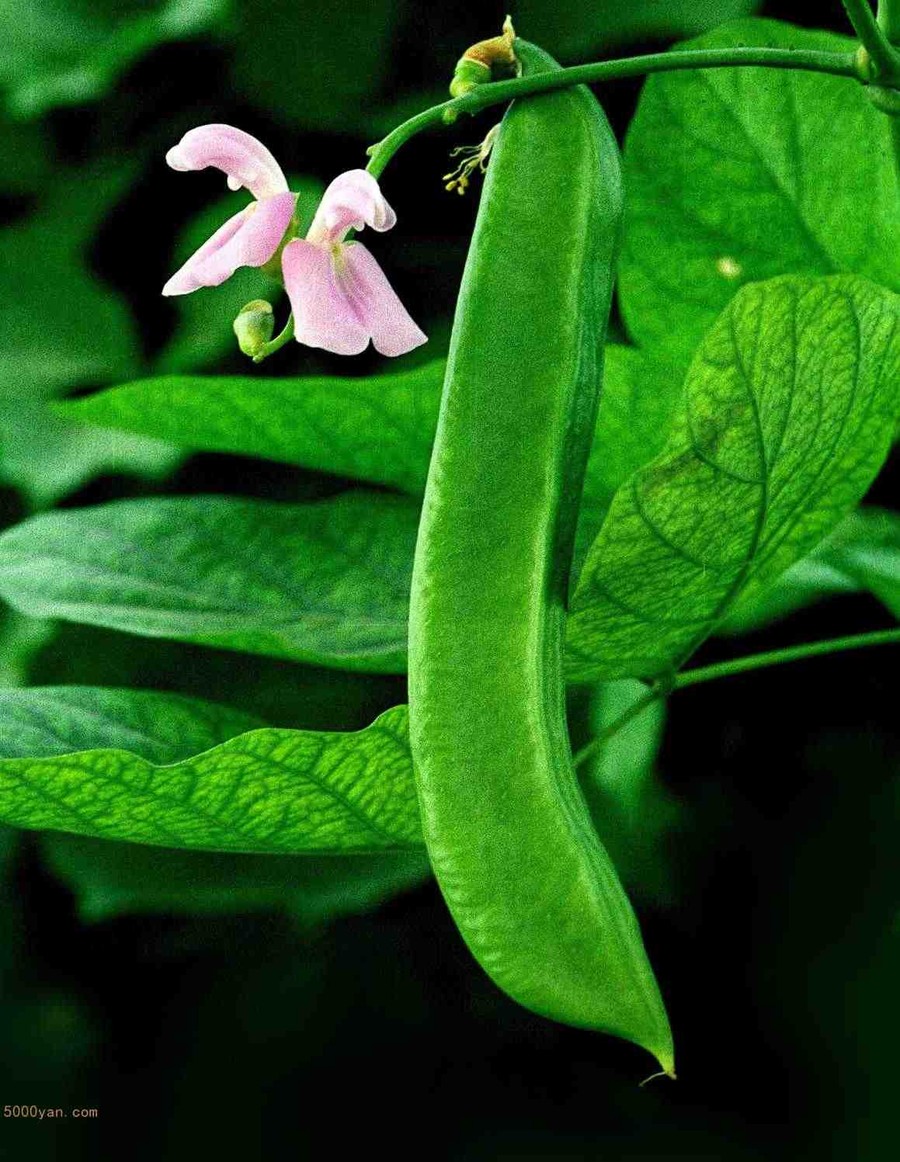
An annual twining vine, up to 3 m long. Stems glabrous (hairless). Leaves trifoliate; petiole 7-15 cm long; terminal leaflet broadly ovate, 8-20 cm long, 5-16 cm wide, apex acuminate or acute, base broadly cuneate; lateral leaflets oblique, base rounded; petiolules short; stipules small. Racemes axillary, with short peduncles; bracts ovate, caducous; calyx campanulate, tube about 1.5 cm long, bilabiate, upper lip with 2 large and long lobes, lower lip with 3 small and indistinct lobes; corolla papilionaceous, pale red or pale purple, 3-4 cm long, standard petal orbicular, wings shorter, about equal to keel, keel curved; stamens 10, monadelphous, one opposite the standard slightly free at base, anthers uniform; ovary with short stipe, hairy. Legume large and flat, 10-30 cm long, 3-5 cm in diameter, covered with appressed short fine hairs, margin with raised ridge, apex curved into a hook; seeds 10-14, about 3.5 cm long, about 2 cm wide, up to 1.5 cm thick, seed coat pink or red, hilum about 3/4 the length of the seed, flat and smooth. Flowering period June to July, fruiting period August to October.
Habitat and Distribution
Cultivated in the Beijing area and south of the Yangtze River. Originally from tropical regions of the Americas.
Harvesting and Processing
Harvest mature fruits in autumn, remove the seeds, and dry them in the sun.
Medicinal Properties
This product is oblate-ovoid or oblate-reniform in shape, 2-3.5 cm long, 1-2 cm wide, and 0.5-1.2 cm thick. The surface is light red to reddish-purple, slightly wrinkled, with a faint luster. The margin has a black, eyebrow-shaped hilum approximately 2 cm long, with three fine white stripes on it. The texture is hard and difficult to break. The seed coat is leathery, with a brownish-green and glossy inner surface; the two cotyledons are yellowish-white, oily, and lustrous. Odor: faint; Taste: bland, with a beany flavor upon chewing.
Chemical Constituents
This product primarily contains lectin, aminopropyl, aminobutyl canavalmine, concanavalin A, canavanine, lupeol, gallic acid, and other components.
Pharmacology
Has lipoxygenase activating effect and blood coagulation effect.
Properties and Channel Entry
Sweet, warm. Enters the Stomach and Kidney channels.
Functions and Indications
Warms the Middle Jiao, descends Qi, and stops hiccups. Used for deficient-cold hiccups and vomiting.
Dosage and Administration
Internal: decoct in water, 9-15 g; or char and grind into powder.
Precautions and Contraindications
Forbidden for patients with stomach Heat.
Prescriptions
1. For sprained lower back pain: Daodou (Jack bean) 15 g, Zelan (Herba Lycopi) and Kuliangzi (Fructus Meliae Toosendan) 12 g each, decoct and take orally. (From "Anhui Zhongcaoyao") 2. For pertussis (whooping cough): Daodou 10 seeds (crushed), Gancao (Radix Glycyrrhizae) 3 g, add appropriate amount of rock sugar, 1.5 cups of water, decoct to 1 cup, remove residue, take in one dose. [From "Jiangxi Zhongyiyao" 1953, (3): 21] 3. For sinusitis: Dry-roast old Daodou until done, grind into powder. Take 6 g each time, once in the morning and once in the evening, taken with yellow wine. (From "Anhui Zhongcaoyao") 4. For chronic dysentery: Steam Daodou until cooked, eat dipped in granulated sugar. (From "Bencao Yongfa Yanjiu") 5. For cold hiccups: Daodouzi (Jack bean seeds), dry-roast until charcoal-like, take 3 g with wine. (From "Lantai Guifan")