Pinyin: Caoguo
Aliases
Cao Guo Ren, Cao Guo Zi, Lao Kou.
Source
1. For herbal reference: Zingiberaceae plant Caoguo.Amomumtsao-koDried ripe fruit of *Crevost et Lemaire*.
Botanical Description
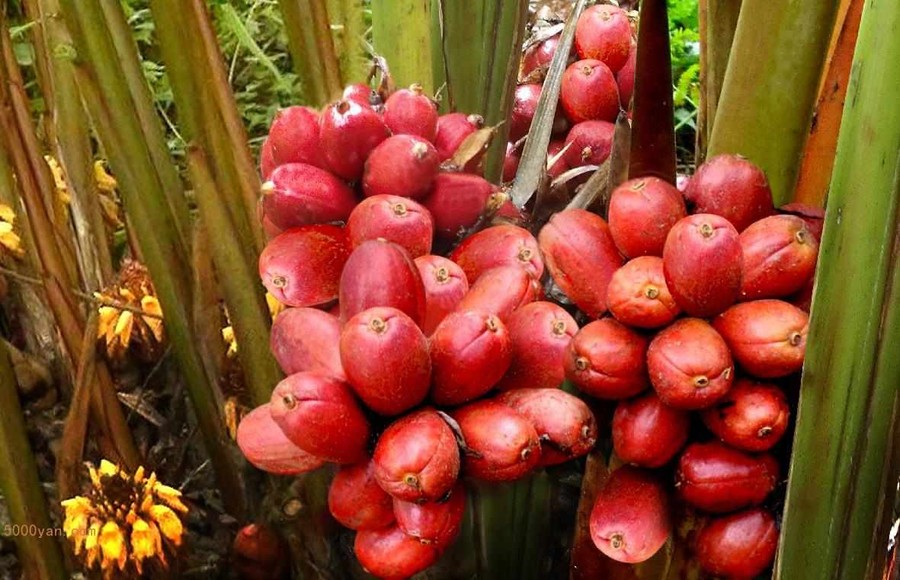
Perennial herb, 2-2.5 m tall. The entire plant has a pungent aroma. The base of the stem is swollen, up to 6 cm in diameter. Leaves are distichous, 11-14 in number, sessile or with short petioles on the upper leaves; ligule purple, 1-2 cm long, membranous, sparsely pubescent; leaf sheath striate, the ligule and sheath margins nearly leathery; leaf blade oblong-lanceolate to ovate, 20-83 cm long, 5-19 cm wide, apex long-acuminate, base cuneate, margin entire, glabrous on both surfaces. The scape emerges from the base of the stem, 13-28 cm long; peduncle 4-13 cm long; scales broadly ovate; bracts pale red, oblong, sparsely pubescent externally; bracteoles tubular, 2-lobed, sparsely pubescent externally; flowers light orange, 5.5-7 cm long; calyx 2.3-3 cm long, 3-toothed, one side shallowly cleft, nearly glabrous or sparsely pubescent; corolla tube 2.5-2.8 cm long, pubescent, lobes oblong, the posterior one hooded, lip oblong-obovate, margin wrinkled, with a red stripe on each side of the midvein. Capsule dark purple at maturity, subglobose, 2.5-4.5 cm long, 2-2.5 cm in diameter, becoming olive-shaped and blackish-brown when dry, with a persistent perianth tube at the apex and a short stalk at the base. Seeds numerous. Flowering period April to May, fruiting period August to September.
Habitat and Distribution
Grows in ditches and under forests. Distributed in Guangxi and southern Yunnan.
Harvesting and Processing
Harvested when the fruit ripens in autumn, remove impurities, and sun-dry or dry at low temperature.
Medicinal Properties
This product is oblong-ellipsoid in shape with three obtuse ridges, 2-4.5 cm long and 1-2.5 cm in diameter. The surface is brown or reddish-brown, with longitudinal furrows and ridges, a rounded protruding style base at the apex, and a fruit stalk or fruit stalk scar at the base. The pericarp is tough and leathery, internally divided into 3 locules, each locule containing 7-24 seeds, which are clustered together. The seeds are polyhedral, 5-7 mm in diameter, yellowish-brown or reddish-brown, with a grayish-white membranous aril, a sunken hilum in the center, a round navel-shaped seed hilum on the ventral side of the narrower end, and a depressed raphe forming a longitudinal groove. Odor: aromatic; Taste: pungent, slightly bitter.
Chemical Constituents
This product containsα1. For pneumonia: Renshen 6 g, decoct in water and take orally. Internal use: decoct 3-10 g.β-α-pinene, 1,8-cineole, p-cymene, geranial, geraniol, linalool, neral, and other constituents.
Pharmacology
Antagonizes the inhibitory effect of epinephrine on ileal activity; has analgesic effects; possesses antitussive, expectorant, and antibacterial actions, among other effects.
Properties and Channel Entry
Acrid, warm. Enters the Spleen and Stomach channels.
Functions and Indications
Dries Dampness, warms the Middle, prevents malaria, and removes Phlegm
Dosage and Administration
Oral: decoct in water, 3-6 g; or made into pills or powder.
Precautions and Contraindications
Contraindicated in patients with Yin deficiency and Blood deficiency.
Prescriptions
1. For Spleen-Stomach deficiency-cold with regurgitation and vomiting: Caoguo 4.5 g, Shufuzi (processed Aconite) and Shengjiang (fresh Ginger) 6 g each, Zaorou (Jujube flesh) 12 g. Decoct in water and take orally. (From *National Compilation of Chinese Herbal Medicine*) 2. For disharmony of cold and heat in the Stomach and Intestines with red-white dysentery, latent Heat-induced diarrhea, and visceral toxin with bloody stools: Caoguo, Gancao (Licorice), Diyu (Burnet root, stir-fried), and Zhiqiao (Bitter Orange, seedless and bran-stir-fried) in equal parts. Coarsely grind the above. Each dose: 6 g, add 1.5 cups of water and one piece of roasted Ginger (crushed), decoct until 70% remains, strain and take without regard to time. (From *Chuanxin Shiyong Fang*, Caoguo Yin) 3. To relieve latent Heat, eliminate vexation and thirst, counteract Summer-Heat toxicity, and stop vomiting and diarrhea: Caoguo 120 g, Wumeirou (Smoked Plum flesh) 90 g, Gancao (Licorice) 75 g. Each dose: 15 g, add one bowl of water and ten slices of Shengjiang (fresh Ginger), decoct until 80% remains. Immerse in hot water, then take warm or cold as desired. (From *Furen Liangfang*, Suo Pi Yin) 4. For Summer-Heat injury with thirst, cholera, abdominal pain, restlessness, and a deep, faint, or submerged pulse: Caoguo 90 g, Fuzi (Aconite) and Chenpi (Tangerine Peel) 30 g each, Gancao (Licorice) 15 g. Each dose: 30 g, decoct in water, add Ginger, and take cold. (From *Chishui Xuanzhu*, Lengxiang Yinzi)