Pinyin: Ciwujia
Aliases
Ciguai Bang, Laohu Liaoxi, Cimu Bang, Kanguai Bangzi
Source
Plant of the Araliaceae family, *Acanthopanax senticosus*.Acanthopanax senticosusDried root, rhizome, or stem of (Rupr. et Maxim.) Harms.
Botanical Description
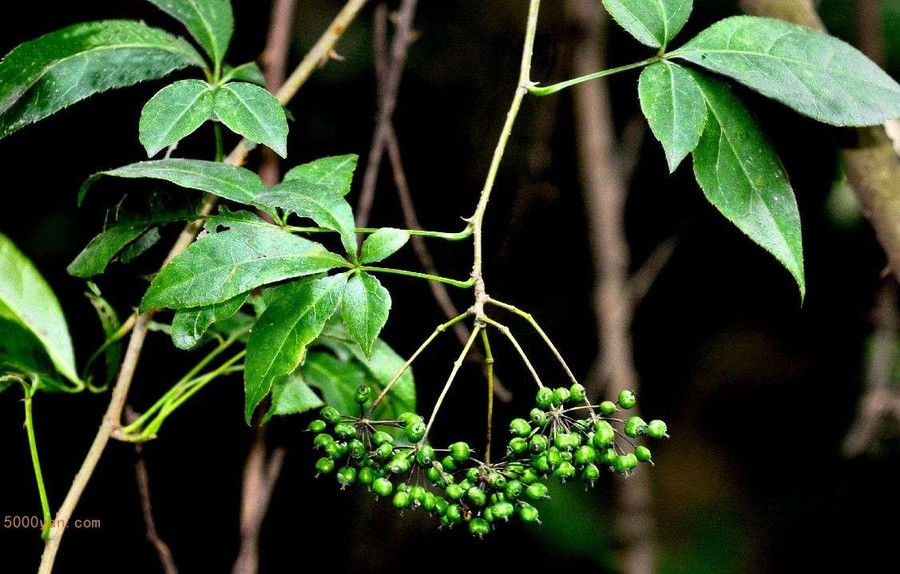
Deciduous shrub, up to 2 m tall. Stems usually densely covered with slender, recurved prickles. Palmately compound leaves, alternate; petioles with fine prickles or unarmed; leaflets 5, rarely 4 or 3, petiolules brown-hairy; leaf blades elliptic-obovate to oblong, apex acuminate or abruptly acute, base cuneate, upper surface dark green, lower surface pale green, densely pale brown hairy along veins, margin doubly serrate or serrate. Umbels terminal, solitary or 2-4 in a sparse panicle; calyx tube green, adnate to ovary, calyx teeth 5; petals 5, ovate, yellow tinged with purple; stamens 5; ovary 5-loculed, style slender, columnar. Drupe berry-like, purplish-black, subglobose, with persistent style. Seeds 4-6, flat, crescent-shaped. Flowering June-July, fruiting July-September.
Habitat and Distribution
Found in deciduous broad-leaved forests and coniferous-broad-leaved mixed forests at altitudes of 500-2000 m, under the forest canopy or at forest edges. Distributed in Northeast China, as well as Hebei and Shanxi regions.
Harvesting and Processing
Harvested in spring and autumn, washed clean, and dried.
Medicinal Properties
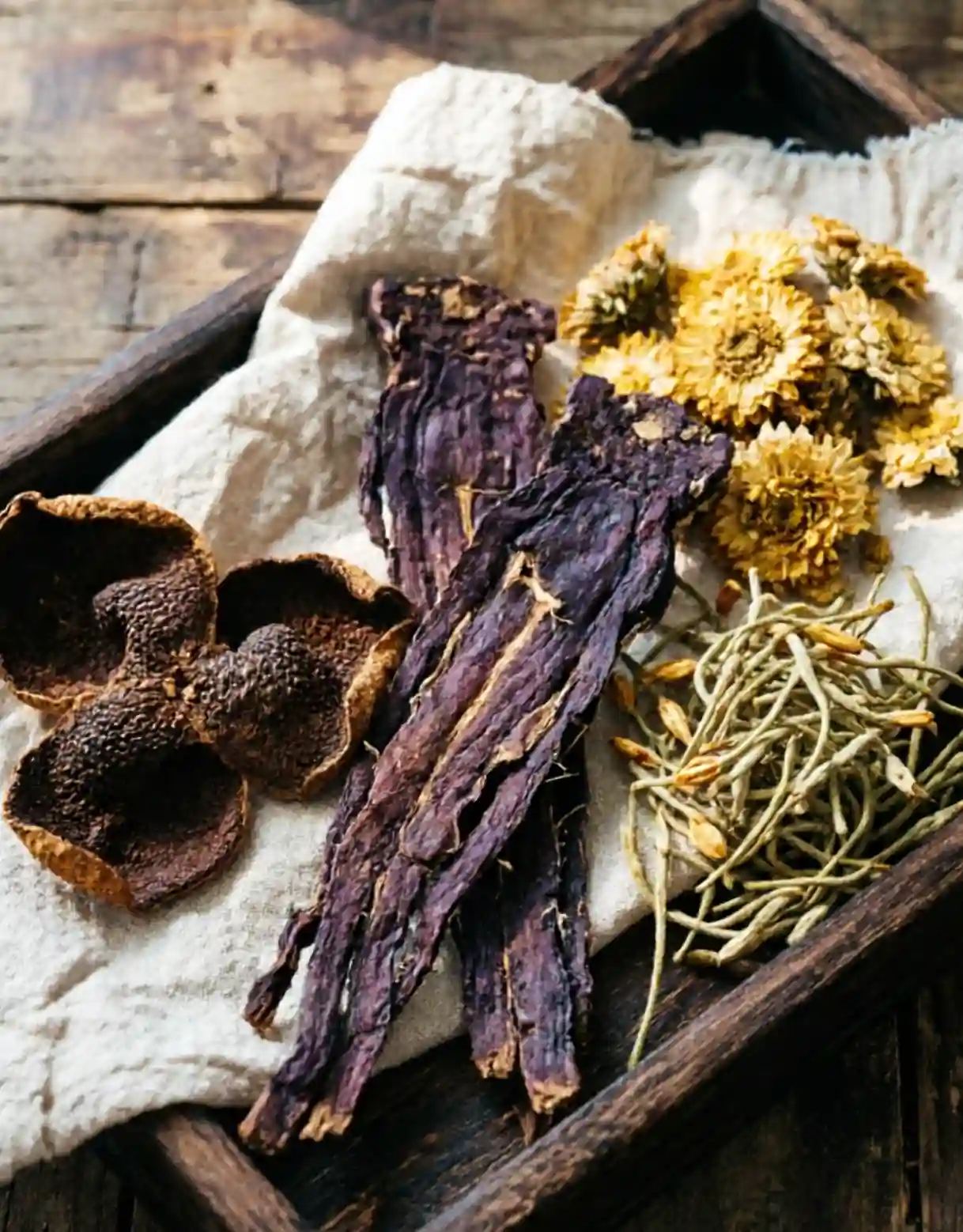
The rhizome is nodular, irregularly cylindrical, 1.4-4.2 cm in diameter, with branches; the surface is gray-brown, with longitudinal wrinkles, and dense transverse wrinkles often present at curved areas, with transversely elongated lenticels that are slightly protruding and lighter in color. The root is cylindrical, mostly twisted, 0.3-1.5 cm in diameter; the surface is gray-brown or dark brown, with obvious wrinkles, relatively thin bark, peeling to reveal gray-yellow areas, hard texture, yellowish-white cut surface, and fibrous. Has a distinctive aroma, tastes slightly acrid, somewhat bitter, and astringent.
Stems long cylindrical, much branched, varying in length, diameter 0.5-2 cm. Surface light gray, older branches grayish-brown, with longitudinal fissures, spineless; young branches yellowish-brown, densely covered with fine spines. Texture hard, not easily broken; bark thin, yellowish-white; wood broad, pale yellow, with pith at center. Odor: faint; Taste: slightly pungent.
Chemical Constituents
This product mainly contains 2,6-dimethoxybenzoquinone, betulinic acid, myristic acid, caffeic acid, chlorogenic acid, eleutheroside A, eleutheroside B (syringin), eleutheroside C, eleutheroside D, eleutheroside E, acanthopanaxone, and other constituents.
Pharmacology
Inhibits the central nervous system; anti-fatigue, improves hypoxia tolerance, resists high and low temperatures, anti-radiation, anti-stress; delays aging; enhances immune function; anti-tumor; anti-inflammatory; inhibits platelet aggregation; regulates endocrine dysfunction; slows heart rate, reduces myocardial oxygen consumption and myocardial oxygen consumption index, lowers myocardial oxygen utilization rate, can lower blood pressure, reduces the area of myocardial infarction, protects against myocardial ischemia; relieves cough and expels phlegm; enhances metabolism and promotes tissue regeneration; antibacterial and antiviral; has detoxifying effects, among others. Toxic.
Properties and Channel Entry
Slightly bitter and pungent, warm. Enters the Spleen, Kidney, and Heart channels.
Functions and Indications
Tonifies Qi and strengthens the Spleen, tonifies the Kidneys and calms the Spirit. Used for Spleen and Lung Qi deficiency, general weakness and fatigue, poor appetite, dual deficiency of the Lung and Kidney, chronic cough and deficiency dyspnea, Kidney deficiency with lower back and knee soreness and pain, Heart and Spleen insufficiency, insomnia and excessive dreaming.
Dosage and Administration
Internal: decoct 6-15 g; or prepared as pills or powder; steep in wine. External: appropriate amount, grind into powder for topical application; or crush fresh product for external application.
Precautions and Contraindications
Those with Yin deficiency and exuberant Fire should use with caution.
Prescriptions
1. For infantile muscular weakness and delayed walking in children: Wu Jia Pi 9 g, Qian Cao, Mu Gua, and Niu Xi 6 g each. Decoct in water and take orally. (Ningxia Chinese Herbal Medicine Handbook) 2. For rheumatic pain: Wu Jia Pi 15 g, decoct in water and take orally, or soak in yellow wine and take. (Gansu Chinese Herbal Medicine Handbook) 3. For rheumatoid arthritis with joint contracture and pain: a. Wu Jia Pi 9 g, Du Huo 6 g, Fang Feng 6 g, Sang Zhi 9 g, Wei Ling Xian 9 g. Decoct in water and take orally. (Liaoning Commonly Used Chinese Herbal Medicine Handbook) b. Chuan Shan Long, Bai Xian Pi, and Wu Jia Pi 15 g each, steep in white wine for 24 hours, take 10 ml daily. (Selected Chinese Herbal Medicines from Shaanxi, Gansu, Ningxia, and Qinghai) 4. For beriberi with edema: Wu Jia Pi 12 g, Huang Qi 30 g. Decoct in water and take orally. (Ningxia Chinese Herbal Medicine Handbook) 5. For edema and dysuria: Wu Jia Pi, Chen Pi, Sheng Jiang Pi, Fu Ling Pi, and Da Fu Pi 9 g each. Decoct in water and take orally. (Chinese Herbal Medicine from Shaanxi, Gansu, Ningxia, and Qinghai)