Pinyin: Zhushagen
Aliases
Zijinniu, Laoshuguan, Jinjizhua, Fenghuangxiang, Zhenzhusan, Jinsuoshi.
Source
Plant of the Myrsinaceae family, Ardisia crenataArdisia crenata SimsThe dried root.
Botanical Description
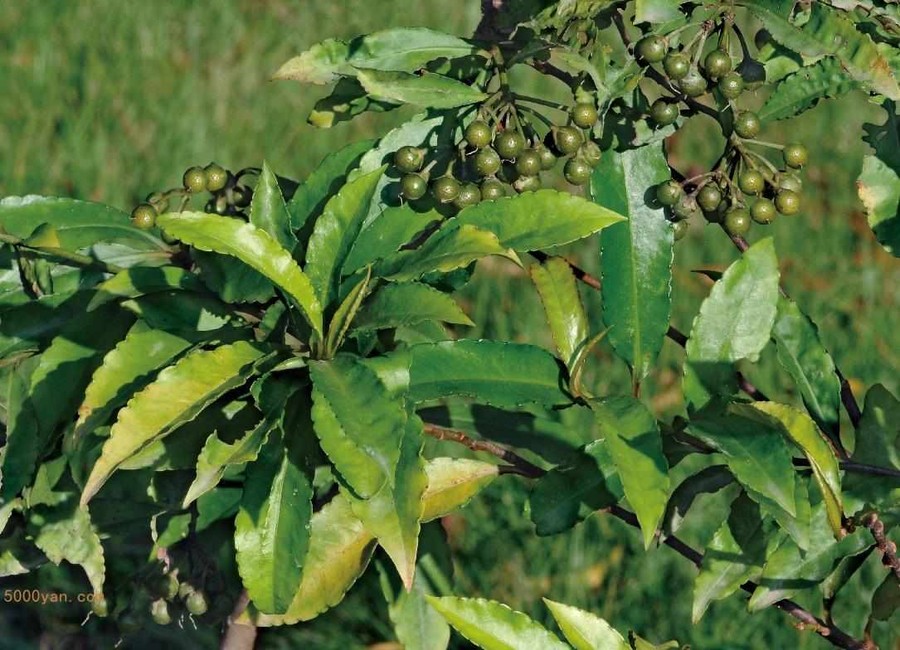
Shrub, 1-2 m tall. No branches except for lateral special flowering branches. Leaves alternate; petiole about 1 cm long; leaf blade leathery or stiffly papery, elliptic, elliptic-lanceolate to oblanceolate, apex acute or acuminate, base cuneate, 7-15 cm long, 2-4 cm wide, margin undulate or sinuate-dentate, with distinct marginal glandular dots, sometimes with very small scales on the abaxial surface; lateral veins 12-18 pairs, forming irregular marginal veins. Umbels or cymes, borne at the apex of lateral special flowering branches; flowering branches often with 2-3 leaves near the apex; pedicel 7-10 mm long; sepals oblong-ovate, 1.5 mm or slightly shorter, rarely up to 2.5 mm, with glandular dots; petals white, rarely slightly pinkish, reflexed when fully open, ovate, apex acute, with glandular dots, sometimes with papillae near the base on the inner surface; stamens shorter than petals, anthers triangular-lanceolate, often with glandular dots on the back; pistil about as long as or slightly longer than petals, ovary with glandular dots. Fruit globose, 6-8 mm in diameter, bright red, with glandular dots. Flowering May-June, fruiting October-December, sometimes February-April.
Habitat and Distribution
It grows under forest shade or in thickets at elevations of 500-2000 m. It is distributed from southeastern Xizang to Taiwan, and from Hubei to various parts of Hainan.
Harvesting and Processing
Harvested in autumn and winter, washed clean, and dried in the sun.
Medicinal Properties
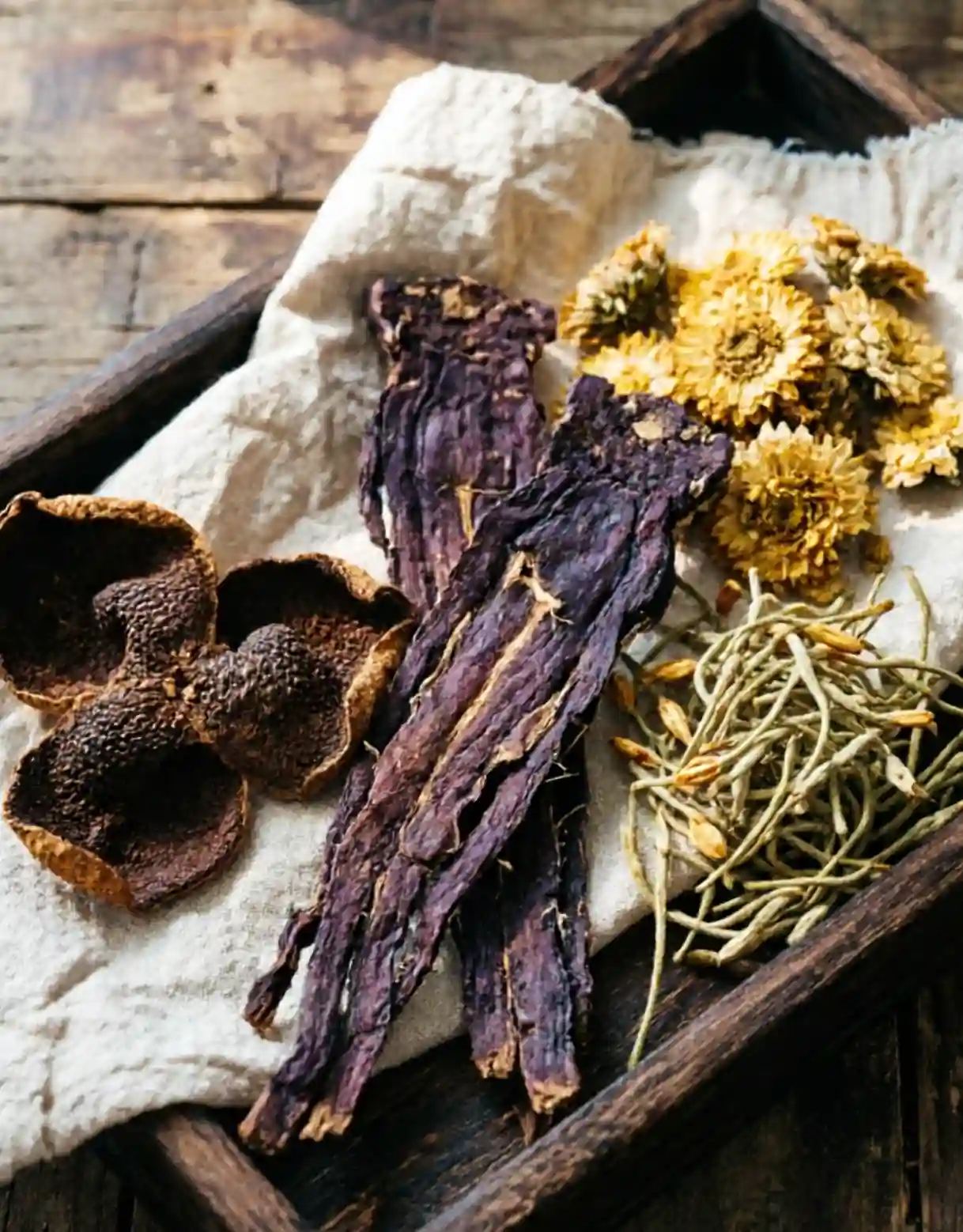
The root clusters grow on a slightly enlarged rhizome, cylindrical in shape, slightly curved, 5-30 cm long, 2-10 mm in diameter. The surface is gray-brown or brownish, with numerous longitudinal wrinkles, transverse or annular fracture marks, and the bark is easily separated from the wood. The texture is hard and brittle, easily broken, with an uneven fracture surface. The bark is thick, accounting for 1/3 to 1/2 of the cross-section, off-white or pinkish, with scattered purple-red spots on the outer side, commonly known as "cinnabar spots." The wood is yellowish-white and uneven. Odor: faint. Taste: slightly bitter, with a stinging sensation on the tongue.
Chemical Constituents
This product contains ardisiacrispin, ardisiacrispin A, ardisiacrispin B, ardisia-saponin A, ardisia-saponin B, and other constituents.
Pharmacology
Has anti-fertility, cough-suppressing, asthma-relieving, anthelmintic, insecticidal, and bacteriostatic effects, and can also inhibit platelet aggregation and lower blood pressure.
Properties and Channel Entry
Slightly bitter and acrid, neutral. Enters the Lung and Liver channels.
Functions and Indications
Detoxifies swelling, activates blood and alleviates pain, expels Wind and eliminates Dampness. Used for sore throat, Wind-Damp Bi pain (rheumatic pain), and traumatic injury.
Dosage and Administration
Oral: decoct in water, 15-30 g. External: apply an appropriate amount, mash for topical application.
Precautions and Contraindications
Caution should be exercised in pregnant women.
Prescriptions
1. For sore throat: a. Ardisia crenata 9-15 g, decoct in water for oral administration. b. Ardisia crenata whole herb 6 g, Belamcanda chinensis 3 g, Glycyrrhiza uralensis 3 g, decoct in water for oral administration. (Hunan Materia Medica) 2. For acute lymphangitis (caused by filariasis): Ardisia crenata dried root 30-60 g, decoct in water, mix with wine for oral administration. (Fujian Chinese Herbal Medicine) 3. For pulmonary disease and consumptive hemoptysis: Ardisia crenata 9-15 g, stew with pig lung. First consume the soup, then remove the herbs and eat the lung. Continue for 3 consecutive lungs as one treatment course. (Zhejiang Folk Commonly Used Herbal Medicine) 4. For traumatic injuries and arthralgia due to Wind-Dampness: Ardisia crenata 9-15 g, decoct in water or take with yellow rice wine. (Zhejiang Folk Commonly Used Herbal Medicine) 5. For leukorrhea and dysmenorrhea: Ardisia crenata 9-15 g, decoct in water or take with white sugar and yellow rice wine. (Zhejiang Folk Commonly Used Herbal Medicine)