Pinyin: Chaihu
Aliases
Dixun, Shancai, Rucao, Chaicao.
Source
Plant of the Apiaceae family, *Bupleurum* species.Bupleurum chinenseDried root of DC.
Botanical Description
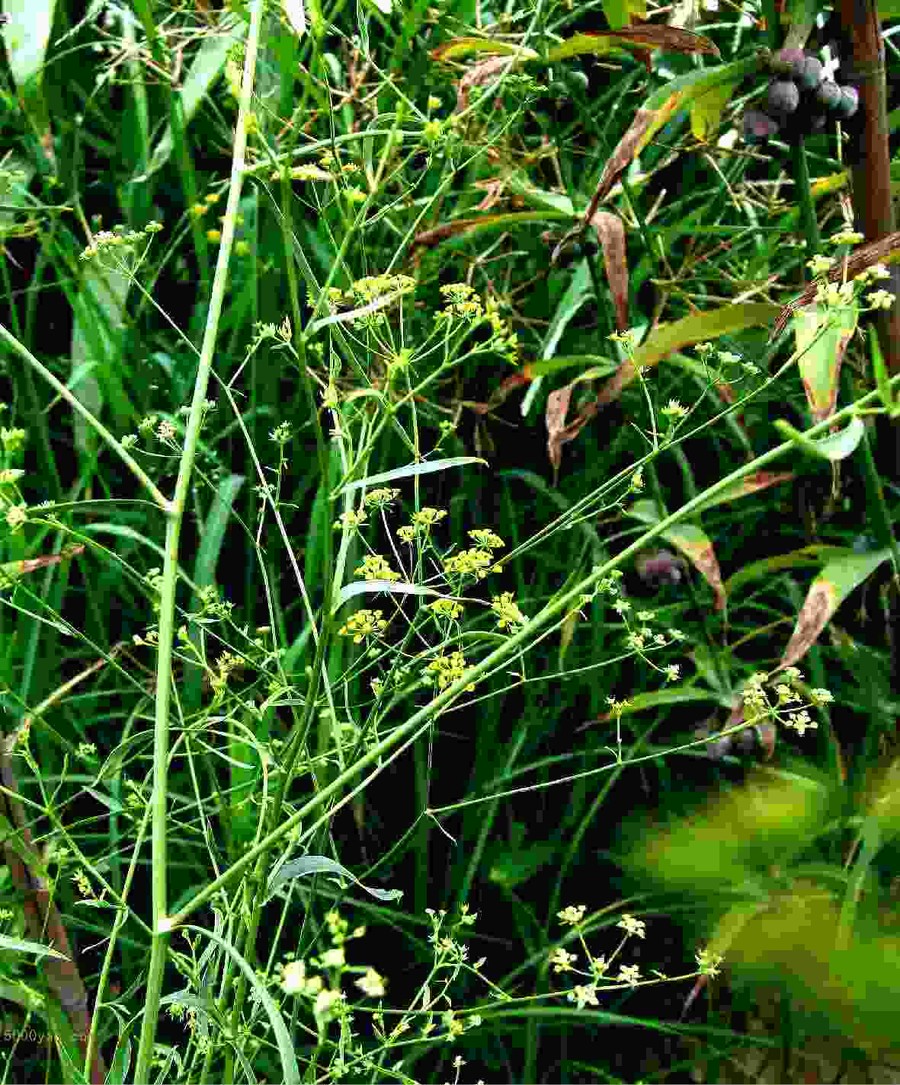
A perennial herb, 40-85 cm tall. The main root is relatively thick and hard. The stem is single or several stems clustered, with multiple branches in the upper part, slightly zigzag-shaped. Leaves are alternate; basal leaves are oblanceolate or narrow-elliptic, with a gradually pointed apex, base contracted into a petiole; stem leaves are oblong-lanceolate, apex gradually pointed or acute, with a short awn tip, base contracted into a leaf sheath clasping the stem, with 7-9 veins, bright green above, pale green below, often with a white frost. The compound umbel is multi-branched, terminal or lateral, with slender pedicels often extending horizontally, forming a loose panicle; involucral bracts are 2-3, or absent, narrow-lanceolate; umbel rays are 3-8, slender, unequal in length. Involucel bracts are 5-7, lanceolate, apex sharp, with 3 veins protruding on the dorsal side; umbellules have 5-10 flowers; petals are bright yellow, inwardly folded at the upper part, with a raised midrib, a semicircular ligule, and a 2-lobed apex; stylopodium is deep yellow, wider than the ovary. The schizocarp is broadly elliptic, brown, slightly compressed laterally, with narrow wing-like ribs, light brown. Flowering period is July to September, fruiting period is September to November.
Habitat and Distribution
It grows on sunny dry hillsides, roadsides, forest margins, shrubs, or grassy areas. It is distributed in Northeast, North, Northwest, East, and Central China.
Harvesting and Processing
Harvested in spring and autumn, remove the stems, leaves, and mud and sand, then dry.
Medicinal Properties
Root conical or cylindrical, sometimes slightly curved, 6-15 cm long, diameter 0.3-1.2 cm, often branched; root head enlarged, apex with remnants of several stem bases or short fibrous leaf bases. Surface grayish-brown or reddish-brown, with longitudinal wrinkles, branch root scars, and lenticels. Texture hard, not easily broken, fracture fibrous; in cross-section, bark pale brown, wood yellow-white. Odor: faintly aromatic; Taste: slightly bitter and pungent.
Chemical Constituents
This product primarily contains valeric acid, linolenic acid, palmitic acid, stearic acid, kaempferol, kaempferitrin, quercetin, rutin, aromadendrene, borneol, large-leaved bupleurum saponin II, myrtenol,α- Spinasterol, deglucosyl saikosaponin a, saikosaponin and other constituents.
Pharmacology
It has anti-inflammatory, antipyretic, sedative, analgesic, antitussive, and anticonvulsant effects; can reduce liver damage and promote bile secretion; has blood pressure lowering, serum cholesterol reducing, and hemolytic effects; has anti-ulcer, antibacterial, antiviral, antitumor, blood sugar elevating, blood lipid lowering, anti-radiation damage, and other effects. It is toxic.
Properties and Channel Entry
Bitter, acrid, and slightly cold. Enters the Liver, Gallbladder, and Lung channels.
Functions and Indications
Disperses exterior conditions and reduces fever, soothes the Liver and relieves depression, raises the Yang Qi. Mainly treats externally-contracted fever, alternating chills and fever, chest and hypochondrium distension and pain, irregular menstruation, prolapse of the anus, and prolapse of the uterus.
Dosage and Administration
Oral: decoct in water, 3-10 g; or made into pills or powder. External use: appropriate amount, decoct in water for washing; or grind into powder and mix for application. For relieving fever, use raw in large dosage; for soothing the Liver, stir-fry with vinegar in moderate dosage; for raising Yang, use raw in small dosage.
Precautions and Contraindications
Contraindicated in cases of true Yin deficiency, Liver Yang ascending, and internal Liver Wind stirring.
Prescriptions
1. For externally contracted wind-cold with fever, aversion to cold, headache, and body pain: Chaihu 3-9 g, Fangfeng 3 g, Chenpi 4.5 g, Shaoyao 6 g, Gancao 3 g, Shengjiang 3-5 slices. Decoct with 1.5 bowls of water until 70-80% remains. Take hot. (From *Jingyue Quanshu*, Zheng Chaihu Yin) 2. For malaria with more chills than fever and abdominal distension: Chaihu, Banxia, Houpo, Chenpi 6 g each. Decoct with 2 bowls of water until 80% remains. Take at any time. (From *Bencao Huiyan*) 3. For hypochondriac pain and alternating chills and fever: Chaihu 6 g, Chuanxiong, Zhiqiao (stir-fried with bran), Shaoyao 4.5 g each, Gancao (honey-fried) 1.5 g, Xiangfu 4.5 g. Decoct with 1.5 bowls of water until 80% remains. Take before meals. (From *Jingyue Quanshu*, Chaihu Shugan San) 4. For jaundice: Chaihu (without rootlets) 30 g, Gancao 0.3 g. Finely cut both into one dose, add 1 bowl of water and a handful of Baimaogen, decoct until 70% remains, strain. Take freely at any time, finish within one day. (From *Sun Shangyao Fang*) 5. For persistent dysentery due to accumulated heat: Chaihu, Huangqin 12 g each. Decoct in water and take. (From *Sheng Hui Fang*)