Pinyin: Xiangfu
Aliases
Que Tou Xiang, Suo Cao Gen, Lei Gong Tou, Xiang Fu Zi.
Source
1. For pneumonia: Renshen 6 g, decoct in water and take orally.Cyperus rotundusL. dried rhizome.
Botanical Description
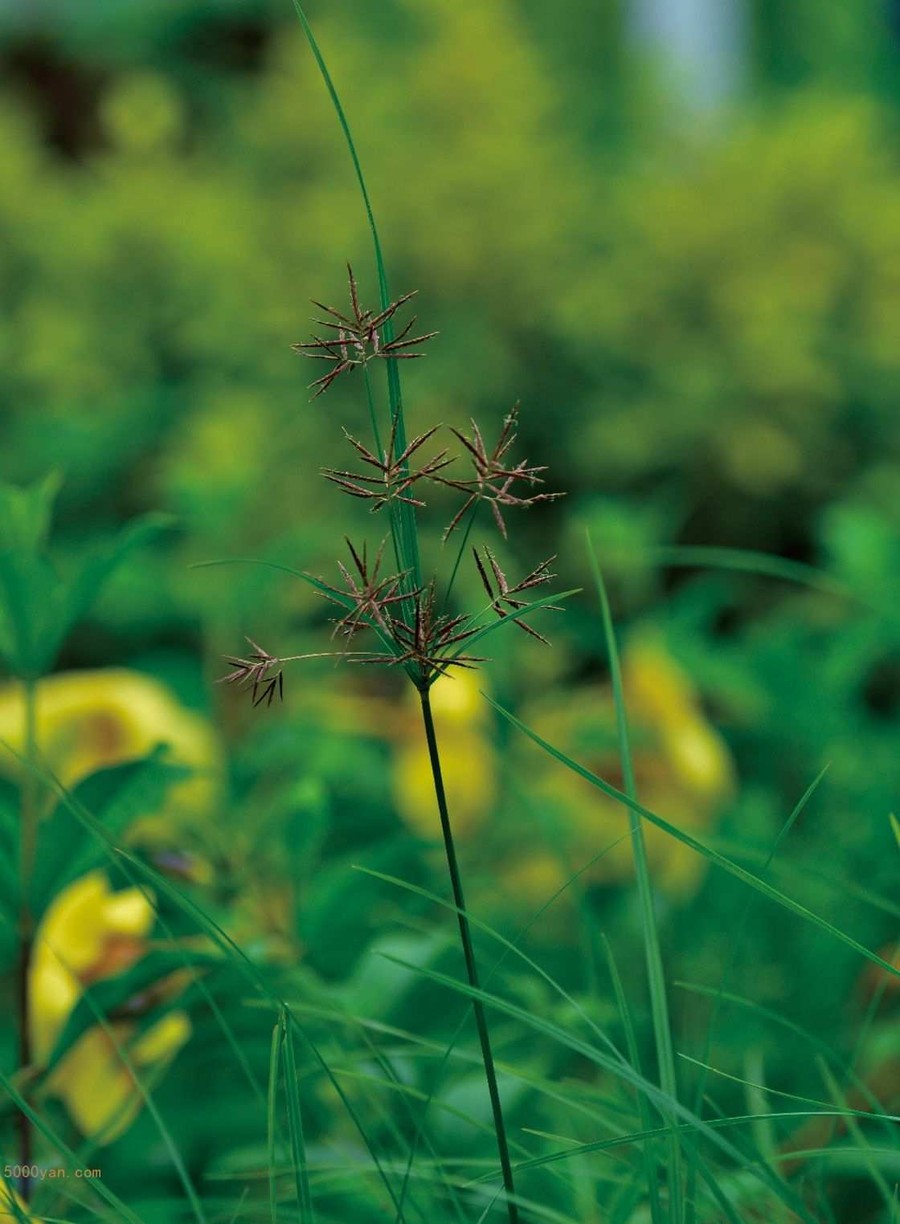
Perennial herb, 15-95 cm tall. Stem erect, triangular; rhizome creeping and elongated, partially enlarged into a fusiform shape, sometimes with several connected segments. Leaves clustered at the base of the stem; leaf sheaths closed, enveloping the stem; leaf blades linear, apex acute, entire margin, with parallel veins, main vein raised on the abaxial surface. Inflorescence a compound spike, 3-6 arranged in an umbel at the top of the stem, each inflorescence bearing 3-10 spikelets, linear; glumes in 2 rows, tightly arranged, ovate to oblong, membranous, purplish-red on both sides with several veins. At the base there are 2-4 leaf-like involucral bracts, equal to or longer than the inflorescence; each glume bears 1 flower, stamens 3; stigmas 3, filiform. Nutlet oblong-obovoid, trigonous. Flowering period from May to August, fruiting period from July to November.
Habitat and Distribution
Born in moist areas of hillside grasslands, cultivated fields, roadsides, and watersides. Distributed in East China, Central-South China, Southwest China, and Liaoning, Hebei, Shanxi, Shaanxi, Gansu, Taiwan, and other regions.
Harvesting and Processing
Harvested in autumn, scorched to remove fibrous roots, briefly boiled or steamed thoroughly in boiling water, then dried in the sun, or directly dried in the sun after scorching.
Medicinal Properties
Rhizome fusiform or slightly curved, 2-3.5 cm long, 0.5-1 cm in diameter. Surface brownish-black or blackish-brown, with irregular longitudinal wrinkles and 6-10 distinctly raised nodes; nodes bear numerous unremoved dark brown fibrous roots and rootlet scars; smoother after removing fibrous roots, with fine dense longitudinal ridges. Texture hard, steamed or boiled ones show horny, brownish-yellow or brownish-red cut surface; sun-dried ones show starchy, off-white cut surface, with distinct endodermis ring, darker central column, and scattered punctiform vascular bundles. Odor: aromatic; Taste: slightly bitter.
Chemical Constituents
This product is primarilyacyperotundone,β-α-Pinene, caryophyllene, eucalyptol, cyperene, cyperol, daucosterol,β- β-sitosterol, physcion, and other constituents.
Pharmacology
Has analgesic, hypoglycemic, and hypolipidemic effects; has protective effects on the gastric mucosa; promotes the breakdown of isolated adipose tissue; has anti-pathogenic microorganism, anti-inflammatory, antioxidant, and apoptosis-inducing effects; has estrogen-like effects.
Properties and Channel Entry
Acrid, sweet, and slightly bitter, neutral. Enters the Liver and Sanjiao channels.
Functions and Indications
Regulates Qi and relieves depression, regulates menstruation and alleviates pain, and calms the fetus. Mainly indicated for distending pain in the hypochondriac region, breast distension and pain, hernia pain, irregular menstruation, epigastric and abdominal fullness and pain, belching and acid reflux, nausea and vomiting, dysmenorrhea, metrorrhagia and leukorrhea, and threatened miscarriage.
Dosage and Administration
Internal: decoct 5-10 g; or made into pills or powder. External: appropriate amount, ground into powder for sprinkling or mixing for application.
Precautions and Contraindications
Patients with Qi deficiency without stagnation, Yin deficiency, or Blood-Heat should use with caution.
Prescriptions
1. For migraines: Chuanxiong 60 g, Xiangfu (stir-fried) 120 g. Grind into powder. Take with tea, preferably aged tea. (from Danliao Fang) 2. For hematemesis: Xiangfu (remove hairs) 150 g, Gancao (cut and roasted) 30 g. Coarsely grind and sieve the two ingredients. Each dose: 6 g, decoct with one cup of water until 7/10 remains, strain and take warm. (from Shengji Zonglu, Xiangcao Tang) 3. For epistaxis: Xiangfu (ground into powder), human hair (burned to ash), mix evenly. Take with soup, one square-inch spoonful. (from Weisheng Yijian Fang) 4. For hematuria: Xiangfu and Diyu in equal parts. Decoct each separately; first take 3-5 sips of Xiangfu decoction, then take Diyu decoction. (from Quansheng Zhimi Fang) 5. For miscarriage prevention: Xiangfu (stir-fried, remove hairs), grind into fine powder. Take 3 g with a strong decoction of Zisu. (from Zhongzang Jing, Tiezhao San)