Pinyin: Kushen
Aliases
Kugu, Fenghuangzhao, Niushen, Digu, Yehuaigen.
Source
Fabaceae plant *Sophora flavescens*Sophora flavescensDried root of Ait.
Botanical Description
Deciduous semi-shrub, 1.5-3 m tall. Root cylindrical, outer bark yellowish-white. Stem erect, much branched, with longitudinal grooves; young branches sparsely hairy, later glabrous. Odd-pinnate compound leaves, alternate; leaflets 15-29, lanceolate to linear-lanceolate, apex acuminate, base rounded, with short petiolules, entire margin, densely appressed hairy on the abaxial surface; stipules linear. Raceme terminal, shortly hairy, bracts linear; calyx campanulate, flattened, 5-lobed; corolla butterfly-shaped, pale yellowish-white; standard spatulate, wings without auricles, equal in length to the keel; stamens 10, filaments free; ovary stalk finely hairy, stigma rounded. Legume linear, apex with a long beak, indehiscent at maturity. Seeds slightly constricted between, indistinctly moniliform, sparsely short-hairy. Seeds 3-7, subglobose, black. Flowering May to July, fruiting July to September.
Habitat and Distribution
Grows in sandy areas or sunny hillside grasslands and along stream banks. Distributed throughout China.
Harvesting and Processing
Harvested in spring and autumn, remove the root crown and small lateral roots, wash clean, dry, or slice fresh and dry.
Medicinal Properties
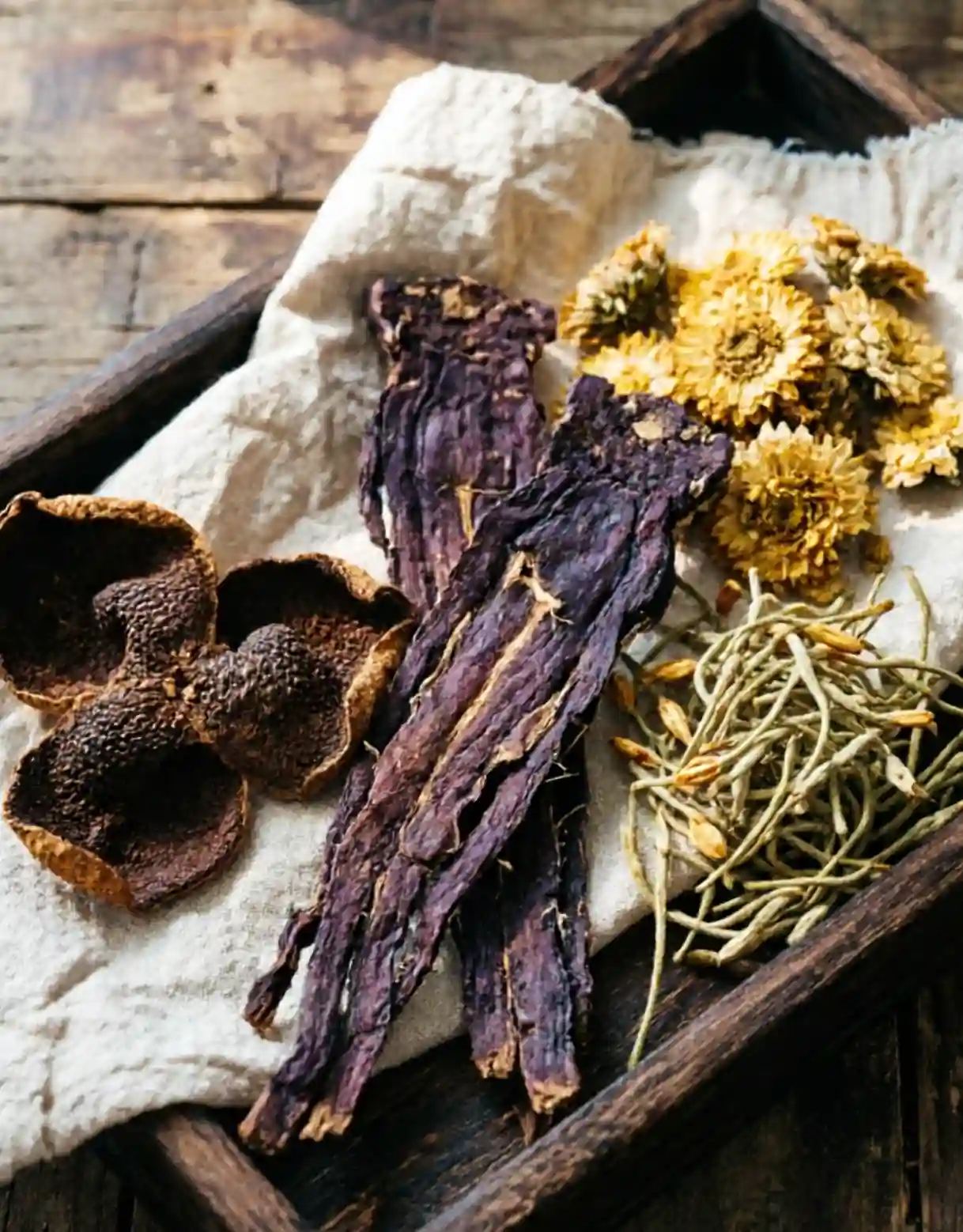
Root long-cylindrical, often branched in the lower part, 10-30 cm long, 1-6.5 cm in diameter. Surface brownish-yellow to grayish-brown, with longitudinal wrinkles and transverse lenticels. Cork bark thin, often cracked and recurved, easily peeled off, revealing yellow inner bark. Texture hard, not easily broken, fracture fibrous. Slices 3-6 mm thick, cut surface yellow-white with radial striations. Odor faint, taste bitter.
Chemical Constituents
This product contains components such as dextrorotatory matrine, levorotatory anagyrine, matrine, sophoridine, oxymatrine, kuraridine, luteolin-7-glucoside, 1,8-cineole, umbelliferone, and dextrorotatory sophoranol.
Pharmacology
It exhibits positive inotropic effects, but excessive doses can lead to spontaneous cardiac contractions and reduced excitability; antiarrhythmic; anti-myocardial ischemia; dilates blood vessels and increases perfusion flow; can antagonize the central excitatory effects of caffeine; has antiasthmatic and antiallergic effects; suppresses the immune system; increases white blood cell count; antitumor, anti-inflammatory, antimicrobial, enhances small intestinal propulsion function in mice, and protects against gastric mucosal injury, among other effects. Toxic.
Properties and Channel Entry
Bitter, cold. Enters the Heart, Liver, Stomach, Large Intestine, and Bladder channels.
Functions and Indications
Clears Heat, dries Dampness, expels Wind, and kills parasites. Mainly treats dysentery due to Heat, bloody stool, jaundice with urinary retention, red and white vaginal discharge, genital itching, scabies, tinea, leprosy, skin pruritus, eczema, damp sores, and external use for trichomonal vaginitis.
Dosage and Administration
Oral administration: decoction, 3-10 g; or made into pills or powder
Precautions and Contraindications
Contraindicated in patients with Spleen and Stomach deficiency-cold. Incompatible with Lilu (Veratrum).
Prescriptions
1. For bloody dysentery: Küshen (Sophora flavescens), stir-fry until scorched, grind into powder, form into pills the size of wutong seeds. Take 15 pills with rice water. (From Rencuntang's Empirical Formulas) 2. For bleeding from tooth crevices: Küshen 30 g, dried alum 3 g. Grind into powder, apply to the teeth three times daily. (From Puji Fang) 3. For difficult urination and defecation: Küshen, talc, and cowry teeth, equal parts. Grind the three ingredients into a powder and sift. Take one spoonful with water, or boil mallow root juice and take, which is even better. (From Waitai) 4. For red and white vaginal discharge: Küshen 60 g, oysters 45 g. Grind into powder. Take a male pig's stomach, cook it thoroughly in three bowls of water, mash into a paste, mix with the powder, and form pills the size of wutong seeds. Take 100 pills with warm wine. (From Jishantang's Empirical Formulas) 5. For scabies: Küshen, Cnidium monnieri, alum, and Schizonepeta spike, equal parts. Decoct the four ingredients in water, allow to cool, and wash the affected area. (From Jisheng Fang's Küshen Decoction)

