Pinyin: Heshouwu
Aliases
Shouwu, Yejiaotenggen, Tiechengtuo
Source
Polygonaceae plant *Polygonum multiflorum* (Heshouwu).Polygonum multiflorumThe dried root tuber of Thunb.
Botanical Description
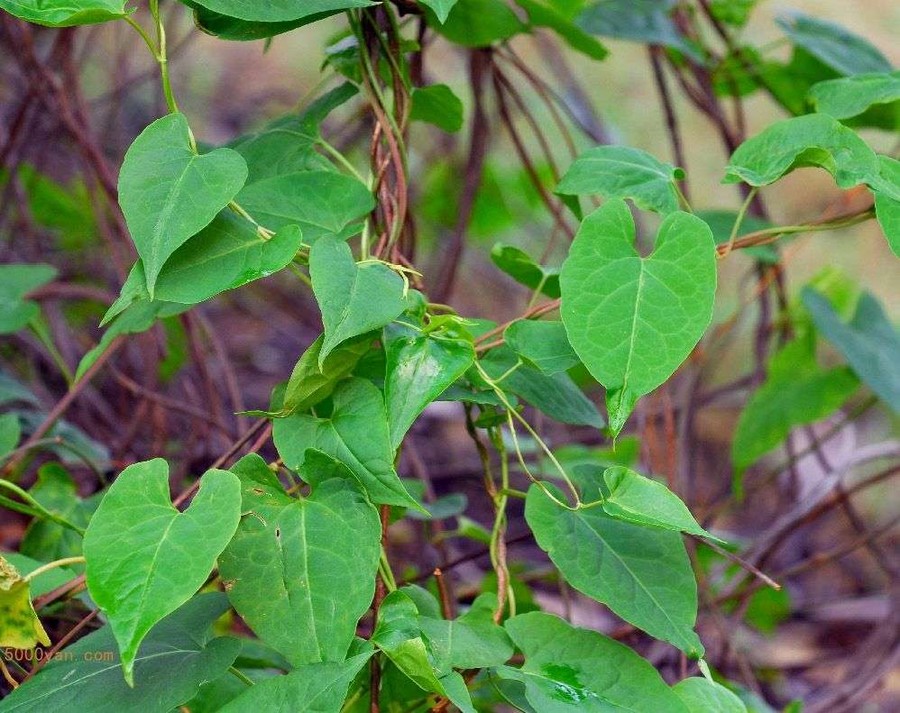
A perennial twining vine. The root is slender, with the terminal portion forming a large tuberous root, the outer surface reddish-brown to dark brown. The stem base is slightly woody and hollow. Leaves are alternate; petioles are long; stipules are membranous and brown; leaf blades are narrow-ovate or cordate, 4-8 cm long, 2.5-5 cm wide, apex acuminate, base cordate or sagittate, margin entire or slightly undulate, upper surface dark green, lower surface light green, both surfaces glabrous (hairless). The inflorescence is a panicle. Flower pedicels have nodes, with membranous bracts at the base; flowers are small; the perianth is greenish-white, 5-lobed, unequal in size, the outer three lobes have wings on the back; stamens 8, unequal in length, shorter than the perianth; pistil 1, stigma 3-lobed, capitate. The achene is ellipsoid, with 3 ridges, black, shiny, surrounded by the persistent perianth, which has distinct 3 wings. Flowering period is from August to October, and fruiting period from September to November.
Habitat and Distribution
Growing on grassy slopes, roadsides, rocky crevices on hillsides, and in shrub thickets. Distributed in East China, Central South China, and Hebei, Shanxi, Shaanxi, Gansu, Taiwan, Sichuan, Guizhou, Yunnan, and other regions.
Harvesting and Processing
Harvested in autumn and winter when the leaves wither, dig up, trim both ends, wash clean, cut large ones into pieces, and dry.
Medicinal Properties
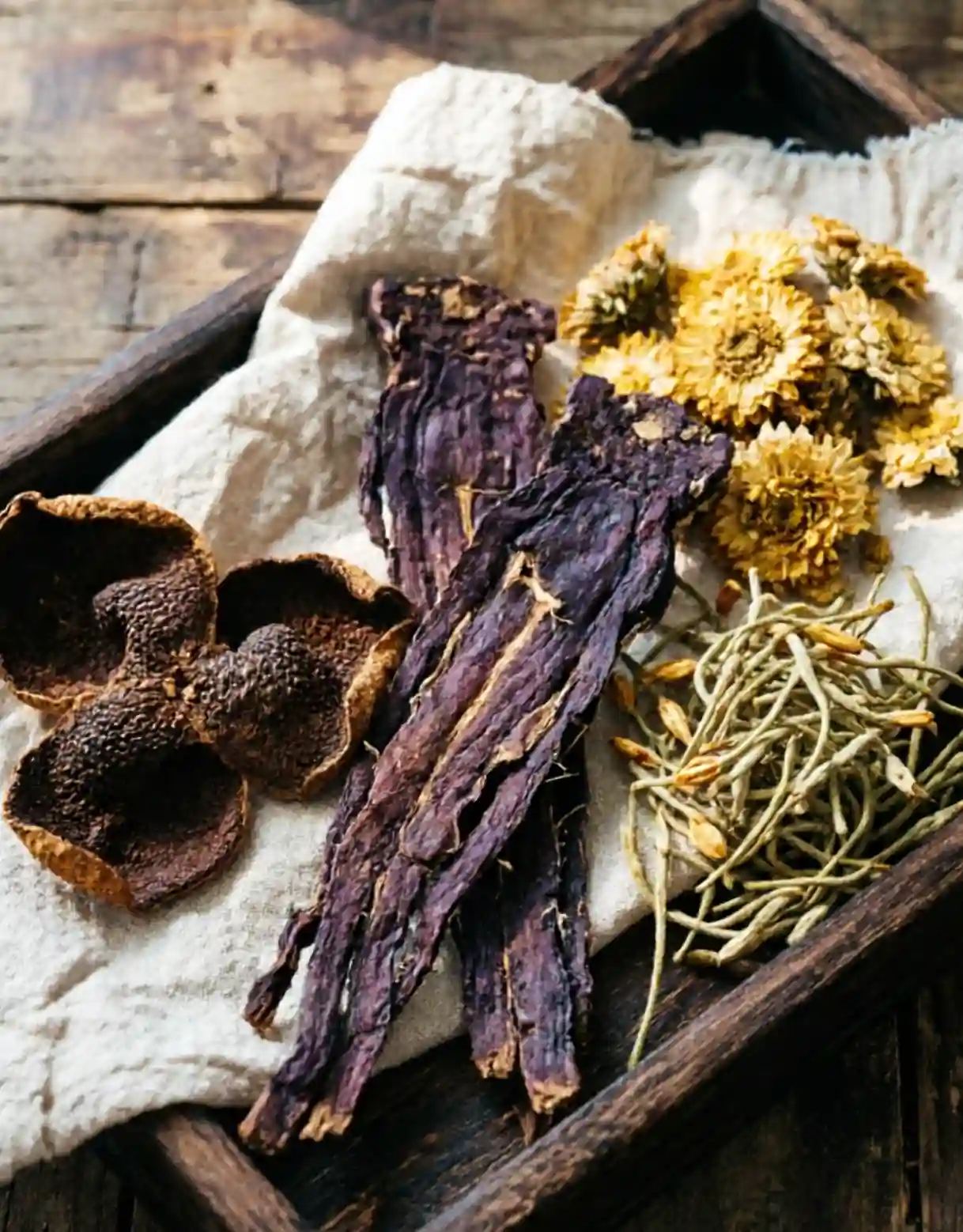
Root fusiform or lump-shaped, generally slightly curved, 5-15 cm long, 4-10 cm in diameter. Surface reddish-brown or reddish-brown, uneven, with irregular longitudinal grooves and dense wrinkles, and transverse lenticels and fine root scars. Texture hard, not easily broken. Cut surface pale yellowish-brown or pale reddish-brown, starchy, with nearly circular anomalous vascular bundles arranged in rings in the bark region, forming "cloud brocade pattern"; central xylem relatively large, some with a woody core. Odor: faint; Taste: slightly bitter, sweet, and astringent.
Chemical Constituents
This product contains aloe emodin, chrysophanol, chrysophanol anthrone, emodin, physcion, rhein, and picein, among others.
Pharmacology
Lowers blood lipids and resists atherosclerosis; enhances immune function; delays aging; protects the liver; can increase coronary blood flow in isolated rabbit hearts, and can antagonize bradycardia caused by pituitrin, but has no antagonistic effect on arrhythmia caused by pituitrin; antibacterial; toxic.
Properties and Channel Entry
Bitter, sweet, astringent, and slightly warm. Enters the Liver, Heart, and Kidney channels.
Functions and Indications
Detoxifies, resolves abscesses, stops malaria, and moistens the Intestines to relieve constipation
Dosage and Administration
Internal: decoct in water, 10-20 g; prepare as paste, steep in liquor, or mix into pills or powder
Precautions and Contraindications
Those with loose stools or Damp-Phlegm should use with caution. Avoid contact with iron utensils.
Prescriptions
1. For malaria: Heshouwu 20 g, Gancao 2 g, reduce dosage for children. Take 1 dose daily, decoct on high heat for 2 hours, divide into 3 portions and take before meals, use for 2 consecutive days. [Guangdong Medical Journal - Traditional Chinese Medicine Edition, 1964, (4): 31] 2. For generalized sores, swelling, and itching pain: Fangfeng, Kushen, Heshouwu, Bohe, equal parts. Coarsely grind the ingredients, take 15 g each time, add equal parts water and wine (total 1 dou and 6 sheng), boil for 10 rolling boils, wash the affected area while hot, then sleep in a sheltered place. (Waike Jingyao: Heshouwu Powder) 3. For intestinal wind toxicity with incessant bloody diarrhea: Heshouwu 60 g, grind into a fine powder. Take 3 g with warm congee before each meal. (Shenghui Fang) 4. For incessant spontaneous sweating: Heshouwu powder, mix with saliva, apply to the navel. (Binhu Ji Jian Fang) 5. For traumatic bleeding: Heshouwu powder applied to the wound stops bleeding. (Weisheng Zazhi)