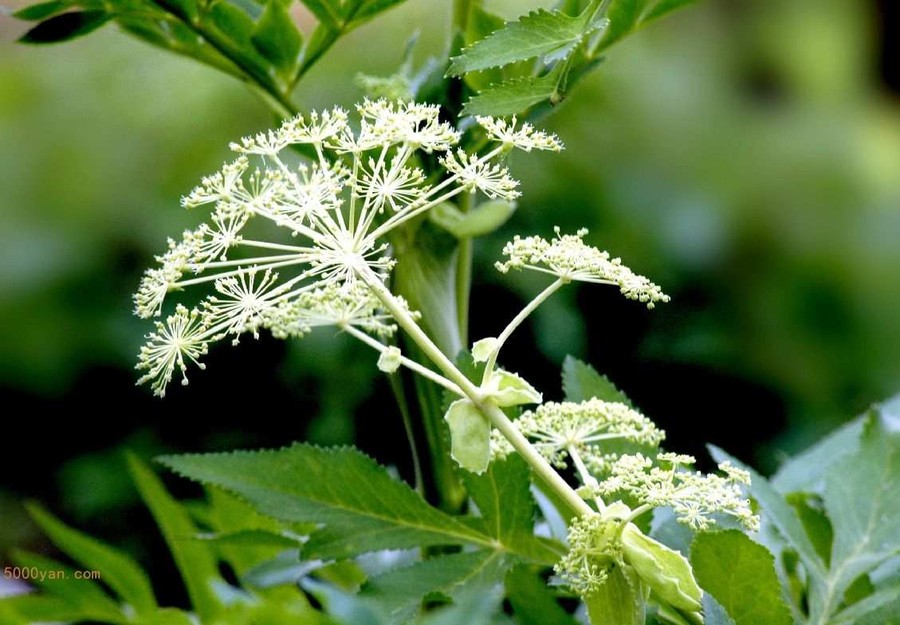
Pinyin: Baizhi
Aliases
Zhi, Fuhao, Xiangbaizhi.
Source
Apiaceae plant Angelica dahurica (Fisch. ex Hoffm.) Benth. et Hook. f. var. formosana (Boiss.) Shan et YuanAngelica dahurica(Fisch.ex Hoffm.)Benth.et Hook.f.var.formosanaDried root of (Boiss.) Shan et Yuan.
Botanical Description
Perennial tall herb, 1-1.5 m high. Root conical, surface grayish-yellow to yellowish-brown, with scattered transverse lenticel-like protrusions, fracture grayish-white, slightly powdery, relatively oily. Stems and leaf sheaths mostly yellowish-green. Basal leaves 1-pinnately compound, with long petioles, lower part of petiole with tubular, stem-clasping, membranous-margined leaf sheath; upper stem leaves 2- to 3-pinnately compound, leaf blade outline ovate to triangular, 15-30 cm long, 10-25 cm wide, lower part of petiole with saccate, inflated membranous leaf sheath, glabrous or sparsely hairy, often purplish; ultimate segments oblong, ovate, or linear-lanceolate, mostly sessile, 2.5-6 cm long, 1-2.5 cm wide, acute, margin with irregular white cartilaginous coarse teeth, with short mucronate tips, base often unequal on both sides, decurrent along rachis into wings; leaves below inflorescence reduced to leafless, conspicuously inflated saccate leaf sheaths, glabrous externally. Compound umbel terminal or axillary, 10-30 cm in diameter, peduncle 5-20 cm long. Peduncle, rays, and pedicels all with short rough hairs; rays 18-40; involucral bracts 1-2, usually absent; involucel bracteoles 5-10, linear-lanceolate, membranous; flowers white; petals obovate, apex incurved and emarginate; styles twice as long as short conical stylopodium. Fruit oblong to ovoid, yellowish-brown, sometimes purplish, 4-7 mm long, 4-6 mm wide, glabrous, dorsal ribs flattened, thick and obtusely rounded, much broader than furrows, lateral ribs winged, narrower than fruit body, furrows with 1 vitae, commissure with 2 vitae. Flowering July-August, fruiting August-September.
Habitat and Distribution
Cultivated in Hebei, Henan and other northern regions.
Harvesting and Processing
Harvested when the leaves turn yellow in summer and autumn, remove fibrous roots and sediment, and sun-dry or dry at low temperature.
Medicinal Properties
This product is elongated conical in shape, 10-25 cm long and 1.5-2.5 cm in diameter. The surface is grayish-brown or yellowish-brown, with a bluntly quadrangular or nearly rounded root crown, longitudinal wrinkles, rootlet scars, and lenticel-like transverse protrusions, some of which are arranged in four longitudinal rows. The apex has a depressed stem scar. The texture is firm, the fracture surface is white or grayish-white, starchy, with a brown cambium ring that is nearly square or nearly circular, and numerous brown oil spots scattered in the bark. Odor: aromatic; Taste: acrid, slightly bitter.
Chemical Constituents
This product contains imperatorin, angelicotoxin, scopoletin, byak-angelicin, isoimperatorin, byak-angelicin hydrate, isopimpinellin, oxypeucedanin, anethole, carvacrol, and palmitic acid.
Pharmacology
Antipyretic, analgesic, and anti-inflammatory; shortens coagulation time, dilates coronary blood vessels, and lowers blood pressure; photosensitizing effect; has antimicrobial and other effects. Toxic.
Properties and Channel Entry
Acrid, warm. Enters the Stomach, Large Intestine, and Lung channels.
Functions and Indications
Relieves the exterior and disperses Cold, dispels Wind and alleviates pain, unblocks the nasal passages, dries Dampness and stops leukorrhea, reduces swelling and expels pus. Used for common cold with headache, supraorbital bone pain, nasal congestion with discharge, allergic rhinitis, sinusitis, toothache, leukorrhea, and sores with swelling and pain.
Dosage and Administration
Oral: decoct in water, 3-10 g; or made into pills or powder. External use: appropriate amount, grind into powder for sprinkling or mix for application.
Precautions and Contraindications
Contraindicated in patients with Blood deficiency accompanied by Heat, and those with Yin deficiency and Yang hyperactivity presenting with headache.
Prescriptions
1. For headache: Gypsum and Angelica dahurica 6 g each, Peppermint leaf and Mirabilite 9 g each, Curcuma aromatica 3 g. Grind into very fine powder, hold water in the mouth, and insufflate into the nose. (Lan Shi Mi Cang - Baizhi San) 2. For nasosinusitis: Magnolia flower, Saposhnikovia divaricata, and Angelica dahurica 2.4 g each, Xanthium sibiricum 3.6 g, Ligusticum chuanxiong 1.5 g, Asarum heterotropoides 2.1 g, Glycyrrhiza uralensis 0.9 g. Decoct in plain water, take four doses consecutively; avoid beef. (Yang Yi Da Quan) 3. For persistent clear nasal discharge: Grind Angelica dahurica into fine powder, mix with mashed scallion white to form pills the size of small beans. Take 10 pills per dose with tea. (Zheng Zhi Zhun Sheng - Baizhi Wan) 4. For ulcerative gastric pain: Angelica dahurica, Paeonia lactiflora, and Bletilla striata 10-30 g each, Amomum cardamomum 6-12 g. 1 dose daily, decoct in water and take in divided doses. (Zhong Yi Za Zhi, 1983, (12): 34 - Si Bai Tang) 5. For painful swelling and heat-toxin: Mix Angelica dahurica powder with vinegar and apply topically. (Wei Sheng Yi Jian Fang)