Pinyin: Bixie
Aliases
Bai Ba Qia, Zhu Mu, Bai Zhi, Tu Shu Yu, Ma Jia Tou.
Source
Dioscoreaceae plant *Dioscorea collettii* var. *hypoglauca*Dioscorea collettiiHook.f.var.hypoglaucaDried rhizome of (Palibin) Pei et Ting.
Botanical Description
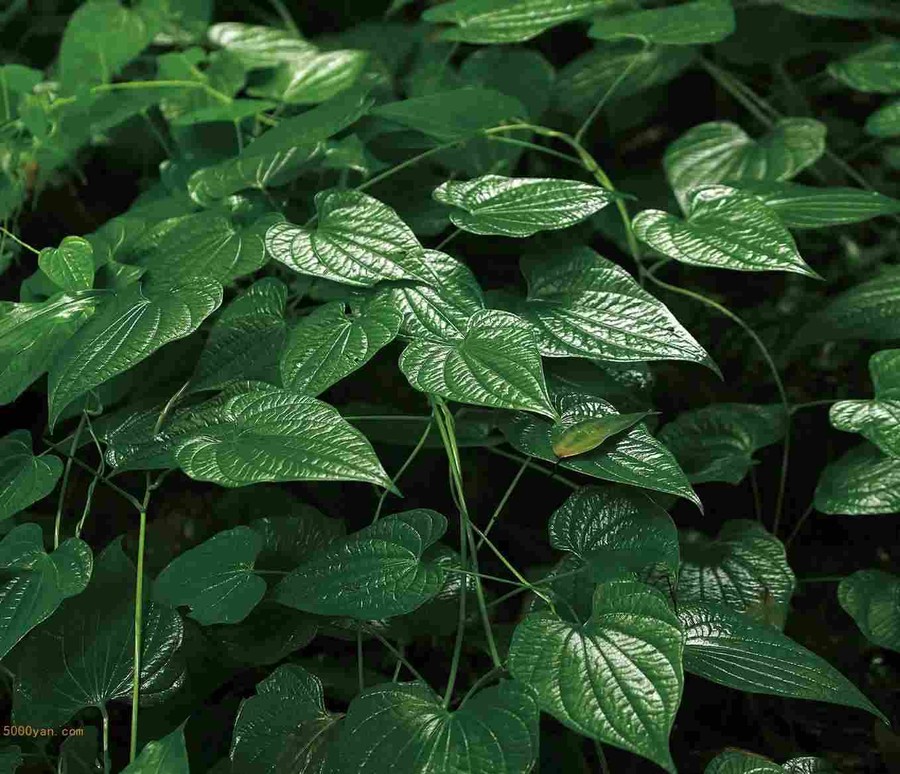
A perennial twining herbaceous vine. The rhizome is horizontal, ginger-shaped, with a ginger-yellow cross-section and many fibrous roots on the surface. The stem is left-twining, glabrous (hairless), sometimes densely covered with yellow pubescence. Leaves are simple and alternate; leaf blade is triangular-cordate or ovate-lanceolate, apex acuminate, margin undulate or subentire, lower surface grayish-white, with yellowish-white stiff hairs along the veins and margins, in some plants the leaf margin is semi-transparent and dry-membranous, turning black after drying. Plants are dioecious. Male inflorescences are solitary or 2-3 clustered in leaf axils; male flowers are sessile, with 2-3 clustered at the base of the inflorescence and solitary toward the apex; bracts are ovate-lanceolate, bracteoles ovate; perianth is disc-shaped, apex 6-lobed, lobes yellow, turning black after drying; stamens 3, inserted on the perianth tube, filaments short, after anthesis the connective becomes broad, about half the length of the anther, forming a short forked shape, staminodes sometimes filamentous, alternating with the 3 developed stamens. Female inflorescences are spicate; flowers all solitary, ovary inferior, stigma 3-lobed, staminodes filamentous. The capsule has 3 wings, both ends truncate, apex and base usually equal in width, becoming reflexed and pendulous after maturity; seeds 2, attached to the middle of the central axis, surrounded by a membranous wing at maturity. Flowering period is May to August, fruiting period is June to October.
Habitat and Distribution
It grows on mountain slopes at altitudes of 200-1300 m, in mixed forest edges or sparse forests on shady slopes, gentle valley slopes, or near ditches. Distributed in Henan, Anhui, Zhejiang, Jiangxi, Fujian, Taiwan, Hubei, Hunan, Guangdong, Guangxi, and other regions.
Harvesting and Processing
Dig up the rhizome in autumn and winter, remove the fibrous roots, clean off the soil, slice, and sun-dry.
Medicinal Properties
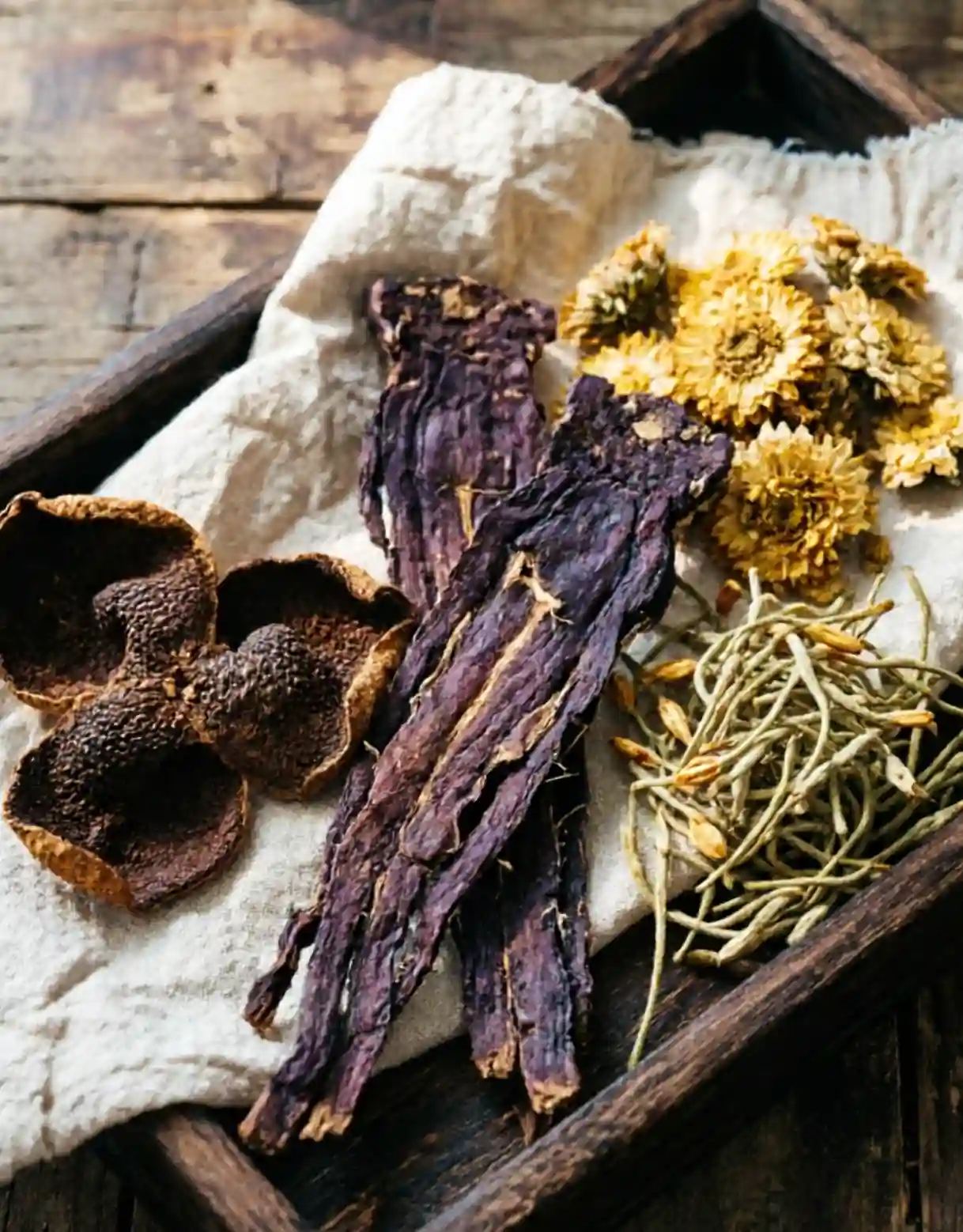
This product appears in a bamboo-joint-like, cylindrical shape with branches, a wrinkled surface, and often retains residual stem scars and incompletely removed slender fibrous roots. Commercial products are mostly irregular thin slices of varying sizes, approximately 0.5 mm thick, with uneven edges, some with a brownish-black or grayish-brown outer bark. The cut surface is yellow-white or light grayish-brown, flat, fine, and powdery with irregular yellow vascular bundle markings (vascular bundles), which are very prominent when viewed against light. The texture is loose and easily broken. Odor: faint; Taste: bitter and slightly acrid. The best quality is characterized by large, thin slices with a yellow-white cut surface.
Chemical Constituents
This product contains diosgenin, yamogenin, and Δ3,5-deoxytigogenin, among other components.
Pharmacology
Has antibacterial, insecticidal, hypoglycemic, and inhibitory effects on tumor cells, among others.
Properties and Channel Entry
Bitter, neutral. Enters the Liver, Stomach, and Bladder channels.
Functions and Indications
Expels Dampness turbidity and dispels Wind-Dampness
Dosage and Administration
Internal: decoct 10-15 g; or prepare into pills or powder.
Precautions and Contraindications
Those with kidney deficiency and yin depletion should use with caution.
Prescriptions
1. For Damp-Heat pouring into the Bladder causing turbid, scanty urine: Bixie 6 g, Huangbai (stir-fried to brown) 1.5 g, Shichangpu 1.5 g, Fuling 3 g, Baizhu 3 g, Lianzixin 2.1 g, Danshen 4.5 g, Cheqianzi 4.5 g. Decoct in water and take orally. (Bixie Fenqing Yin from *Yixue Xinwu*) 2. For prolonged leukorrhea with physical weakness: Huaishanyao 30 g, Bixie 24 g, Lianzi 9 g. Decoct in water and take warm before meals. (Selected Prescriptions from *Shaanxi Zhongyi Yanfang Xuanbian*) 3. For kidney impairment causing bone atrophy and inability to rise from bed: Bixie, Duzhong (stir-fried), Congrong (soaked in wine), Tusizi (soaked in wine), equal parts. Grind into fine powder, cook with wine and pig kidney to form pills the size of *wutong* seeds. Take 50-70 pills on an empty stomach with wine. (Jingang Wan from *Yixue Gangmu*) 4. For toothache: Bixie, Liangjiang, Hujiao, Xixin, equal parts, ground into powder. Take a small amount, hold warm water in the mouth, and insufflate the powder into the nostril on the painful side. (*Weisheng Yijian Fang*) 5. For lower back pain and beriberi: Poguzhi (raw), Xuduan, Mugua Gan, Niuxi (soaked in wine), Duzhong (peeled, cut, processed with ginger, stir-fried until fibers break) each 30 g, Bixie 60 g. Grind into powder, form honey pills the size of *wutong* seeds. Take 50 pills with salt water or salt wine. (Li'an Wan from *Sanyin Fang*)