Pinyin: Xuduan
Aliases
Jiegu, Jiegu cao, Guchui cao, Chuan Duan.
Source
Plant of the family Dipsacaceae, Dipsacus asper.Dipsacus asperDried root of Wall. ex Henry.
Botanical Description
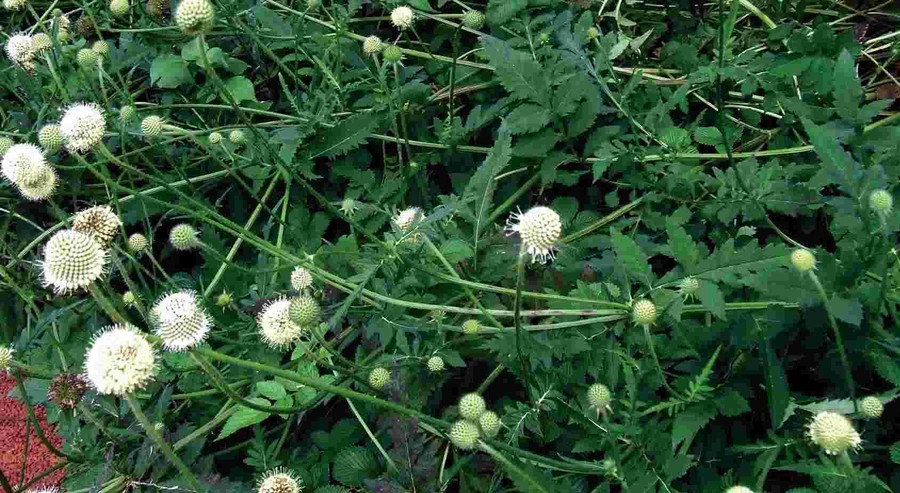
Perennial herb, 60-200 cm tall. Root solitary or multiple, cylindrical, yellowish-brown, slightly fleshy, with slender lateral roots sparsely arranged. Stem erect, 6-8-ridged, with spines on ridges. Basal leaves sparsely tufted, with long petioles, lyrate-pinnatifid, 15-25 cm long, 5-20 cm wide, with 3-4 pairs of lateral lobes, the pair near the central lobe larger, gradually smaller downward, lateral lobes obovate or spatulate, largest 4-9 cm long, 3-4.5 cm wide, upper surface with short hairs, lower surface with prickles on veins; stem leaves in middle and lower part pinnately parted, central lobe very long, lanceolate, up to 11 cm long, 5 cm wide, apex acuminate, with sparse coarse teeth, 2-4 pairs of lateral lobes, lanceolate or oblong, smaller, with long petioles, petioles becoming shorter upward; upper leaves lanceolate, entire or basally 3-lobed. Inflorescence capitate, globose, 2-3 cm in diameter; peduncle up to 55 cm long; involucral bracts 5-7, inserted at base of inflorescence, leaf-like, lanceolate or linear, 1-4.5 cm long, 0.2-0.5 cm wide, hirsute; bracteoles obovate-cuneate, 7-11 mm long, 4-5 mm at widest, apex slightly truncate, pubescent; calyx quadrangular, entire or 4-lobed to 4-parted, externally pubescent, hairs longer at apex; corolla pale yellow-white, corolla tube narrow-funnelform, constricted into a narrow tube at base 1/4-1/3, apex 4-lobed, lobes obovate, one slightly larger, externally pubescent; stamens 4, inserted on upper part of corolla tube, distinctly exserted, anthers purple, elliptic; style shorter than stamens, stigma short-clavate, ovary inferior, enclosed within involucel. Achenes long-obovoid, only apex exposed beyond involucel. Flowering August-September, fruiting September-October.
Habitat and Distribution
Born in fertile, moist soil on slopes and grasslands. Distributed in Jiangxi, Hubei, Hunan, Guangxi, Sichuan, Guizhou, Yunnan, Tibet, and other regions.
Harvesting and Processing
Harvested in autumn, remove the root and fibrous roots, dry over a gentle fire until half-dry, pile up to "sweat" until the interior turns green, then dry thoroughly.
Medicinal Properties
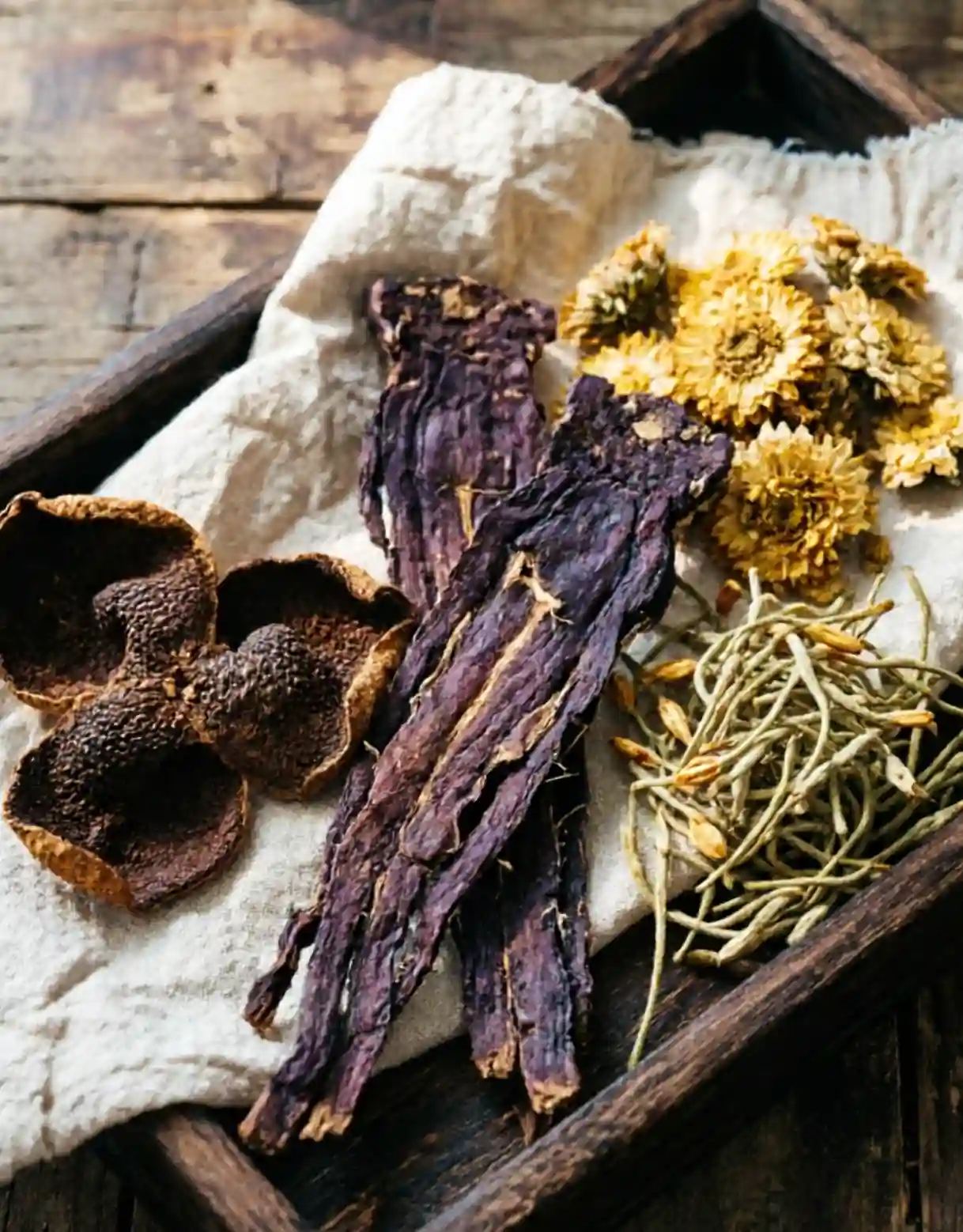
This product is cylindrical in shape, slightly flat, some slightly curved, 5-15 cm long, 0.5-2 cm in diameter. The surface is grayish-brown or yellowish-brown, with slightly twisted or obviously twisted longitudinal wrinkles and grooves, visible transversely arranged lenticel-like spots and a few rootlet scars. The texture is soft, becomes hard after long storage, easily broken, the fracture surface is uneven, the bark is dark green or brown, the outer edge is brown or light brown, the wood is yellowish-brown, and the vascular bundles are arranged radially. The odor is faintly aromatic, the taste is bitter, slightly sweet, and then astringent.
Chemical Constituents
This product contains dipsacoside VI, sweroside, loganin, cantleyoside, akebia saponin D, daucosterol, and other constituents.
Pharmacology
Has antibacterial and anti-inflammatory effects, enhances immune regulation, antioxidant and anti-aging effects, promotes bone injury healing, and prevents preterm birth and miscarriage.
Properties and Channel Entry
Bitter, acrid, slightly warm. Enters the Liver and Kidney channels.
Functions and Indications
Tonifies the Liver and Kidney, strengthens the sinews and bones, heals fractures and injuries, and stops uterine bleeding. Used for Liver and Kidney deficiency, soreness and weakness of the lower back and knees, Wind-Damp Bi pain (rheumatic pain), traumatic injuries, tendon and bone fractures, uterine bleeding (metrorrhagia and metrostaxis), and threatened miscarriage. Wine-processed Xuduan is primarily used for Wind-Damp Bi pain, traumatic injuries, and tendon and bone fractures. Salt-processed Xuduan is primarily used for soreness and weakness of the lower back and knees.
Dosage and Administration
Oral: decoct 6-15 g; or prepared into pills or powder. External: appropriate amount of fresh product, mash for topical application.
Precautions and Contraindications
Elei Wan.
Prescriptions
1. For elderly patients with wind-cold and turning bone pain: Xuduan (Dipsaci Radix) and Niuxi (Achyranthis Bidentatae Radix, with root removed and soaked in wine). Grind into fine powder. Take 6 g with warm wine before meals. (From Yang's Family Prescriptions: Xuduan Powder) 2. For threatened miscarriage at two to three months of pregnancy: Xuduan (soaked in wine) and Duzhong (Eucommiae Cortex, stir-fried with ginger juice to remove fibers) 60 g each. Grind into powder, mix with boiled jujube pulp, form into pills the size of wutong seeds. Take 30 pills with rice water. (From Compendium of Materia Medica) 3. For stomach pain: Xuduan 9-15 g. Decoct in water for oral administration. Avoid sour and spicy foods. (From Guangxi Ethnic Medicine Compendium) 4. For breast carbuncle (early stage can resolve, chronic cases can heal): Xuduan (soaked in wine and stir-fried) 240 g and Pugongying (Taraxaci Herba, sun-dried and stir-fried) 120 g. Both ground into powder. Take 9 g each morning and evening with plain water. (From Collected Commentaries on the Materia Medica) 5. For promoting hair growth: Wash hair with the juice of Xuduan. (From Universal Relief Prescriptions)