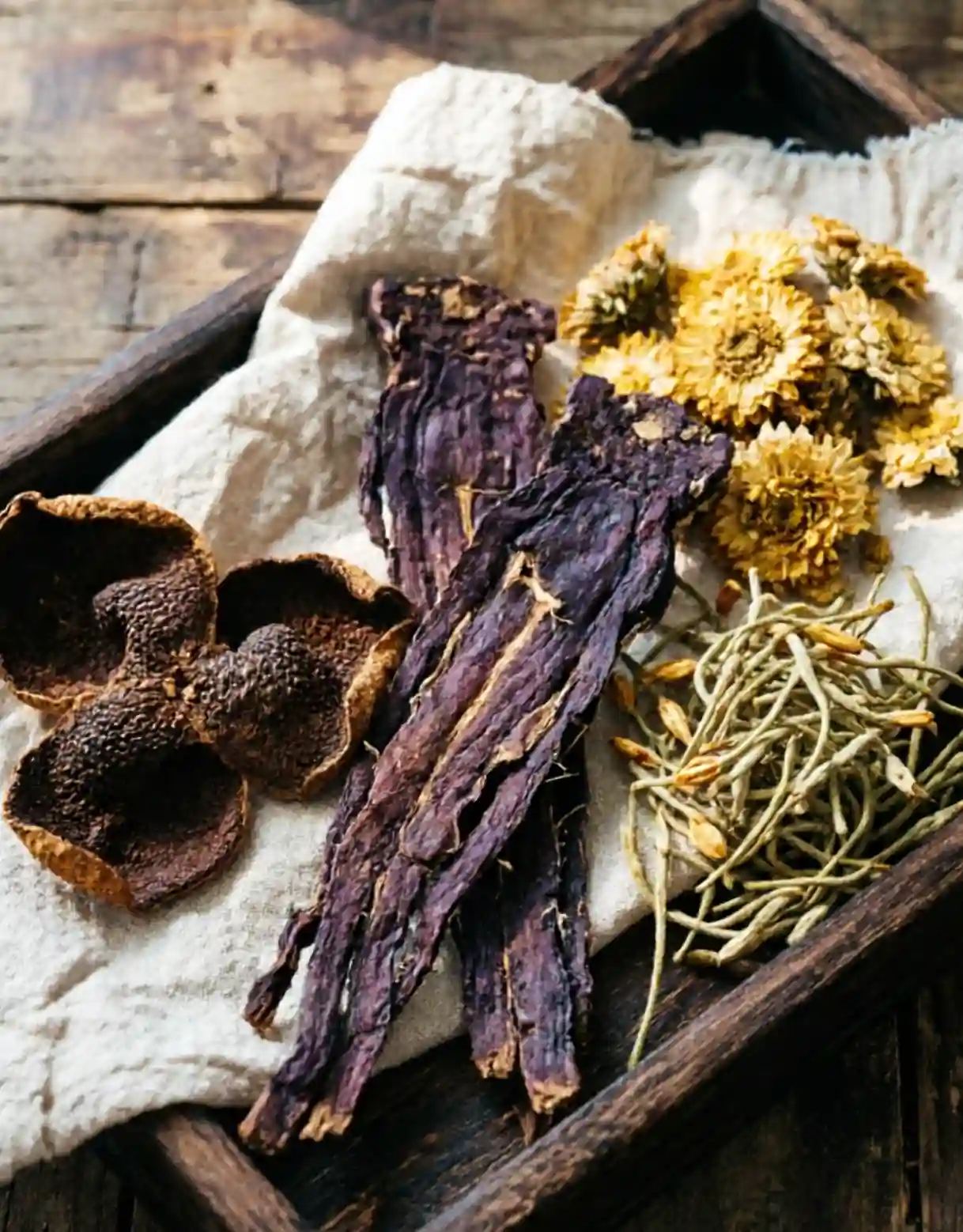
Pinyin: Tubeimu
Aliases
Tubo, Dabeimu, Dikudan, Tengbeimu
Source
Cucurbitaceae plant *Bolbostemma paniculatum* (Maxim.) Franquet.Bolbostemma pani-culatumDried tuber of (Maxim.) Franquet.
Botanical Description
Climbing herbaceous vine. Bulb fleshy, white, flat-globose or irregularly globose, up to 3 cm in diameter; stem slender, glabrous, with angular grooves. Petiole slender, 1.5-3.5 cm long; leaf blade ovate-nearly orbicular, 4-11 cm long, 3-10 cm wide, palmately 5-lobed, each lobe 3-5-lobed; lateral lobes ovate-oblong, acute; middle lobe oblong-lanceolate, acuminate; base of each small lobe with a prominent gland at apex; both surfaces of leaf blade glabrous or with short hairs only on veins. Tendrils filiform, simple or 2-branched. Flowers dioecious. Both male and female inflorescences are lax panicles, rarely flowers solitary; pedicels slender; flowers yellow-green; calyx and corolla similar, lobes ovate-lanceolate, apex with long filiform tail; stamens 5, free, filaments separate or paired; ovary subglobose, sparsely with inconspicuous warty protuberances; style 3, stigma 2-lobed. Fruit cylindrical, 1.5-3 cm long, 1-1.2 cm in diameter, dehiscent from apex when mature; fruit cap conical, with 6 seeds; seeds ovate-rhomboid, dark brown, surface with sculptured protuberances, margin with irregular teeth, 8-10 mm long, ca. 5 mm wide, 1.5 mm thick, apex with membranous wing, wing 8-10 mm long. Flowering period June to August, fruiting period August to September.
Habitat and Distribution
Often grows on shaded mountain slopes, but is now widely cultivated. It is distributed in Hebei, Shanxi, Shaanxi, Gansu, Shandong, Henan, Hubei, Hunan, Sichuan, and other regions.
Harvesting and Processing
Harvest in autumn, dig out, wash clean, break apart, boil until no white core remains, remove, and sun-dry.
Medicinal Properties
This product consists of irregular pieces of varying sizes. The surface is light reddish-brown or dark brown, uneven. The texture is hard, not easily broken, with a horn-like fracture. Odor: faint; Taste: slightly bitter.
Chemical Constituents
This product contains triterpenoid saponins and other compounds.
Pharmacology
Has anti-inflammatory and anti-cancer effects.
Properties and Channel Entry
Bitter and slightly cold. Enters the Lung and Spleen channels.
Functions and Indications
Resolves toxicity, dissipates masses, and reduces swelling. Used for breast abscess (mastitis), scrofula (lymph node tuberculosis), and subcutaneous nodules (phlegm nodules).
Dosage and Administration
Internal use: decoction, 9-30 g; or made into pills or powder. External use: appropriate amount, ground into powder for topical application or made into paste for plaster.
Prescriptions
1. For acute mastitis at early stage: Baizhi (Angelica dahurica) and Tubeimu (Bolbostemma paniculatum), equal parts. Grind into fine powder, take 9 g each time with warm rice wine, keep warm to induce sweating, then the condition resolves; for severe cases, take another dose. For those with strong constitution, take 15 g each time. (from "Compendium of Materia Medica Gleanings") 2. For breast cancer: Tubeimu (Bolbostemma paniculatum) 15 g, Pugongying (Taraxacum mongolicum) 15 g, Shanjia (Manis pentadactyla squama) 15 g, Juhe (Citrus reticulata seed) 15 g, Yinhua (Lonicera japonica) 15 g, and Xiakucao (Prunella vulgaris) 15 g. Decoct in water and take one dose daily, divided into two doses. Particularly effective for cases accompanied by redness, swelling, heat, and pain. (from "Anticancer Chinese Herbal Preparations") 3. For cervical lymph node tuberculosis without ulceration: Tubeimu (Bolbostemma paniculatum) 9 g, decoct in water and take orally. Simultaneously, grind Tubeimu into powder, mix with vinegar, and apply externally. (from "Shaanxi Chinese Herbal Medicine") 4. For bone tuberculosis with ulceration and pus discharge: Tubeimu (Bolbostemma paniculatum) and Wugong (Scolopendra subspinipes), equal amounts. Grind together into fine powder, take 3 g each time, twice daily, mix with hot sweet rice wine and take. (from "Anhui Chinese Herbal Medicine") 5. For carbuncles, swellings, and furuncles: Fresh Tubeimu (Bolbostemma paniculatum), mash and apply externally. If the carbuncle has already ulcerated with pus discharge but swelling persists, use Tubeimu 12 g and Hanliancao (Eclipta prostrata) 12 g, decoct in water and take orally. (from "Hebei Chinese Herbal Medicine") 6. For knife cuts, axe wounds, scissors, gunshot, and arrow injuries: Apply Tubeimu powder to the wound to stop bleeding and promote wound closure. (from "Nian Xiyao's Collected Proven Prescriptions")

