Pinyin: Huangqi
Aliases
Huangqi, Wangsun, Jianqi, Mianhuangqi
Source
Fabaceae plant *Astragalus membranaceus* var. *mongholicus*Astragalus membranaceus(Fisch.) Bge. var.mongholicusDried root of (Bge.) Hsiao.
Botanical Description
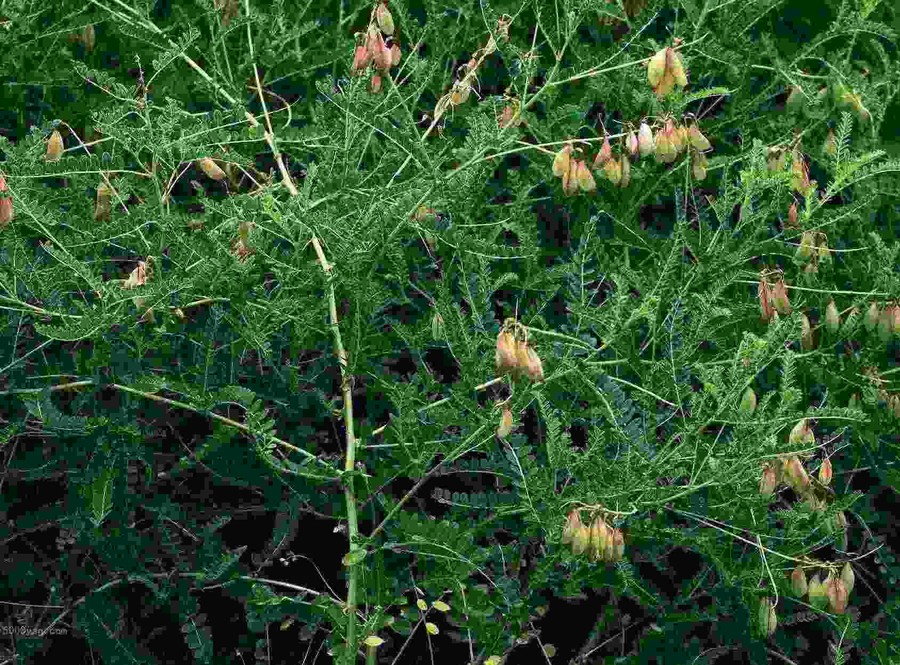
A perennial herb, 50-150 cm tall. The root is straight and long, cylindrical, slightly woody, with a root head 1.5-3 cm in diameter, the surface is pale brownish-yellow to dark brown; the stem is erect, branched in the upper part, and covered with long hairs. Odd-pinnate compound leaves, alternate; the petiole base has lanceolate stipules, about 6 mm long; there are 25-37 leaflets, the leaflets are broadly elliptical, 4-9 mm long, the apex is slightly obtuse with a short tip, the base is cuneate, the margin is entire, and both sides have white long hairs. Racemes axillary, with 10-15 flowers, loosely arranged; the pedicels are short, with black stiff hairs; the bracts are linear-lanceolate; the calyx is tubular, about 5 mm long, with 5 calyx teeth, covered with long hairs; the corolla is yellow, butterfly-shaped, less than 2 cm long, the standard petal is triangular-obovate, without a claw, the apex is slightly emarginate, the wing petals and keel petals both have long claws; stamens 10, diadelphous; the ovary is stipitate, smooth and glabrous, the style is glabrous. The legume is membranous, inflated, ovate-oblong, 11-15 mm wide, with a beak at the apex and prominent reticulate veins. Seeds 5-6, kidney-shaped, black. Flowering period June to July, fruiting period August to September.
Habitat and Distribution
Grows on mountain slopes, beside ditches, or under sparse forests. Distributed in Heilongjiang, Jilin, Liaoning, Inner Mongolia, Hebei, Shanxi, Xinjiang, and Xizang. Cultivated in Northeast China, Inner Mongolia, Hebei, and Shanxi.
Harvesting and Processing
Harvested in spring and autumn, remove the fibrous roots and root heads, and dry in the sun.
Medicinal Properties
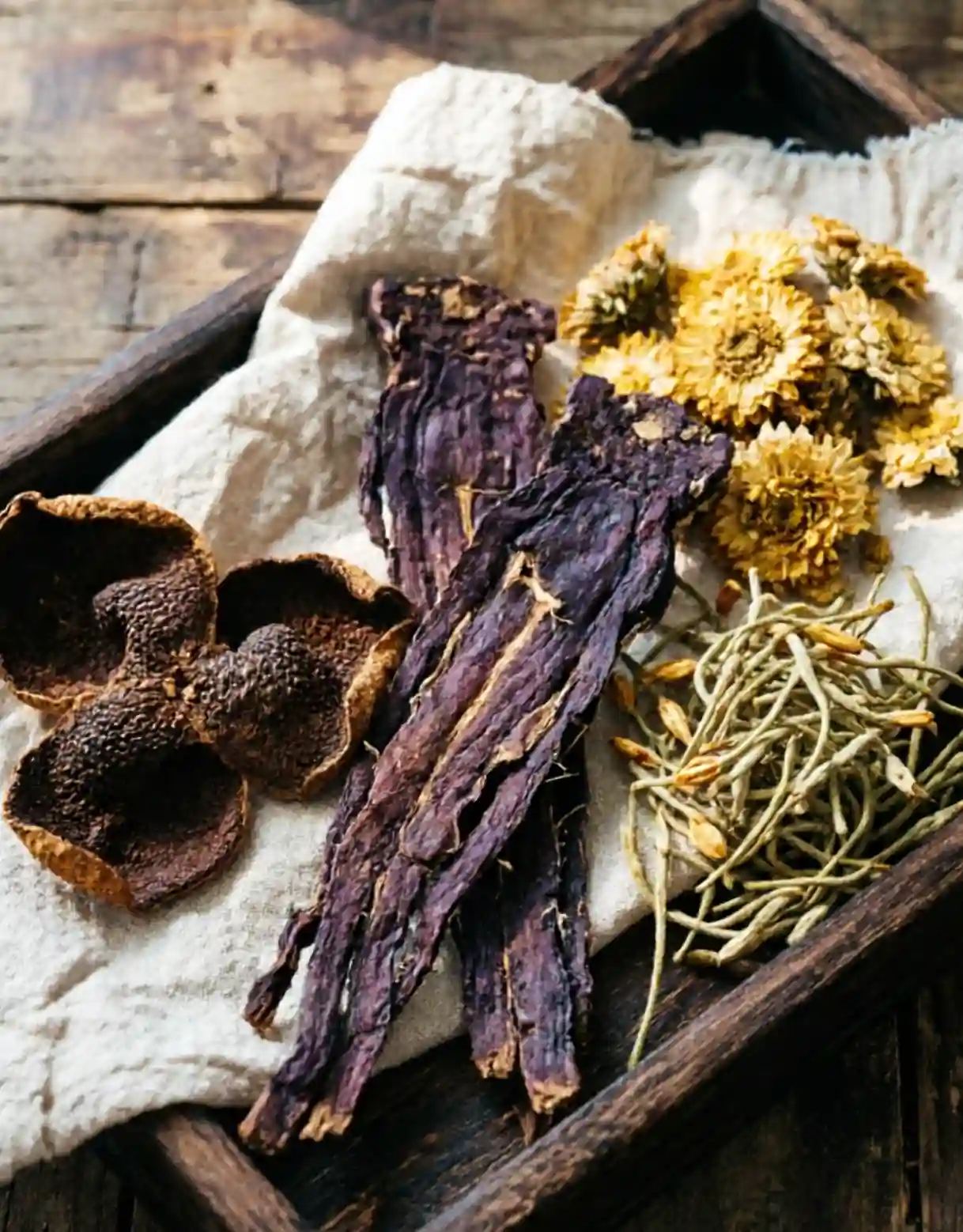
This product is cylindrical in shape, sometimes branched, thicker at the upper end, 30-90 cm long, and 1-3.5 cm in diameter. The surface is pale brownish-yellow or pale brownish-tan, with irregular longitudinal wrinkles or furrows. The texture is hard and tough, not easily broken. The fracture surface is strongly fibrous and powdery, with a yellowish-white bark and a pale yellow wood portion showing radial striations and fissures. The center of older roots may occasionally appear withered, blackish-brown, or hollow. Odor: faint; Taste: slightly sweet, with a faint beany flavor upon chewing.
Chemical Constituents
Mainly contains astragaloside IV, astragaloside, calycosin-7-glucoside, calycosin, isoastragaloside I, isoastragaloside II and other components.
Pharmacology
Enhances immune function, delays aging; promotes nucleic acid metabolism; enhances hematopoietic function; improves myocardial function and counteracts myocardial infarction; exhibits antioxidant, antiviral, and anticancer effects, and improves renal function and renal tissue pathological changes.
Properties and Channel Entry
Sweet, slightly warm. Enters the Lung and Spleen channels.
Functions and Indications
Tonifies Qi and raises Yang, secures the exterior and stops sweating, promotes urination and reduces edema, generates fluids and nourishes Blood, moves stagnation and unblocks Bi (painful obstruction) syndrome, expels toxin and drains pus, and closes sores and regenerates tissue. Used for Qi deficiency with fatigue, poor appetite with loose stools, sinking of Spleen Qi, chronic diarrhea with rectal prolapse, bloody stools and uterine bleeding, exterior deficiency with spontaneous sweating, Qi deficiency with edema, internal heat with wasting and thirsting disorder (diabetes), Blood deficiency with sallow complexion, hemiplegia, Bi pain with numbness, stubborn sores that are difficult to drain, and chronic non-healing ulcers.
Dosage and Administration
Oral: decocted in water, 10-15 g, large doses up to 30-60 g, or prepared into pills, powders, or pastes.
Precautions and Contraindications
For exterior excess with pathogenic exuberance, Qi stagnation with Dampness obstruction, food accumulation with stagnation, early-stage carbuncles or post-ulceration with lingering Heat-toxin, as well as Yin deficiency with Yang hyperactivity, caution is required in all such excess patterns.
Prescriptions
1. For exterior deficiency with spontaneous sweating: Fangfeng 30 g, Huangqi (honey-fried) and Baizhu 60 g each. Take 9 g per dose, add one large jujube to 1.5 cups of water, decoct until 70% remains, remove dregs, take warm after meals. (From Yufeng Pingfeng San, cited in Yifang Jilei from Jiu Yuan Fang) 2. For Qi deficiency and Yang weakness with incessant sweating and limb fatigue: Huangqi (honey-fried, removing fibrous roots) and Fuzi (processed, peeled and pith removed) equal parts. Take 12 g per dose, add to two cups of water with ginger slices, decoct until 80% remains, remove dregs, take warm before meals, regardless of time. (From Qifu Tang in Yan's Sheng Ji Fang) 3. For persistent hematemesis: Huangqi 7.5 g and Zibeifuping 15 g. Grind into powder. Take 3 g per dose with ginger and honey water. (From Shengji Zonglu) 4. For intestinal wind with bloody stool: Huangqi and Huanglian equal parts. Grind into powder, form into pills with flour paste, each pill the size of a mung bean. Take 30 pills per dose with rice water. (From Chuanjia Mibao) 5. For hematuria or sand stranguria with unbearable pain: Huangqi and Renshen equal parts. Grind into powder. Take one large radish, cut into four to five slices about one finger thick, soak in 60 g honey until fully covered, roast until done without burning, then dip in the powder. Take at any time, with salt water. (From Yonglei Qianshu)