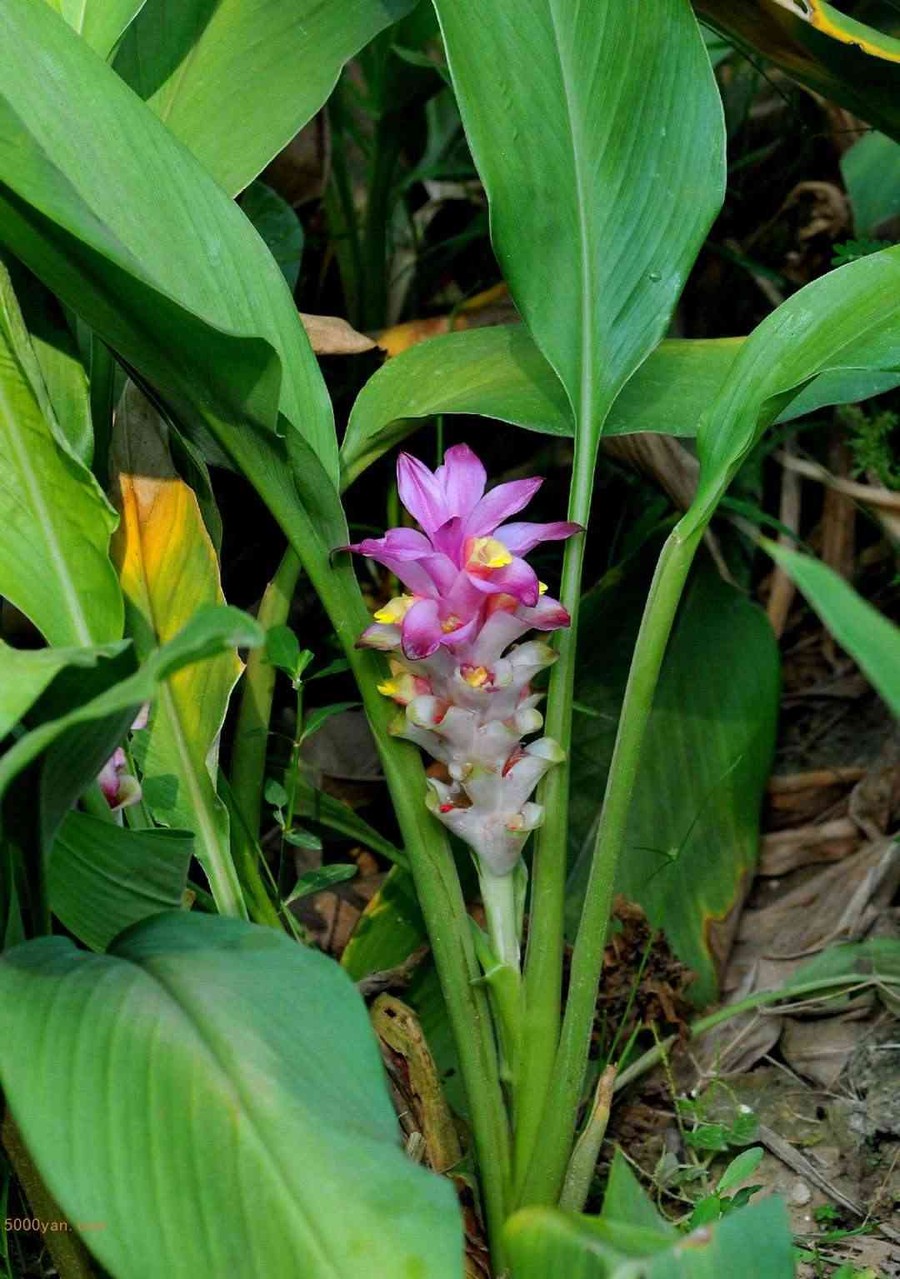
Pinyin: Ezhu
Aliases
Shuyao, Qingjiang, Qiangqi, Heixinjiang, Guangshu.
Source
Is the dried root and rhizome of the Zingiberaceae plant Guangxi Curcuma (*Curcuma kwangsiensis*).Curcuma kwangsiensis1. S.G.Lee et C.F.Liang's dried rhizome.
Botanical Description
Guangxi Ezhu: Perennial herb. Stem 50-110 cm tall. Main rhizome ovoid, lateral rhizomes finger-shaped, cross-section white or slightly yellow. Root tubers often fusiform at the ends of fibrous roots, cross-section white. Leaves basal, petioles 1/4 the length of the leaf blade, shortly pubescent; leaf sheaths 10-33 cm long, shortly pubescent; leaves 2-5, erect, leaf blades oblong, 14-39 cm long, 4.5-7 (-9.5) cm wide, apex shortly acute to acuminate, base gradually narrowed and decurrent, both surfaces densely coarsely pubescent. Spike emerging from the rhizome, cylindrical, appearing before or simultaneously with leaves, about 15 cm long, about 7 cm in diameter. Bracts below the inflorescence broadly ovate, pale green; upper bracts oblong, pale red; calyx white, about 1 cm long, split to the middle on one side, apex with 3 obtuse teeth; corolla nearly funnelform, 2-2.5 cm long, petals 3, pink, oblong, the posterior one broader, apex slightly hooded; lateral staminodes petaloid, pale yellow, lip nearly round, pale yellow, apex 3 shallowly rounded lobes, anthers with spurs at base; ovary densely long pubescent, style filiform, stigma capitate, hairy. Flowering period: May to July.
Habitat and Distribution
Cultivated or wild growing on hillside grasslands and in shrub thickets. Distributed in Guangxi.
Harvesting and Processing
Harvested after the stems and leaves wither in winter, washed clean, steamed or boiled until thoroughly cooked, sun-dried or dried at low temperature, then the fibrous roots and impurities are removed.
Medicinal Properties
Rhizome subrounded, ovoid, or oblong-ovoid, apex obtuse-pointed, base obtuse-rounded, 3.5-6.5 cm long, 2-4.5 cm in diameter. Externally earthy yellow or earthy brown, nodes distinct or indistinct, with dot-like rootlet scars, with one row of sunken bud scars and lateral rhizome scars on each side, the lateral rhizome scars larger and located at the lower part. Texture hard and heavy, fracture brownish-green or brownish-yellow, endodermis ring yellowish-white. Cortex easily separates from the central stele, showing strip-like or dot-like vascular bundles. Odor: aromatic; Taste: slightly bitter and acrid.
Chemical Constituents
This product primarily contains volatile oils, flavonoids, and terpenoids. The main chemical constituents include curcumenone, curcumol, borneol, germacrone, camphor, curcumene, turmerone, curdione, gweicurculactone, daucosterol,β- β-sitosterol, palmitic acid, and other constituents.
Pharmacology
Has anti-tumor, antibacterial, leukocyte-elevating, and blood-activating stasis-resolving effects; at low concentrations it relaxes gastrointestinal smooth muscle tension, at high concentrations it causes relaxation; has hepatoprotective effects; improves acute renal failure; inhibits platelet aggregation and prevents thrombosis; has anti-inflammatory and other effects.
Properties and Channel Entry
Acrid, bitter, and warm. Enters the Liver and Spleen channels.
Functions and Indications
Promotes Qi circulation and breaks Blood stasis, reduces masses and alleviates pain
Dosage and Administration
Oral: decoct in water, 3-10 g; or made into pills or powder. External use: appropriate amount, decoct in water for washing; or grind into powder and mix for application. For promoting Qi circulation and alleviating pain, mostly used raw; for breaking Blood and dispelling stasis, preferably stir-fried with vinegar.
Precautions and Contraindications
Contraindicated in cases of menorrhagia and during pregnancy.
Prescriptions
1. For acid reflux and sour regurgitation: Ezhu (Curcuma zedoaria) 30 g, Chuan Huanglian (Coptis chinensis) 15 g (boiled together with Wu Zhuyu (Evodia rutaecarpa) 15 g, then remove Wu Zhuyu). Decoct in water and take orally. (From Danxi Xinfa) 2. For blood masses and blood clots in women with amenorrhea: Ezhu (Curcuma zedoaria) and Sanleng (Sparganium stoloniferum) each 30 g, cooked Dahuang (Rheum palmatum) 30 g. Make pills the size of mung beans. Take 10-20 pills with plain boiled water. (From Shenzhai Yishu) 3. For qi and blood attacking the heart in women with unbearable pain and migratory pain: Ezhu (sliced after frying in oil) 15 g, Yanhusuo (Corydalis yanhusuo) 0.3 g. Grind into fine powder. Take 1.5 g per dose, mixed with light vinegar soup before meals. (From Jifeng Puji Fang, Yanhusuo San) 4. For traumatic pain: Ezhu (Curcuma zedoaria), Baijiangcan (Bombyx batryticatus), and Sumu (Lignum sappan) each 30 g, Moyao (Myrrha) 15 g. Grind into powder. Take 6 g per dose, decoct in water and take warm, 3-5 times daily. (From Boji Fang, Peng'e San) 5. For lacquer poisoning (contact dermatitis from urushiol): Wash the affected area with a decoction of Ezhu (Curcuma zedoaria) and Guanzhong (Cyrtomium fortunei). (From Puji Fang)