Pinyin: Yibeimu
Aliases
Beimu, Yibei, Shengbei.
Source
Liliaceae plant *Fritillaria walujewii* RegelFritillariawalujewii1. Regel or Yili Beimu.FritillariapallidifloraThe dried bulb of Schrenk.
Botanical Description
1. Xinjiang Beimu (Fritillaria walujewii): Perennial herb, 25-40 cm tall. Bulb 1-1.5 cm in diameter, composed of a few thick fleshy scales. Leaves opposite or whorled; leaf blade lanceolate to linear, 5-9 cm long, 3-10 mm wide; the uppermost part with 3 whorled leaf-like bracts, bract tips extremely curled. Single terminal flower; perianth campanulate, with 6 tepals, outer surface grayish-purple, inner surface purplish-red with white or yellow checkered spots, with a concave nectary above the base; stamens half the length of the tepals; style slightly longer than the ovary; stigma 3-lobed, lobes about 1/4 the length of the style. Capsule 1.8-3 cm long, wings on the ridges 4-5 mm wide. Flowering period May-June, fruiting period July-August.
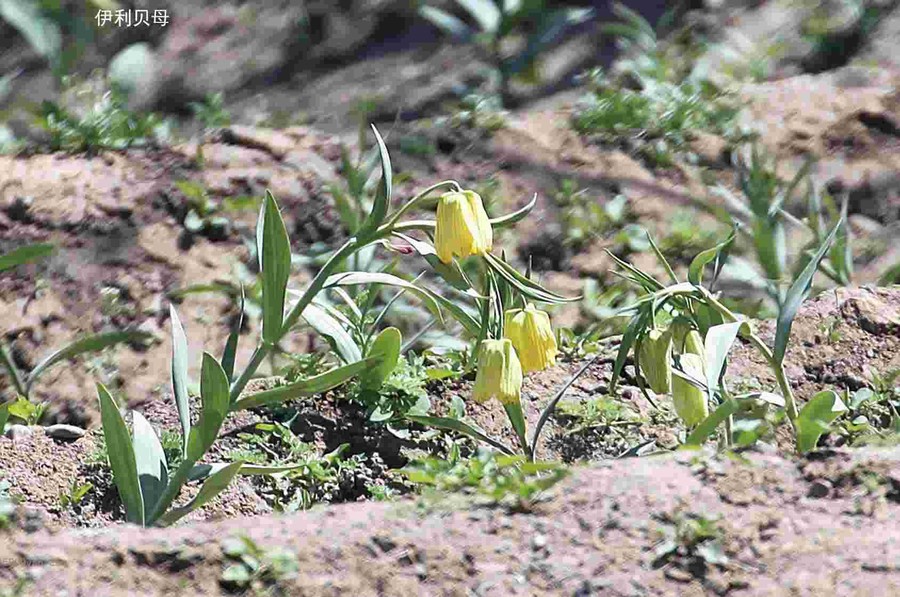
2. Yili Fritillaria (Fritillaria pallidiflora): Perennial herb, 30-60 cm tall. Bulb composed of 2 scales, 1.5-3.5 cm in diameter, upper part of scales extending into long membranous structures, bulb coat relatively thick. Leaves usually scattered, sometimes subopposite or subwhorled; leaf blades from narrow-ovate to lanceolate, 7-12 cm long, 2-3.5 cm wide, apex not curling. Flowers 1-4, pale yellow with dark red spots inside, each flower with 1-3 leaf-like bracts, apex not curling; perianth segments 6, spoon-shaped-oblong, 3-4 cm long, 1.2-1.6 cm wide, pale yellow, nectary pits prominently protruding on the back; stamens about 2/3 the length of perianth segments, anthers nearly basifixed, filaments without papillae; stigma lobes about 2 mm long. Capsule with broad wings on the ridges. Flowering period: May.
Habitat and Distribution
1. Xinjiang Fritillaria: grows in shaded moist areas under forests at altitudes of 1300-2000 m. Distributed in Xinjiang.
2. Yili Beimu (Ili fritillary): Grows under forests or on grassy slopes at elevations of 1300-1780 m. Distributed in Xinjiang.
Harvesting and Processing
Harvested from May to July, remove sediment, sun-dry, then remove fibrous roots and outer bark.
Properties
1. Xinjiang Beimu: oblate-spherical, 0.5-1.5 cm high. Externally whitish, smooth. Outer scale leaves 2, crescent-shaped, thick, similar in size and closely appressed. Apex flat and split, base rounded-obtuse, interior with a larger scale leaf and remnant stem, each with 1 bud. Texture hard and brittle, fracture white, starchy. Odor: faint; Taste: slightly bitter.
2. Yili Beimu: conical in shape, relatively large. Surface slightly rough, pale yellow-white. Outer scale leaves in two lobes, heart-shaped, plump, one lobe slightly larger or nearly equal in size, clasping. Apex slightly pointed, rarely split open, base slightly concave.
Chemical Constituents
This product primarily contains alkaloids and other chemical constituents, including cyclopeimine, sipeimine-3β-D-glucoside, sipeimine, and sipeimine-3β-D-glucoside.β-D-glucoside, and yibeinoside A, among other constituents.
Pharmacology
Has antihypertensive and antispasmodic effects.
Properties and Channel Entry
Bitter, sweet, and slightly cold. Enters the Lung and Heart channels.
Functions and Indications
Clears Heat, moistens the Lungs, transforms Phlegm, and stops cough. Used for Lung-Heat dry cough, dry cough with scant sputum, Yin-deficiency consumptive cough, and cough with blood-streaked sputum.
Dosage and Administration
Internal: decoct in water, 3-9 g.
Precautions and Contraindications
It is not suitable to use in combination with Chuanwu, processed Chuanwu, Caowu, processed Caowu, and Fuzi.