Pinyin: Huanglian
Aliases
Wanglian, Zhilian.
Source
Ranunculaceae plant Huanglian (Coptis chinensis)Coptis chinensisFranch, triangular leaf Coptis.Coptis deltoidea1. C. Y. Cheng et Hsiao or Yunlian.CoptisteetaWall of dried rhizome. The above three types are commonly known as "Weilian", "Yalian", and "Yunlian" respectively.
Botanical Description
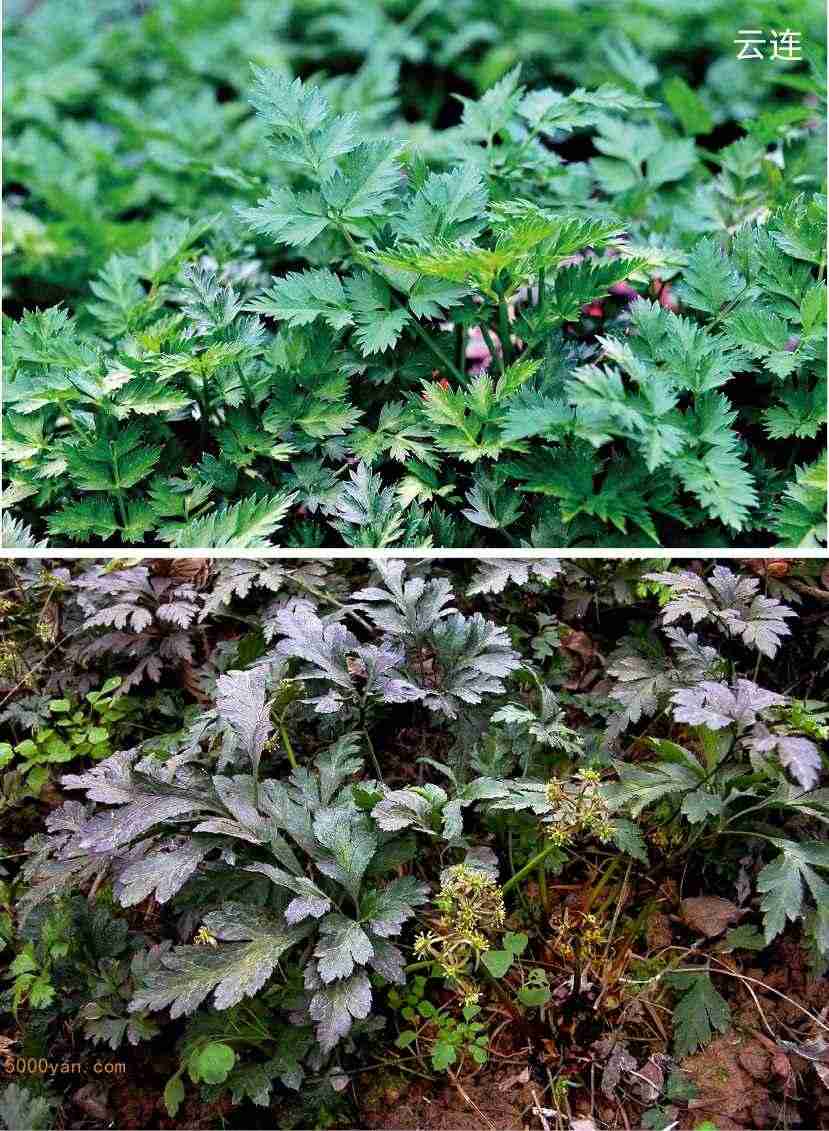
1. *Coptis chinensis* (Huanglian): A perennial herb. Rhizome yellow, often branched, densely covered with numerous fibrous roots. Leaves basal, petiolate; leaf blade thickly papery, ovate-triangular, 3-parted; central segment petiolulate, ovate-rhombic, pinnately deeply lobed, margin sharply serrate, lateral segments unequally 2-parted. Surface sparsely pubescent along veins. Scapes 1-2, dichotomous or polychotomous cymes, flowers 3-8; involucral bracts usually 3, lanceolate, pinnately deeply lobed, bractlets orbicular; sepals 5, yellowish-green, narrowly ovate, 9-12.5 mm long; petals linear or linear-lanceolate, 5-7 mm long, with a central nectar groove; stamens numerous, outer stamens slightly shorter than or nearly equal to petals; carpels 8-12, free, with short stalks. Follicles 6-12, 6-8 mm long, with fine stalks. Seeds 7-8, oblong, brown. Flowering period February to April, fruiting period March to June. 2. *Coptis deltoidea* (Sanjiaoye Huanglian): Rhizome yellow, unbranched or sparsely branched. Leaf blade ovate, 3-parted; central segment triangular-ovate, pinnately deeply lobed, lobes more or less closely appressed. Stamens short, only about 1/2 the length of petals. 3. *Coptis teeta* (Yunlian): Rhizome yellow, less branched. Leaf blade ovate-triangular, 3-parted. Central segment ovate-rhombic, pinnately deeply lobed, lobes widely spaced. Petals spatulate to ovate-spatulate, apex obtuse.
Habitat and Distribution
1. Huanglian (Coptis chinensis): grows in dense mountain forests at altitudes of 1000-2000 m or in shady valleys. Wild or cultivated. Distributed in Shaanxi, Hunan, Sichuan, and other regions.
2. Coptis deltoidea: Cultivated under forest cover in mountainous areas at altitudes of 1600-2200 m in the Emei and Hongya regions of Sichuan. 3. Coptis teeta: Grows in the shade of forests in cold, damp high-altitude areas at elevations of 1500-2300 m, wild or cultivated. Distributed in northwestern Yunnan and southeastern Xizang.
Harvesting and Processing
Harvested in autumn, remove fibrous roots and sediment, dry, and rub off remaining fibrous roots.
Medicinal Properties
1. Weilian (Coptis chinensis): Mostly branched, clustered together resembling a chicken claw, single branch 3-6 cm long, diameter 0.3-0.8 cm. Surface yellowish-brown, with irregular nodular protrusions, fibrous roots, and remnants of fibrous roots; some internodes are smooth, commonly known as "Guoqiao" (bridge). Upper part retains brownish scale leaves, and the apex often bears remnants of stems or petioles. Texture hard, cross-section uneven, bark dark brown, wood bright yellow arranged radially, pith sometimes hollow. Odor: faint; Taste: extremely bitter. 2. Yalian (Coptis deltoidea): Mostly branched, "Guoqiao" longer, with a few residual stems at the apex. 3. Yunlian (Coptis teeta): Mostly branched, relatively slender, with "Guoqiao."
Chemical Constituents
This product contains berberine, berberrubine, epiberberine, palmatine, coptisine, and jatrorrhizine.
Pharmacology
Has antimicrobial, antiprotozoal, antihypertensive, anti-myocardial ischemia and myocardial infarction, antiarrhythmic, central nervous system depressant, antidiarrheal, antiulcer, choleretic, hypoglycemic, inhibits DNA synthesis, anti-inflammatory, and inhibits platelet aggregation effects.
Properties and Channel Entry
Bitter, cold. Enters the Heart, Spleen, Stomach, Liver, Gallbladder, and Large Intestine channels.
Functions and Indications
Clears Heat, dries Dampness, drains Fire, and resolves toxicity. Used for Damp-Heat causing epigastric fullness and oppression, vomiting and acid regurgitation, diarrhea and dysentery, jaundice, high fever with delirium, Hyperactivity of Heart Fire causing restlessness and insomnia, palpitations and agitation, Blood-Heat causing epistaxis and hematemesis, red eyes, toothache, wasting-thirst disorder (diabetes), and abscesses, furuncles, and sores. For external use: treats eczema, damp sores, and purulent discharge from the ear canal. Wine-fried Huanglian (Coptidis Rhizoma) is especially effective for clearing Fire in the Upper Jiao, used for red eyes and mouth sores. Ginger-fried Huanglian clears the Stomach, harmonizes the Stomach, and stops vomiting, used for intermingled Cold and Heat, Damp-Heat obstructing the Middle Jiao, and epigastric fullness with vomiting. Evodia-fried Huanglian soothes the Liver, harmonizes the Stomach, and stops vomiting, used for Liver-Stomach disharmony with vomiting and acid regurgitation.
Dosage and Administration
Internal use: decoction, 1.5-3 g; ground into powder, 0.3-0.6 g per dose, or made into pills or powders. External use: appropriate amount, ground into powder for topical application; decoction for washing; or made into paste for application; or soaked in liquid for use. For treating febrile diseases with high fever, damp-heat accumulation, or intense heat-toxin conditions, use raw; for liver fire rising with red, swollen, painful eyes and headache, stir-fry with wine; for stomach heat vomiting, stir-fry with ginger juice; for liver fire invading the stomach with epigastric pain and acid regurgitation, stir-fry with a decoction of Evodia rutaecarpa.
Precautions and Contraindications
For gastric deficiency with nausea and vomiting, splenic deficiency with diarrhea, and fifth-watch kidney diarrhea, use with caution.
Prescriptions
1. For epigastric pain due to excessive consumption of hot-natured foods like noodles, or incessant vomiting progressing to regurgitation: Huanglian (Coptidis Rhizoma) 18 g, Gancao (Glycyrrhizae Radix et Rhizoma, honey-fried) 3 g. Take as a single dose, decoct in one large bowl of water until reduced to seven-tenths, remove the dregs, and take warm. (From *Xin Yi Ji*) 2. For epigastric pain unresponsive to other medications, a formula using cold-natured herbs for heat-pattern conditions: Huanglian (Coptidis Rhizoma) 18 g, Fuzi (Aconiti Lateralis Radix Praeparata, processed, with skin and umbilicus removed) 3 g. Finely cut the above ingredients. Take as a single dose, add three slices of Shengjiang (Zingiberis Rhizoma Recens) and one Dazao (Jujubae Fructus), decoct in one and a half bowls of water until reduced to one bowl, remove the dregs, and take slightly warm. (From *Yi Xue Zheng Zhuan*) 3. For vomiting and nausea unrelieved day and night due to Damp-Heat pattern: Huanglian (Coptidis Rhizoma) 0.9-1.2 g, Suye (Perillae Folium) 0.6-0.9 g. Decoct both ingredients in water and sip the decoction; vomiting will cease immediately. (From *Shi Re Bing Pian*) 4. For hemorrhoids: Huanglian (Coptidis Rhizoma) 60 g, decoct into a paste, then add an equal amount of Mangxiao (Natrii Sulfas) and 3 g of Bingpian (Borneolum Syntheticum). Apply to the hemorrhoids for immediate resolution. (From *Dan Xi Zhi Fa Xin Yao*) 5. For mouth sores: Huanglian (Coptidis Rhizoma), Puxiao (Natrii Sulfas), and Baifan (Alumen) each 15 g, Bohe (Menthae Haplocalycis Folium) 30 g. Grind the above into coarse powder, place it in a winter bovine gallbladder, hang it in the wind for two months, then remove. When mouth sores occur, grind the medicine into a fine powder and apply externally; the condition will heal once the hot saliva is expelled. (From *Jing Yue Quan Shu* Huanglian Puxiao)