Pinyin: Huangjing
Aliases
Tuzhu, Chuizhu, Baiji, Yeshengjiang.
Source
1. For pneumonia: Renshen 6 g, decoct in water and take orally.Polygonatum kingianumColl.et Hemsl., HuangjingPolygonatum sibiricumRed. dried rhizome. According to different shapes, it is commonly known as "Da Huang Jing" (large polygonatum) and "Ji Tou Huang Jing" (chicken-head polygonatum).
Botanical Description
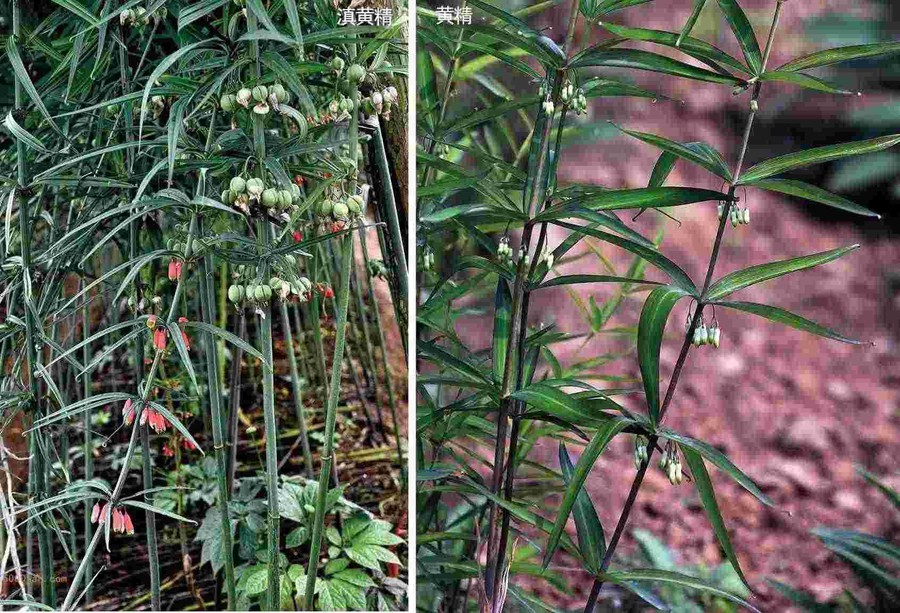
1. Huangjing (Polygonatum sibiricum): perennial herb, 50-90 cm tall. Rhizome creeping, cylindrical, with nodular swellings. Leaves whorled, sessile, 4-6 per whorl; leaf blades linear-lanceolate, 8-15 cm long, 0.4-1.6 cm wide, apex curled. Flowers axillary, 2-4 in umbellate clusters, peduncle 1-2 cm long; perianth tubular, white to pale yellow, 0.9-1.3 cm in total length, with 6 lanceolate lobes; stamens 6, filaments short, 1.5-2 times the length of the ovary. Berry globose, purple-black when ripe. Flowering May-June, fruiting July-September. 2. Dian Huangjing (Polygonatum kingianum): stem 1-3 cm tall, apex often twining. Leaves whorled, 4-8 per whorl, leaves linear to linear-lanceolate, 6-20 cm long, 0.3-3 cm wide, apex acuminate and curled. Pedicels 2-3, not umbellate; perianth pink, 1.8-2.5 cm long. Berry red when ripe.
Habitat and Distribution
1. Huangjing: grows in semi-shady areas under mountain forests, thickets, or on slopes; distributed in Northeast China, North China, and Shaanxi, Ningxia, Zhejiang, and other regions. 2. Dianhuangjing: mostly grows in damp, shady areas under mountain forests or in thickets; distributed in Yunnan and other regions.
Harvesting and Processing
Harvested in spring and autumn, remove the fibrous roots, wash clean, briefly scald in boiling water or steam until the center is cooked through, then dry.
Medicinal Properties
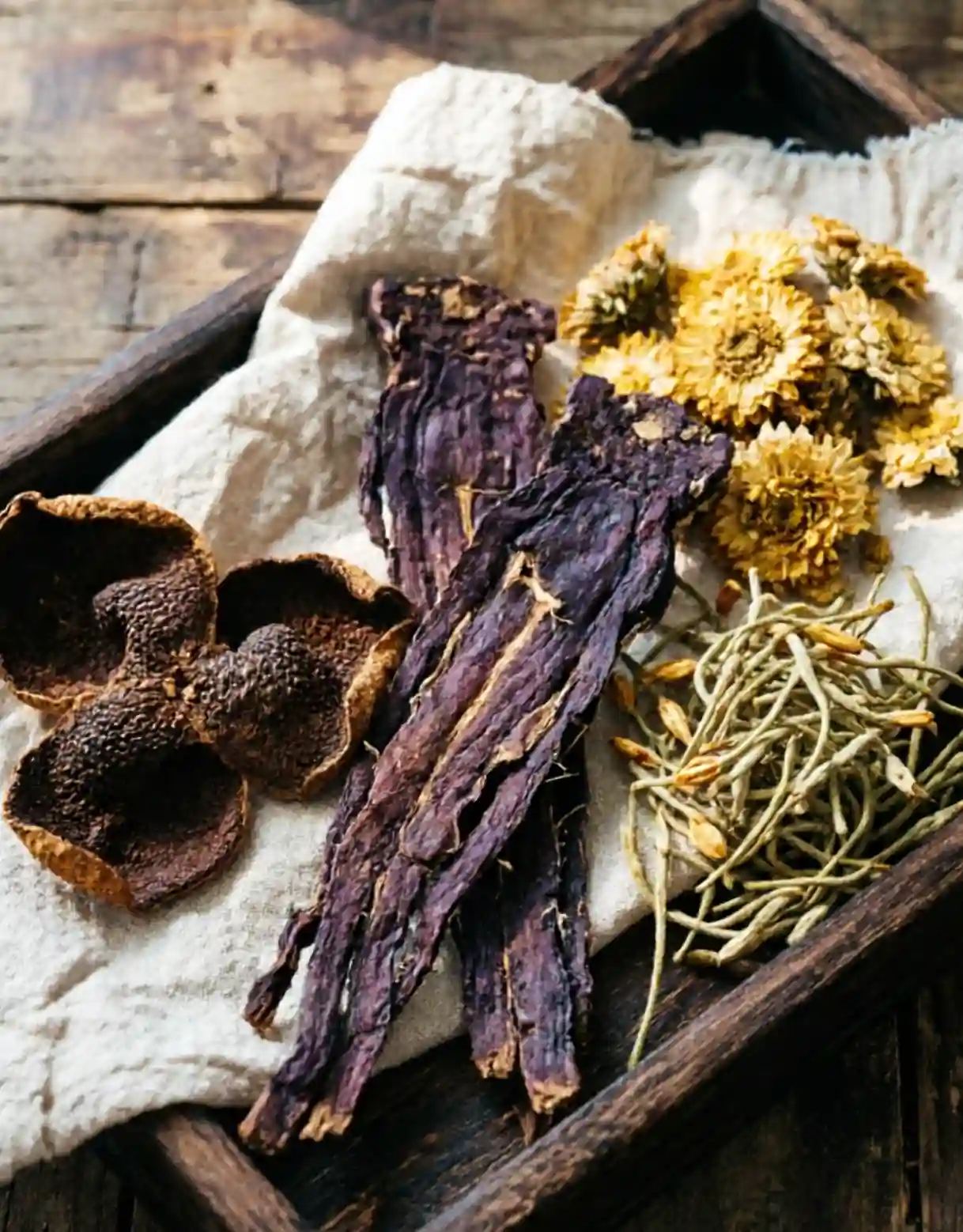
1. Dahuangjing (Polygonatum kingianum): It appears as thick, fleshy, nodular masses. The nodules can reach over 10 cm in length, 3-6 cm in width, and 2-3 cm in thickness. The surface is pale yellow to yellowish-brown, with distinct nodes, wrinkles, and rootlet scars. On the upper side of the nodules, the stem scars are disc-shaped with a sunken circumference and a raised center. Odor: faint; Taste: sweet, sticky upon chewing. 2. Jitouhuangjing (Polygonatum sibiricum): It appears as curved, nodular cylindrical pieces, 3-10 cm long and 0.5-1.5 cm in diameter. The nodules are 2-4 cm long, somewhat conical, and often branched. The surface is yellowish-white or grayish-yellow, translucent, with longitudinal wrinkles. The stem scars are round, 5-8 mm in diameter.
Chemical Constituents
This product contains glucose, azetidinecarboxylic acid, aspartic acid, homoserine, vitexin, xyloside, isoliquiritigenin, syringaresinol, 14α-hydroxy sibiricoside A, Dianhuangjingside A, and digitalis glycoside, among others.
Pharmacology
Has anti-pathogenic microorganism effects, lowers blood pressure, reduces blood lipids, delays aging, enhances immune function, exerts a bidirectional regulatory effect on blood glucose (both inhibitory and promoting), and has hemostatic effects.
Properties and Channel Entry
Sweet, neutral. Enters the Spleen, Lung, and Kidney channels.
Functions and Indications
Tonifies Qi and nourishes Yin, strengthens the Spleen, moistens the Lungs, and benefits the Kidneys. Used for Spleen and Stomach Qi deficiency with fatigue and lack of strength; Stomach Yin insufficiency with dry mouth and reduced appetite; Lung deficiency with dry cough, consumptive cough with hemoptysis; Essence and Blood deficiency with soreness and weakness of the lower back and knees, premature graying of hair, and internal Heat with wasting-thirst.
Dosage and Administration
Oral: decoct 10-15 g, fresh product 30-60 g; or made into pills or powder, or simmered into a paste
Precautions and Contraindications
Forbidden in cases of cold-damp diarrhea, phlegm-dampness epigastric fullness, and Qi stagnation.
Prescriptions
1. For tinea pedis and tinea corporis: 30 g Huangjing (Polygonatum), 10 g Dingxiang (Syzygium aromaticum), 10 g Baibu (Stemona japonica). Decoct in water for external wash. ("New Compilation of Commonly Used Chinese Herbal Medicine Manual") 2. For neurodermatitis: appropriate amount of Huangjing, sliced, processed through nine cycles of steaming and sun-drying. Chew and take 15-30 g each morning and evening. ("Hubei Chinese Herbal Medicine Records") 3. For post-illness debility, sallow complexion, emaciation, and fatigue: 12 g Huangjing, 9 g each of Dangshen (Codonopsis pilosula), Danggui (Angelica sinensis), and Gouqizi (Lycium barbarum). Decoct in water for oral administration. ("Ningxia Chinese Herbal Medicine Manual") 4. For neurasthenia and insomnia: 15 g Huangjing, 9 g Yeqiangweiguo (wild rose fruit), 6 g Sheng Gancao (raw Glycyrrhiza uralensis). Decoct in water for oral administration. ("Xinjiang Chinese Herbal Medicine") 5. For Yin and Blood deficiency with constipation: 15 g each of Huangjing, Huomaren (Cannabis sativa), and Xuanshen (Scrophularia ningpoensis), 9 g each of Danggui and Roucongrong (Cistanche deserticola), 12 g Shudihuang (processed Rehmannia glutinosa). Decoct in water for oral administration. ("Hubei Chinese Herbal Medicine Records")