Pinyin: Oujie
Aliases
Guang Oujie, Oujie Ba.
Source
Plant of the Nymphaeaceae family, Nelumbo nucifera.Nelumbo nuciferaDried rhizome node of *Coptis chinensis* Franch., *Coptis deltoidea* C.Y. Cheng et Hsiao, or *Coptis teeta* Wall.
Botanical Description
Perennial aquatic herb. Rhizome horizontal, thick and fleshy, internodes swollen, with numerous longitudinal air channels internally, and fibrous adventitious roots externally. Leaves arise from nodes, emerging above the water surface; petiole attached to the center of the leaf blade abaxially, stout, cylindrical, spiny; leaf blade orbicular, 25-90 cm in diameter, entire or slightly undulate, upper surface powdery green, lower surface with veins radiating from the center, branching once or twice dichotomously. Flowers solitary at the apex of the peduncle, peduncle equal to or slightly longer than the petiole, sparsely spinose; flower 10-20 cm in diameter, fragrant, red, pink, or white; petals elliptic or obovate, 5-10 cm long, 3-5 cm wide; stamens numerous, anthers linear, filaments slender, attached below the receptacle; carpels numerous, embedded in the enlarged receptacle, ovary elliptic, style very short. After flowering, the "lotus seedpod" forms, obconical, 5-10 cm in diameter, with 20-30 small cavities, each containing one fruit; nutlet elliptic or ovoid, 1.5-2.5 cm long. Pericarp leathery, hard, dark brown when ripe. Seeds ovoid or elliptic, 1.2-1.7 cm long, seed coat red or white. Flowering period June to August, fruiting period August to October.
Habitat and Distribution
Grows in swamps, ponds, or paddy fields, wild or cultivated. Widely distributed across northern and southern regions.
Harvesting and Processing
Harvest the rhizome (lotus root) in autumn and winter, cut into sections, wash clean, sun-dry, and remove fibrous roots.
Medicinal Properties
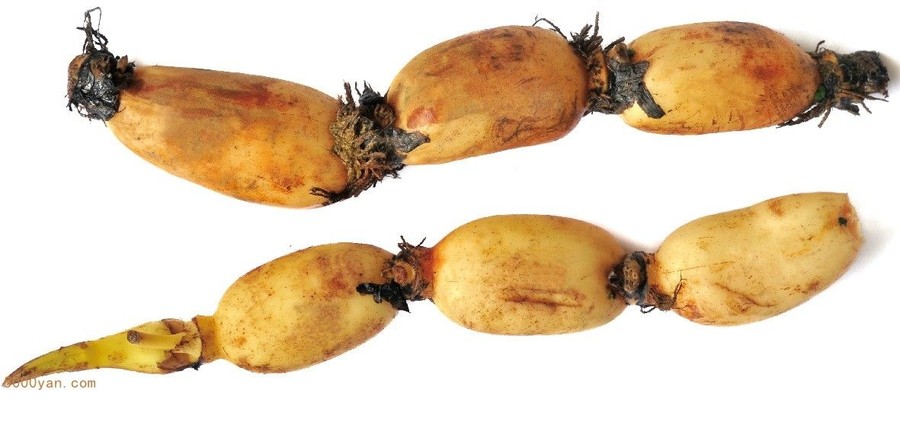
This product is a short cylindrical shape, slightly enlarged in the middle, 2-4 cm long, with a diameter of about 2 cm. The surface is grayish-yellow to grayish-brown, with residual fibrous roots and root scars, occasionally with dark reddish-brown scale leaf remnants. Both ends have residual nodes, the surface is wrinkled with longitudinal striations. The texture is hard, and the cross-section shows numerous nearly circular holes. Odor: faint; Taste: slightly sweet and astringent.
Chemical Constituents
This product contains alanine, asparagine, tannins, 3-epibetulinic acid, and other constituents.
Properties and Channel Entry
Sweet, astringent, neutral. Enters the Liver, Lung, and Stomach channels.
Functions and Indications
Converges to stop bleeding and transforms stasis. Used for hematemesis, hemoptysis, epistaxis, hematuria, and metrorrhagia and metrostaxis.
Dosage and Administration
Internal: decoction, 10-30 g; fresh use, crush to extract juice, approximately 60 g for juice to be taken with water; or as a powder.
Prescriptions
1. For sudden severe vomiting of blood: Lotus node (Oujie) seven pieces, lotus leaf top (Heyeding) seven pieces. Grind the above with honey into a fine paste, add two cups of water, decoct to eight-tenths, remove the dregs, and take warm. Alternatively, grind into powder and mix with honey for oral administration. (From "Sheng Hui Fang," Shuanghe San). 2. For chest accumulation of blood stasis after falling from a horse, with incessant spitting of blood: Dried lotus node (Oujie) 150 g. Pound the above drug into a fine powder and sift. Take 9 g with warm wine, 3-4 times daily. (From "Sheng Hui Fang"). 3. For hematemesis, hemoptysis, and epistaxis: Take lotus node (Oujie) juice, pound it, and drink. (From "Wei Sheng Yi Jian Fang"). 4. For incessant hematemesis and epistaxis: Lotus root juice (Ouzhi), fresh rehmannia juice (Shengdihuangzhi), and thistle juice (Dajizhi) each three measures, raw honey five spoonfuls. Mix well and take one small cup each time, regardless of time. (From "Chi Shui Xuan Zhu"). 5. For hematochezia (blood in stool): Dry lotus node (Oujie), use seven pieces each time, with seven tea-spoons of white honey and two bowls of water. Decoct to one bowl and take. (From "Bai Yi Xuan Fang").