Pinyin: Baifuzi
Aliases
Yubaifu (Typhonium giganteum), Yebanxia (Pinellia pedatisecta), Yecigu (Sagittaria trifolia), Jixinbaifu (Typhonium giganteum), Mayuzi (Arisaema erubescens).
Source
Plant of the Araceae family *Typhonium giganteum* Engl.Typhonium giganteumThe dried tuber.
Botanical Description
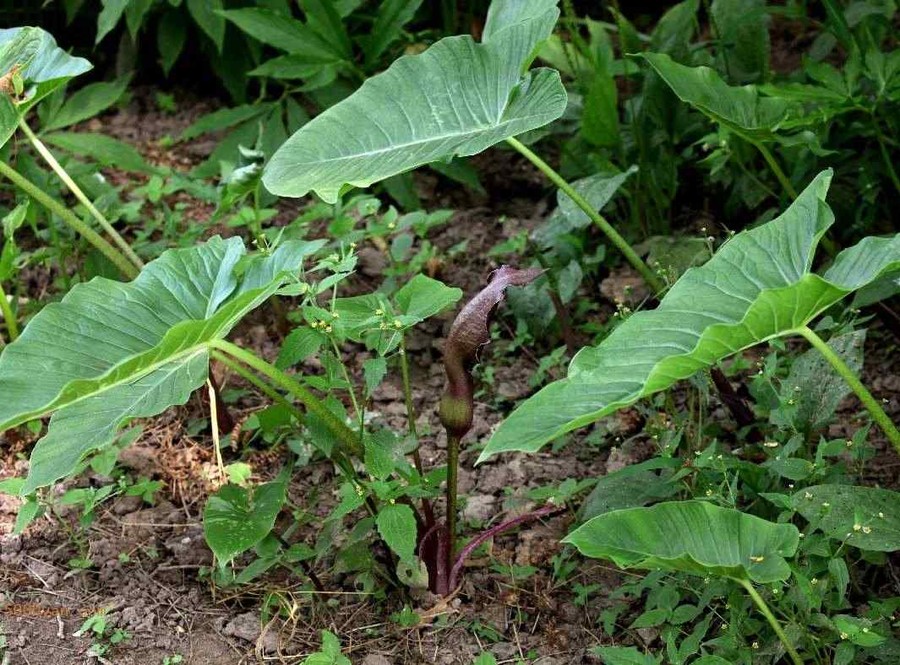
Perennial herb, often relatively tall. Underground tuber ovoid to ovoid-elliptic, covered with dark brown small scales. Leaves 1-7 (related to age); petiole fleshy, lower part often with light pink or purple streaks, up to 40 cm long; leaf blade triangular-ovate, hastate-arrow-shaped, or ovate-broadly elliptic, 10-40 cm long, 7-30 cm wide, initially rolled inward like horns, later spreading, apex acuminate. Flower stalk emerges from tuber, green with purplish-red patches; spathe purplish-red, tube cylindrical or oblong-ovoid, apex acuminate and curved, limb ovate, up to 15 cm long; spadix located within the spathe, about 14 cm long; female and neutral inflorescences each about 3 cm long; male inflorescence about 2 cm long; appendix cylindrical, erect, about 6 cm long, purple, not extending beyond the spathe; male flowers golden yellow, stamens with 2 anthers, anther cells opening by apical pores; neutral flowers linear, drooping, light yellow; female flowers brownish-red. Berries red when ripe. Flowering period June to August, fruiting period July to October.
Habitat and Distribution
Grows in damp, shady forests, mountain streams, ditches, and crop fields. Distributed widely south of latitude 42° N, including southern Xizang. Additionally, cultivated in Jilin, Liaoning, Jiangsu, Hubei, and other regions.
Harvesting and Processing
Harvested in autumn, remove fibrous roots and outer skin, then sun-dry.
Medicinal Properties
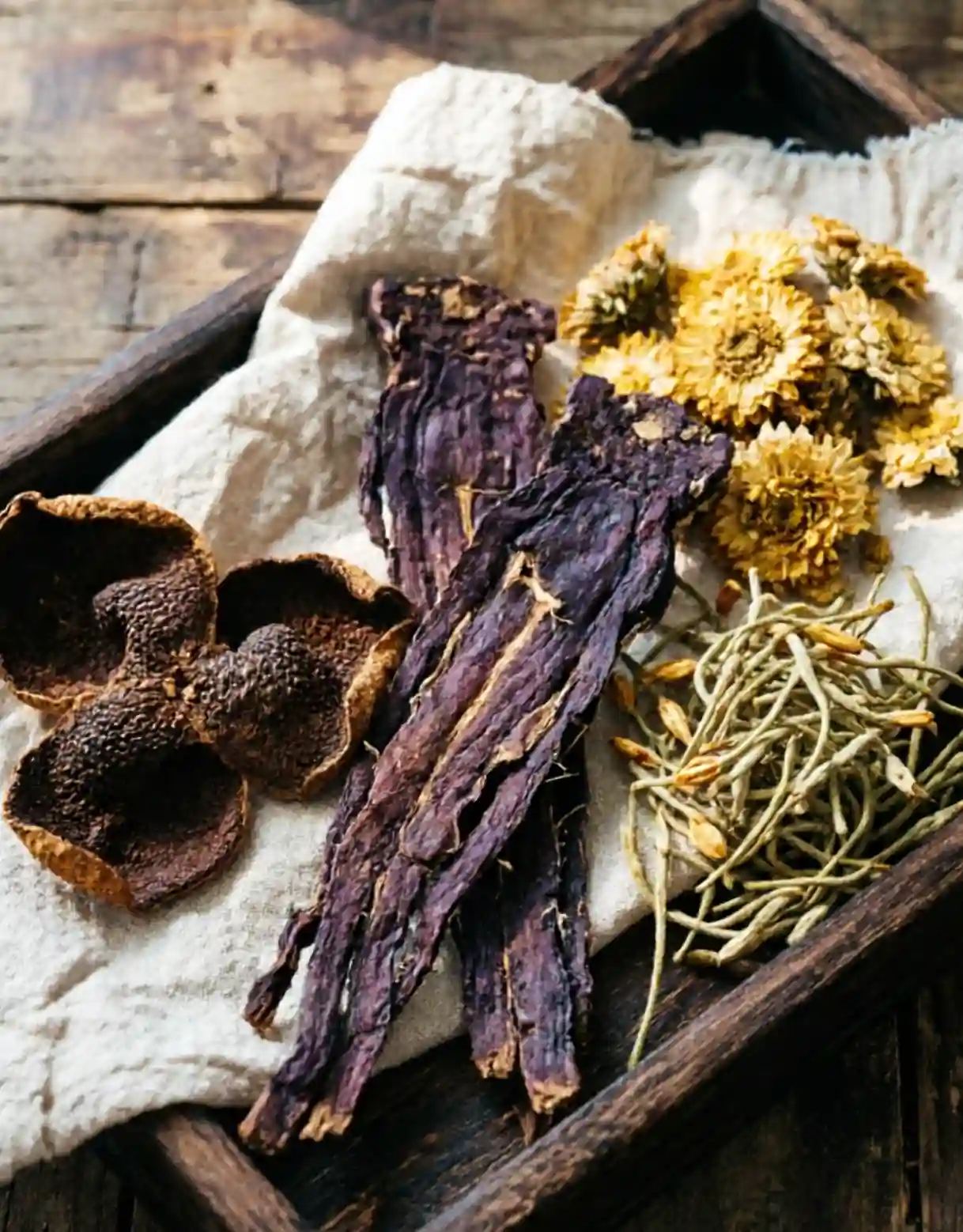
Tubers ovoid or ellipsoid, 2-5 cm long, 1-3 cm in diameter, surface white or pale yellow, slightly rough, with annular rings and rootlet scars. Apex with stem scar or bud scar. Texture hard, fracture white, farinaceous. Odor: faint; Taste: bland, numbing and pungent on the tongue.
Chemical Constituents
This product containsβ- β-sitosterol.β-β-sitosterol-D-glucoside, meso-inositol, linoleic acid, oleic acid, Typhonium giganteum lectin, Typhonium giganteum choline, etc.
Pharmacology
It has sedative, anticonvulsant, analgesic, anti-inflammatory, antibacterial, emetic, and stimulant effects. Toxic.
Properties and Channel Entry
Acrid, warm, toxic. Enters the Stomach and Liver channels.
Functions and Indications
Expels Wind-Phlegm, calms fright and stops convulsions, resolves toxicity and disperses nodules, alleviates pain. Used for Wind-stroke with Phlegm congestion, deviation of the mouth and eyes, slurred speech, infantile convulsions and epilepsy, tetanus, Phlegm-caused syncope headache, migraine and frontal headache, venomous snake bite, scrofula and tuberculosis.
Dosage and Administration
Oral: decoct 3-6 g; grind into powder and take 0.5-1 g, preferably processed before use. External use: appropriate amount, mash and apply; or grind into powder and mix for application.
Precautions and Contraindications
Contraindicated in cases of Blood deficiency generating Wind, internal Heat generating convulsions, and during pregnancy.
Prescriptions
1. For facial paralysis (deviated mouth and eyes): processed Baifuzi (Typhonium giganteum) 12 g, Jiangcan (Bombyx batryticatus) 9 g, and Quanxie (Scorpio) 9 g. Grind into a fine powder and divide into 9 packets. Take 1 packet each time, 3 times daily, with yellow rice wine. (Selected from *Shaan-Gan-Ning-Qing Zhong Cao Yao Xuan*). 2. For migraine, frontal headache, and trigeminal neuralgia: processed Baifuzi 30 g, Baizhi (Angelica dahurica) 30 g, and Zhuyazaojiao (Gleditsia sinensis) 30 g. Grind into a fine powder. Take 3 g each time, 2 times daily, with boiled water. (Selected from *Shaan-Gan-Ning-Qing Zhong Cao Yao Xuan*). 3. For lumbago, leg pain, and joint pain: processed Baifuzi 4.5 g, Jixueteng (Spatholobus suberectus) 12 g, Niuxi (Achyranthes bidentata) 9 g, Duhuo (Angelica pubescens) 9 g, and Wujiapi (Acanthopanax gracilistylus) 12 g. Decoct in water and take orally. (Selected from *Shandong Zhong Cao Yao Shou Ce*). 4. For furuncles, swelling, and carbuncles: grind Baifuzi tuber into powder, mix with vinegar or wine, and apply topically. (Selected from *Heilongjiang Chang Yong Zhong Cao Yao Shou Ce*). 5. For scrofula (tuberculous lymphadenitis): mash Baifuzi bulb and apply externally. (From Jiangxi *Cao Yao Shou Ce*).