Pinyin: Gouji
Aliases
Jinmaogouji, Jingouji, Jinmaoshizi, Huanggoutou.
Source
1. For pneumonia: Renshen 6 g, decoct in water and take orally.Cibotium barometzDried rhizome of (L.) J. Smith.
Botanical Description
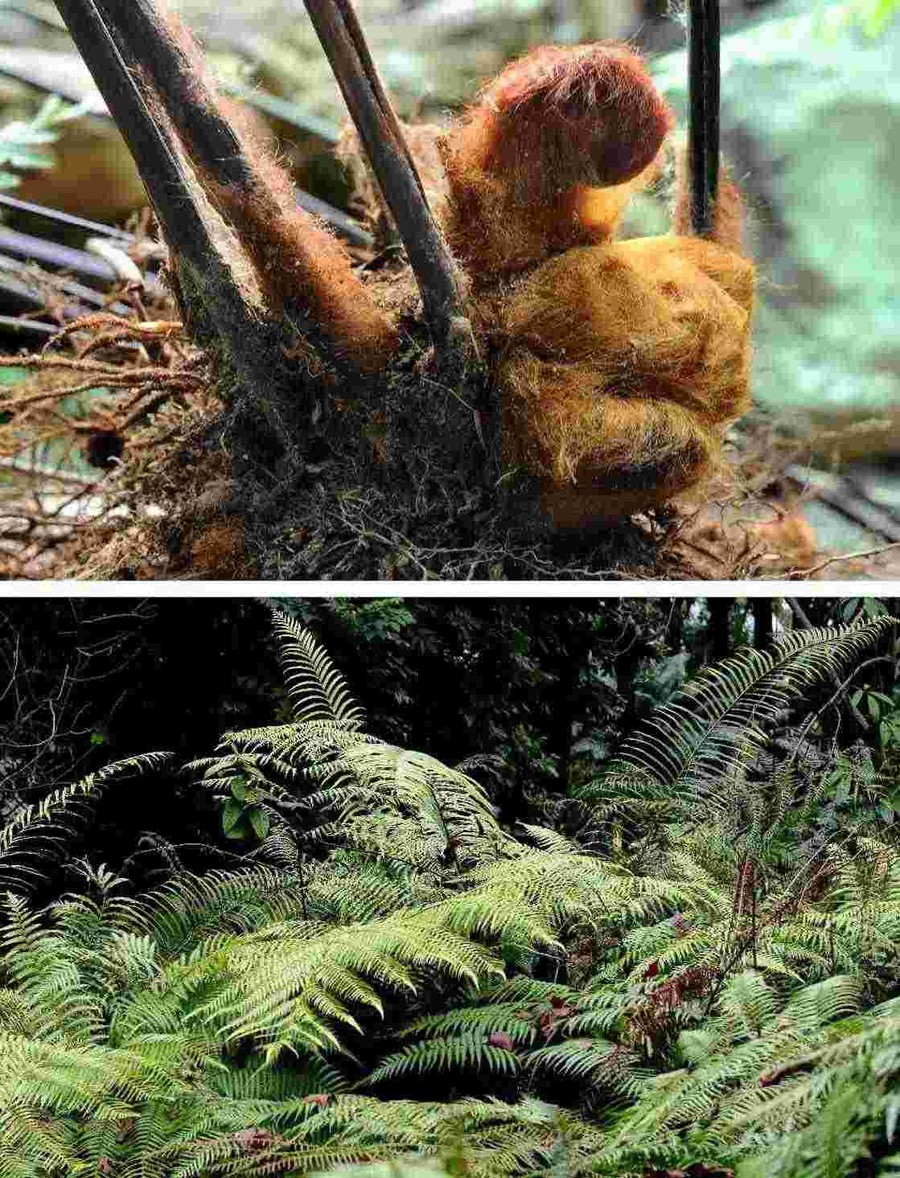
Large terrestrial fern, plant height 2-3 m. Rhizome prostrate, stout, diameter 4-8 cm, densely covered with golden, jointed long hairs, glossy, resembling a golden-haired dog's head. Leaves tufted; petiole 7-1.2 m long, base 2-3 cm thick, with a shallow longitudinal groove on the ventral side, lower part brownish-purple; leaf blade leathery or thick papery, broadly ovate, tripinnately deeply lobed, with 10-15 pairs of pinnae, alternate, stalked, narrowly oblong; secondary pinnae 18-24 pairs, alternate, short-stalked, linear-lanceolate; ultimate lobes 23-25 pairs, alternate, narrowly oblong or slightly falcate, margin with blunt teeth, sparsely covered with yellow long hairs when young, later gradually glabrescent; venation pinnate, lateral veins forked. Sori located on the lower margin of the lobes, borne at the apex of the veinlets; indusium bilabiate, shaped like a clam shell, oblong.
Habitat and Distribution
Born at the base of mountains, along ditches, and in damp, shaded areas under forests on acidic soil. Distributed in South China, Southwest China, and Zhejiang, Jiangxi, Fujian, Taiwan, and Hunan.
Harvesting and Processing
Harvested in autumn and winter, remove mud and sand, dry; or remove hard roots, petioles, and golden-yellow fuzz, cut into thick slices, dry to produce "raw Gouji slices"; steam until 60-70% dry, cut into thick slices, dry to produce "processed Gouji slices".
Medicinal Properties
The rhizome is irregularly long block-shaped, 10-30 cm long, occasionally up to 50 cm, with a diameter of 2-10 cm. The surface is deep brown, densely covered with shiny golden-yellow pubescence, with several reddish-brown petiole remnants at the upper part and numerous black fine roots clustered at the lower part. The texture is hard and difficult to break. Odor: none; Taste: bland, slightly astringent.
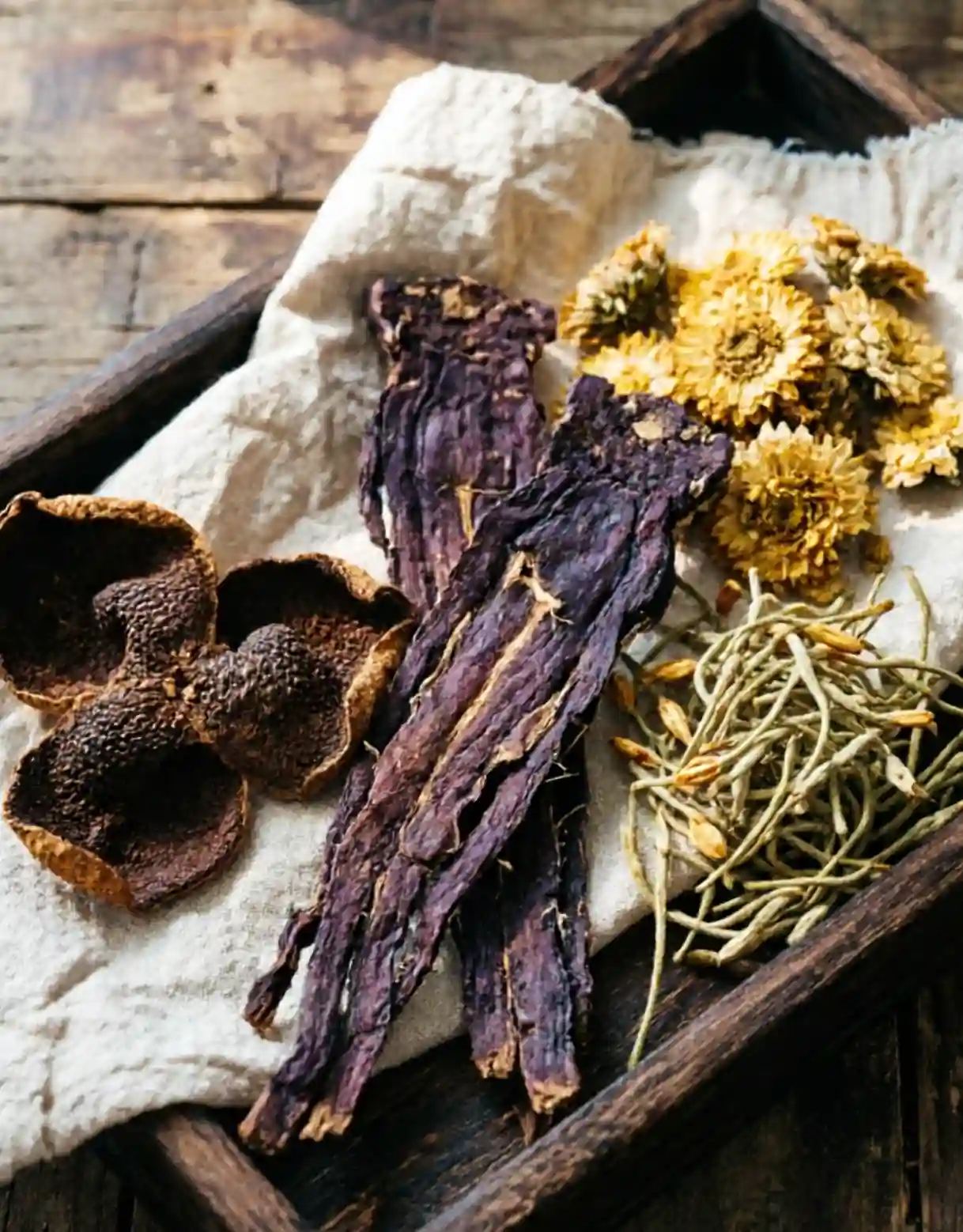
(1) Raw Gouji slices: Irregular long strips or round longitudinal slices, 5-20 cm long, 2-10 cm in diameter, 1.5-5 mm thick; irregular edges, dark brown outer surface, occasionally with incompletely removed golden-yellow pubescence; light brown cross-section, with a raised brownish-yellow xylem ring or striae 2-5 mm from the outer bark. Brittle, easily broken, starchy. (2) Prepared Gouji slices: Entirely blackish-brown, with distinct xylem rings, hard in texture.
Chemical Constituents
This product contains protocatechuic acid, pterosin R, pterosin Z, ptaquiloside, and daucosterol.β- β-sitosterol, linoleic acid, oleic acid, onitin, onitin-2′-O- glucoside, Onychin, and Woodwardia acid, among others.
Pharmacology
Can increase myocardial tolerance to86For Rb intake.
Properties and Channel Entry
Bitter, sweet, and warm in nature. Enters the Liver and Kidney channels.
Functions and Indications
Strengthens the lower back and knees, dispels Wind-Dampness, and tonifies the Liver and Kidneys
Dosage and Administration
Internal: decoct in water, 10-15 g; or steep in wine. External: appropriate amount, fresh product mashed for application.
Precautions and Contraindications
For kidney deficiency with Heat, difficult urination, or short, painful, yellow-red urination, and bitter taste in the mouth with dry tongue, all are contraindicated for oral administration.
Prescriptions
1. For infantile anal prolapse: Gouji (shaved) and Jingjie (chopped) 30 g each: Boil in 1 liter of water until it reaches a boil, first steam the affected area, then wash. (Puji Prescriptions) 2. For tuberculosis: Gouji 15 g, 5 eggs, and brown sugar 30 g as a daily dose. Add the Gouji and eggs to 500 g of water, bring to a boil, then remove the eggs, crack the shells, and return them to the decoction to cook thoroughly, allowing the medicinal liquid to permeate the eggs. Eat the eggs and drink the decoction mixed with brown sugar until recovery. [Henan Traditional Chinese Medicine, 1985, (1): 13] 3. For toxic sores and ulcers that have not healed for a long time: Pound fresh Gouji with an appropriate amount of white sugar into a paste and apply to the affected area. (Application of Chinese Medicinal Combinations) 4. For lower back and leg pain, numbness of the hands and feet, and discomfort of the sinews and vessels: Mushroom and Gouji 120 g each, soak in 500 g of wine for half a month to one month. Take 9-15 g each time, 3 times daily. (Jiangxi Chinese Herbal Medicine, Jiawei Shujin Medicinal Wine)