Pinyin: Tiannanxing
Aliases
Banxiajing, Yeyutou, Shanbangzi.
Source
Plant of the Araceae family, *Arisaema erubescens* (Wall.) SchottArisaema erubes-censThe dried tuber.
Botanical Description
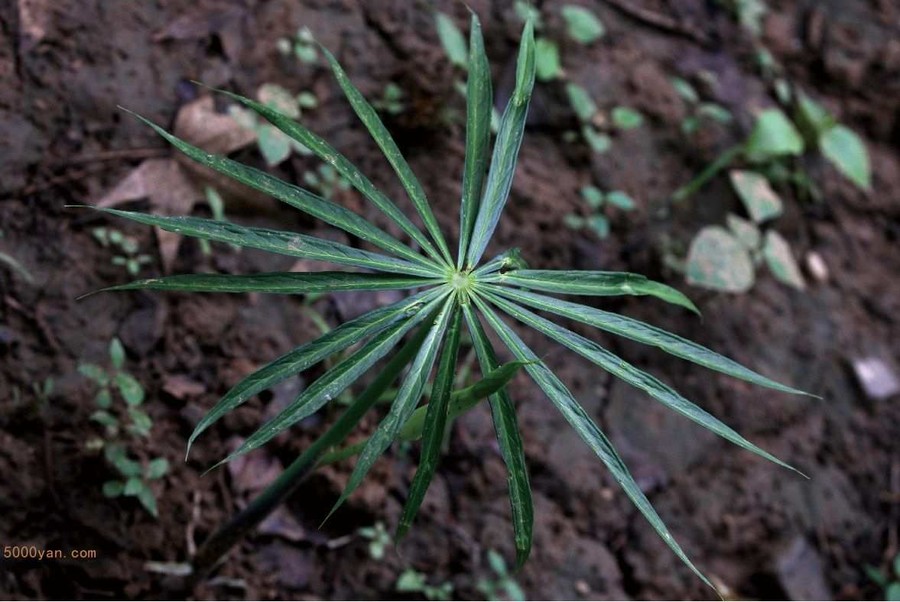
Perennial herb. Tubers nearly globose, diameter 2-5 cm. Leaves usually solitary; petiole lower part sheath-like, lower part with 2-3 membranous scale leaves; leaves radially divided, segments indefinite, radially spreading, lanceolate or oblong, sessile, apex long acuminate. Inflorescence peduncle emerging from middle part of petiole; spathe tube 3-6 cm long, greenish-white, throat truncate, margin reflexed, limb ovate-lanceolate, sometimes curved downward like a helmet, pale green to pale yellow; spadix axis completely separated from spathe; spadix bisexual or male inflorescence unisexual; bisexual inflorescence lower female part about 2 cm long with dense flowers, upper male part about 3 cm long with sparse flowers; unisexual male inflorescence 35 cm long, 3-5 mm thick; appendix extending beyond spathe throat in a zigzag upward pattern. Infructescence nearly conical, berries red when ripe, spathe withered leaving fruit exposed. Seeds yellow-red. Flowering April to May, fruiting June to September.
Habitat and Distribution
It grows in thickets, grasslands, and under forests. It is distributed in most regions of China (except Northeast China, Inner Mongolia, and Tibet).
Harvesting and Processing
Harvested in autumn and winter when the stems and leaves wither, remove fibrous roots and outer skin, then dry.
Medicinal Properties
This product is oblate-spherical in shape, 1-2 cm high and 1.5-6.5 cm in diameter. The surface is whitish or light brown, relatively smooth, with a depressed stem scar at the apex and pitted root scars around it; some tubers have small oblate-spherical lateral buds around the periphery. The texture is hard, not easily broken; the fracture is uneven, white, and powdery. Odor: slightly pungent; Taste: numbing and spicy.
Chemical Constituents
This product mainly contains L-prolyl-L-valine anhydride, L-valyl-L-valine anhydride, apigenin, pedatisectine, apigenin-6-C-arabinoside-8-C-galactoside, lysine, daucosterol, gallic acid, schaftoside,β- beta-sitosterol, etc.
Pharmacology
Expectorant; anti-tumor; sedative; anticonvulsant; antiarrhythmic; antioxidant, etc.
Properties and Channel Entry
Bitter, acrid, warm; toxic. Enters the Lung, Liver, and Spleen channels.
Functions and Indications
Disperses masses and reduces swelling. For external use to treat abscesses, swellings, and snake or insect bites.
Dosage and Administration
Oral administration: decoct in water, 3-9 g, generally used after processing, or made into pills or powder. For external use, apply an appropriate amount of the raw product, ground into powder and mixed with vinegar or wine to apply to the affected area.
Precautions and Contraindications
Contraindicated in patients with Yin deficiency and dry cough, extreme Heat, or Blood deficiency causing internal Wind; use with caution during pregnancy; caution should be exercised with internal use of the raw product.
Prescriptions
1. For headache, unilateral or bilateral migraine with pain extending to the eyes and forehead: Tian Nanxing (Arisaema) and Chuan Wu (Aconite) in equal parts, grind together into a very fine powder, mix with lotus root and scallion white (mashed into a paste), and apply to the temple area. (From *National Chinese Patent Medicine Prescription Collection* - Zhi Tong Gao). 2. For carbuncles, abscesses, and sores: Tian Nanxing (Arisaema) 60 g, Chi Xiao Dou (Adzuki Bean) 90 g, Bai Ji (Bletilla) 120 g. Grind the three ingredients into fine powder, mix evenly, adjust with cold water, apply to the swollen area around the lesion, and secure with silk. (From *Liu Juan Zi's Ghost-Bequeathed Prescriptions* - Shou Nong San). 3. For breast redness, swelling, or impending abscess formation: Grind Tian Nanxing (Arisaema) into fine powder, mix with fresh ginger juice, and apply topically; it will disperse on its own. Use immediately upon onset. (From *Bai Yi Xuan Fang*). 4. For scrofula (tuberculous lymphadenitis): Tian Nanxing (Arisaema) and Ban Xia (Pinellia) in equal parts, grind into powder, mix with rice vinegar or egg white, and apply topically. (From *Qian Zhai Jian Xiao Fang*). 5. For goiter or thyroid nodules: Use raw Tian Nan Xing (Arisaema) powder, mix with vinegar, and apply topically. (From *Wai Ke Zheng Zhi Quan Shu*).