Pinyin: Fangji
Aliases
Han Fangji, Shan Wugui, Shi Chanha.
Source
Menispermaceae plant *Stephania tetrandra* S. MooreStephania tetrandraDried root of S. Moore.
Botanical Description
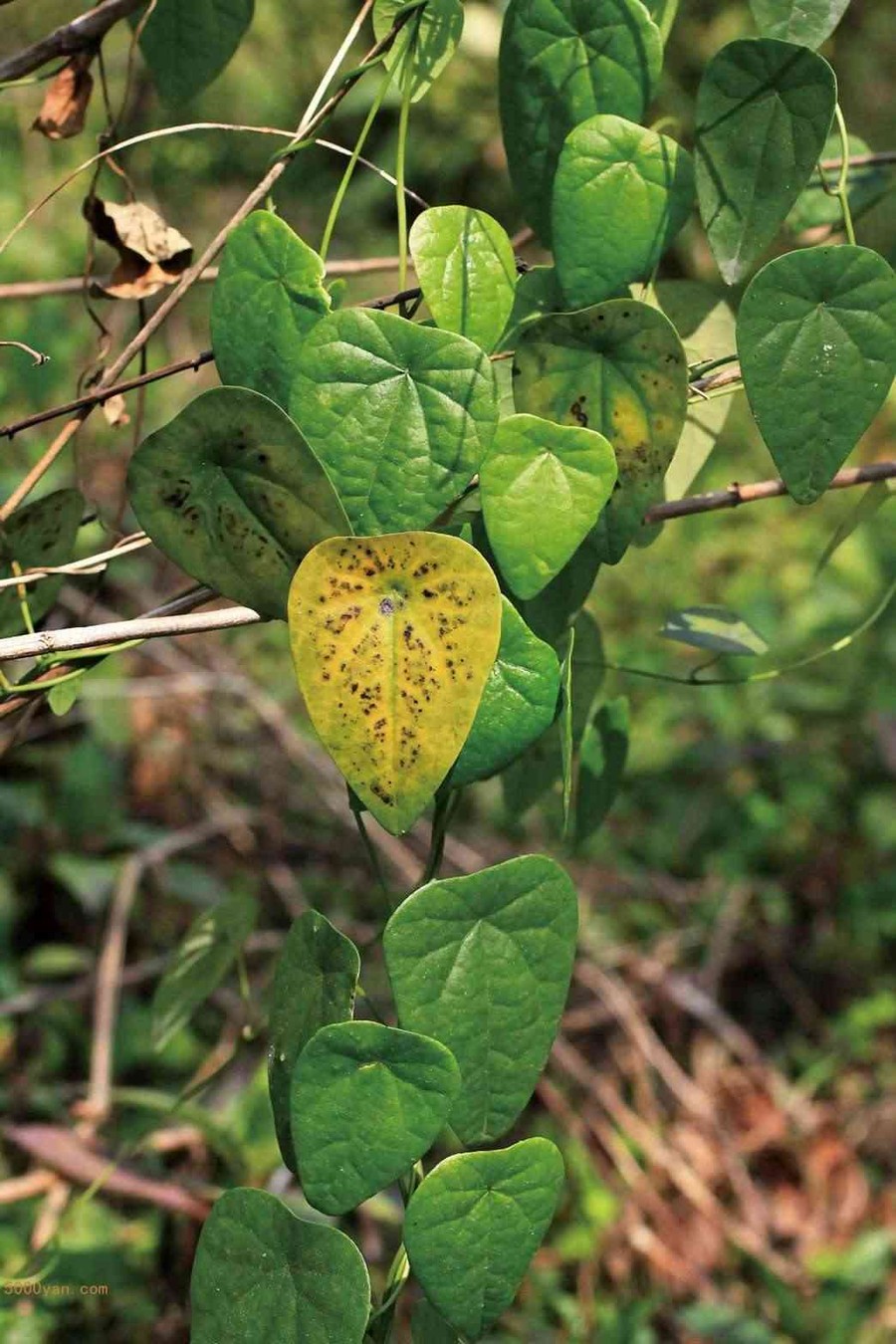
Perennial deciduous vine. Tuberous roots usually cylindrical, fleshy, penetrating deep into the soil, outer bark light brown or brownish-tan with transverse striations. Stems and branches slender, with straight striations; leaves alternate, petioles peltate; leaf blades triangular-broadly ovate or broadly triangular, apex obtuse with a small mucronate tip, base truncate or slightly cordate, margin entire, upper surface green, lower surface grayish-green or powdery white, both sides covered with short pubescence, denser on the lower surface, palmate veins 5. Flowers small, unisexual, dioecious; male plants with capitate cymes arranged in racemes; male flowers: sepals arranged in 1 whorl, green, spatulate, base cuneate; petals 4, green, obovate, fleshy, margins slightly incurved, sometimes with short claws; stamens 4, filaments fused into a column, upper part discoid, anthers attached; female plants with shortened cymes forming false heads, arranged in racemes; female flowers: sepals 4, arranged in 1 whorl; petals 4; ovary ellipsoid, styles 3, papillose. Drupe globose, red, endocarp 4-5 mm in both length and width, with 4 rows of sculpturing on the back, the middle 2 rows cristate. Flowering period May-June, fruiting period July-September.
Habitat and Distribution
Grows on hillsides, open grasslands, and in shrub forests. Distributed in Anhui, Zhejiang, Jiangxi, Fujian, Taiwan, Hubei, Hunan, Guangdong, Guangxi, and other regions.
Harvesting and Processing
Harvested in autumn, washed clean, scrape off the rough outer bark, cut into long segments, split thick roots into 2-4 pieces, and sun-dried.
Medicinal Properties
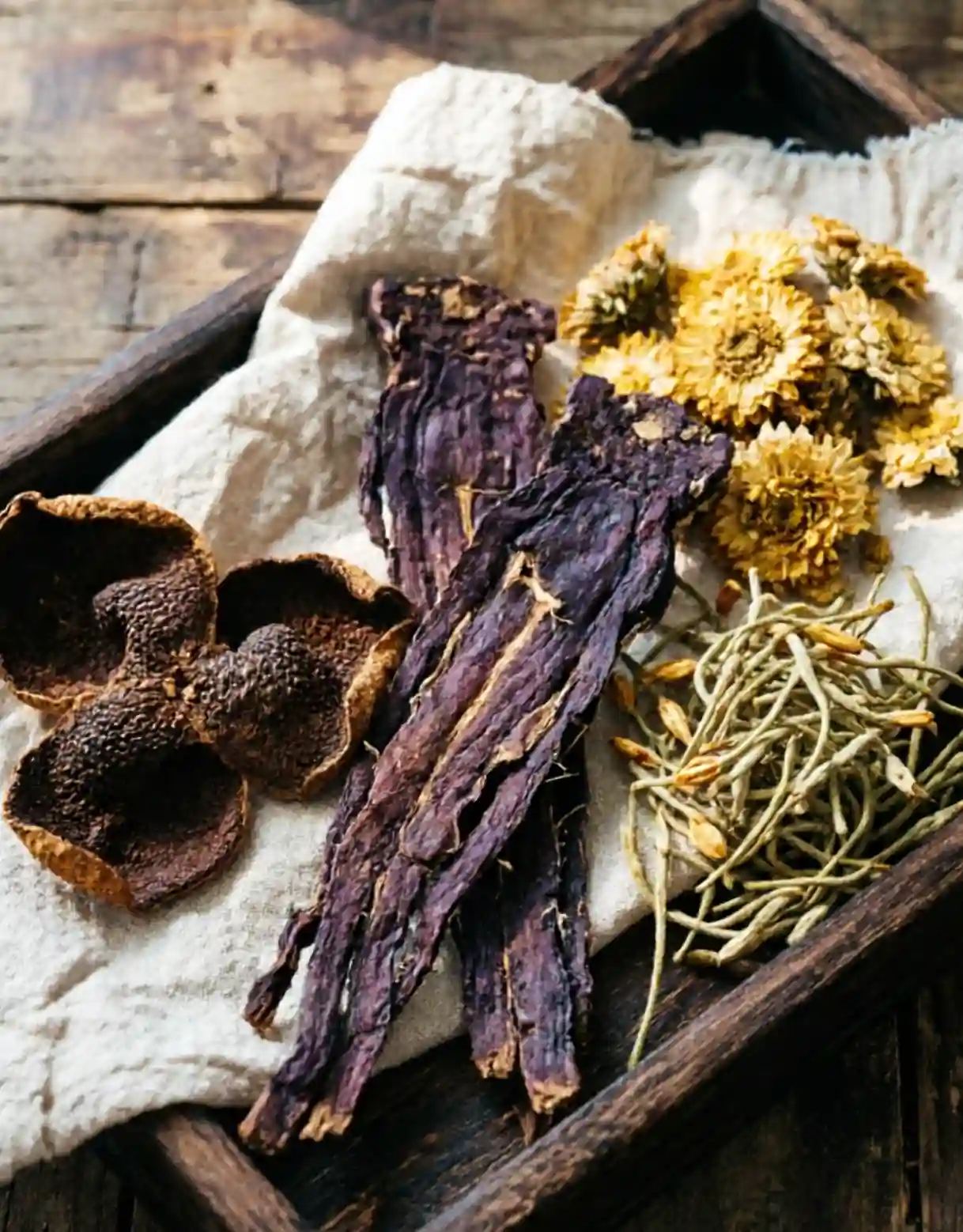
This product is irregularly cylindrical, semi-cylindrical, or lump-shaped, mostly curved, 5-10 cm long, 1-5 cm in diameter. The surface is pale grayish-yellow, often with deeply sunken transverse grooves at the bends, forming nodular, tumor-like lumps. Heavy in weight, firm in texture, the cross-section is flat, grayish-white, rich in starchy powder, with sparse radial striations. Odor: faint; Taste: bitter.
Chemical Constituents
This product primarily contains alkaloid components such as fangchinoline, tetrandrine, and fenfangjine A.
Properties and Channel Entry
Bitter, cold. Enters the Urinary Bladder and Lung channels.
Functions and Indications
Promotes diuresis to reduce edema, expels Wind and alleviates pain. Used for rheumatic arthralgia, edema and beriberi, difficult urination, eczema and sores.
Dosage and Administration
Internal: decoct in water, 6-10 g; or made into pills or powder.
Precautions and Contraindications
Contraindicated in cases of poor appetite and Yin deficiency without Dampness.
Prescriptions
1. For enuresis (bedwetting) and painful urination: Fangji (Stephania tetrandra), Kuizi (Malva verticillata seed), and Fangfeng (Saposhnikovia divaricata) 30 g each. Take the above three ingredients, add 5 sheng of water, decoct to obtain 2.5 sheng, divide into three doses. Taking as a powder is also effective. (From *Qianjin Yaofang*) 2. For bladder water accumulation causing distension, nearly forming edema: Fangji 6 g, Cheqianzi (Plantago asiatica seed), Jiucaizi (Allium tuberosum seed), and Zexie (Alisma orientale) 9 g each. Decoct in water and take orally. (From *Bencao Qieyao*) 3. For beriberi with painful swelling: Fangji, Mugua (Chaenomeles speciosa), and Niuxi (Achyranthes bidentata) 9 g each, Guizhi (Cinnamomum cassia twig) 1.5 g, and Zhiqiao (Citrus aurantium fruit) 3 g. Decoct in water and take orally. (From *Bencao Qieyao*) 4. For water distension (ascites): Fangji 30 g and Shengjiang (fresh ginger) 15 g. Stir-fry together, then decoct in water and take on a semi-empty stomach. (From *Bencao Huiyan*) 5. For epistaxis (nosebleed): Fangji (raw) 90 g, grind into a fine powder. Take 6 g per dose, mixed with freshly drawn water. For the elderly or children, mix 3 g with wine. Also, mix a small amount of powder with hot water and inhale through the nose for better effect. (From *Shengji Zonglu*)