Pinyin: Cangzhu
Aliases
Shanjing, Chishu, Xianshu
Source
The source plant is *Atractylodes lancea* (Thunb.) DC.Atractylodes lanceaDried rhizome of (Thunb.) DC.
Botanical Description
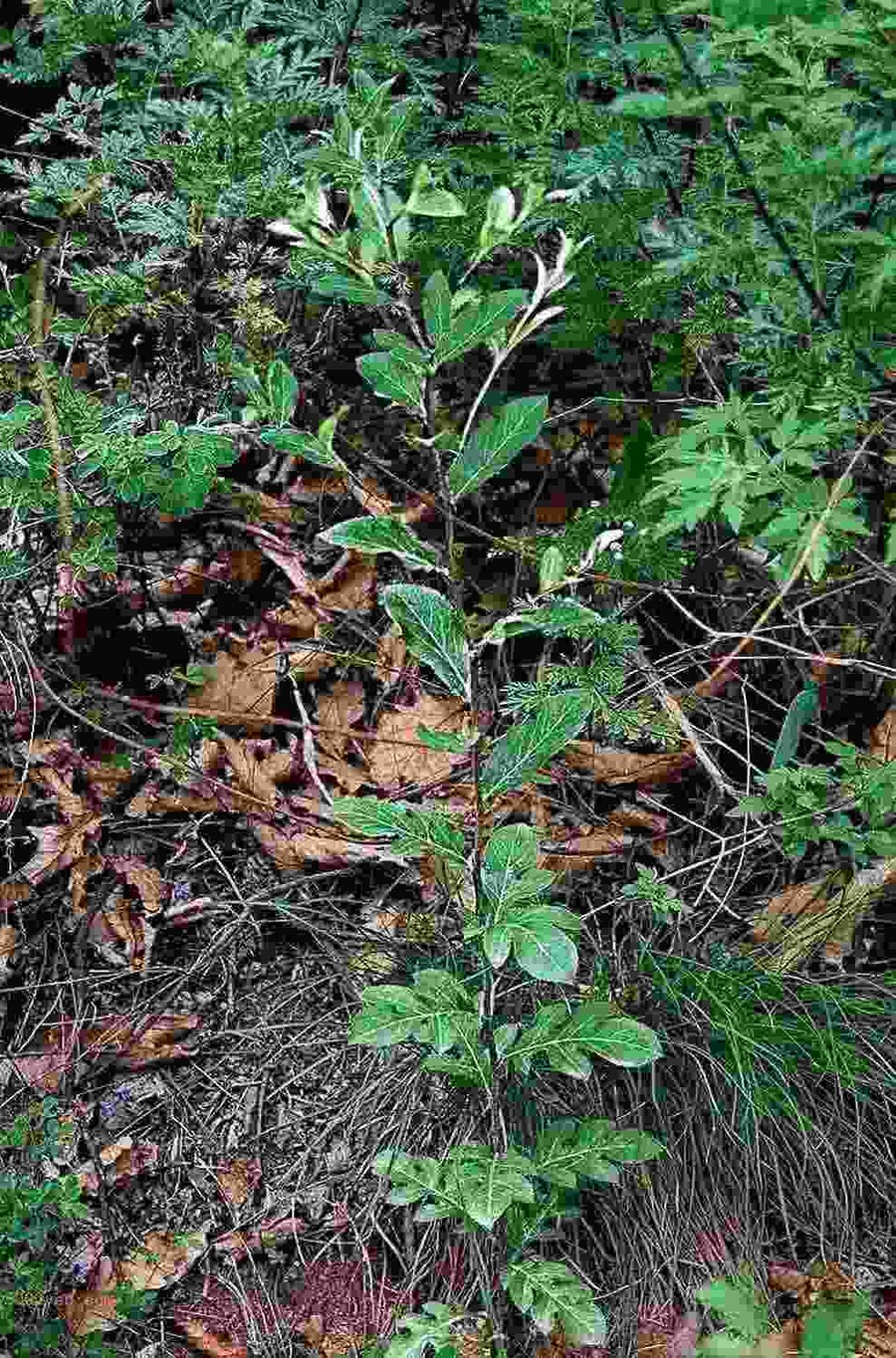
A perennial herb. Rhizome creeping, nodular. Stem multi-ridged, 30-100 cm tall, unbranched or slightly branched above. Leaves alternate, leathery; leaf blade ovate-lanceolate to elliptic, 3-8 cm long, 1-3 cm wide, apex acuminate, base attenuate, central lobe larger, ovate, margin with spinulose serrations or double serrations, upper surface dark green and glossy, lower surface pale green, veins raised, sessile, entire, or lower leaves often 3-lobed with pointed lobes. Terminal lobe very large, ovate, lateral lobes smaller, base cuneate, sessile or petiolate. Capitula terminal on stems and branches, bracts in 1 series, leaf-like, pinnately parted with spinulose segments; involucre cylindrical, phyllaries in 5-8 series, ovate to lanceolate, ciliate; florets numerous, bisexual or unisexual, often dioecious; corolla tubular, white or slightly reddish, about 1 cm long, slightly expanded above, apex 5-lobed, lobes linear; bisexual florets with many pinnately divided pappus; unisexual florets usually female, with 5 linear staminodes, apex slightly curled. Achenes obovate, densely covered with yellowish-white hairs. Flowering August to October, fruiting September to December.
Habitat and Distribution
It grows on hillside thickets and grasslands. It is distributed in Shandong, Jiangsu, Anhui, Zhejiang, Jiangxi, Henan, Hubei, Sichuan, and other regions, and is widely cultivated in many places.
Harvesting and Processing
Harvested in spring and autumn, remove mud and sand, dry in the sun, and rub off the fibrous roots.
Medicinal Properties
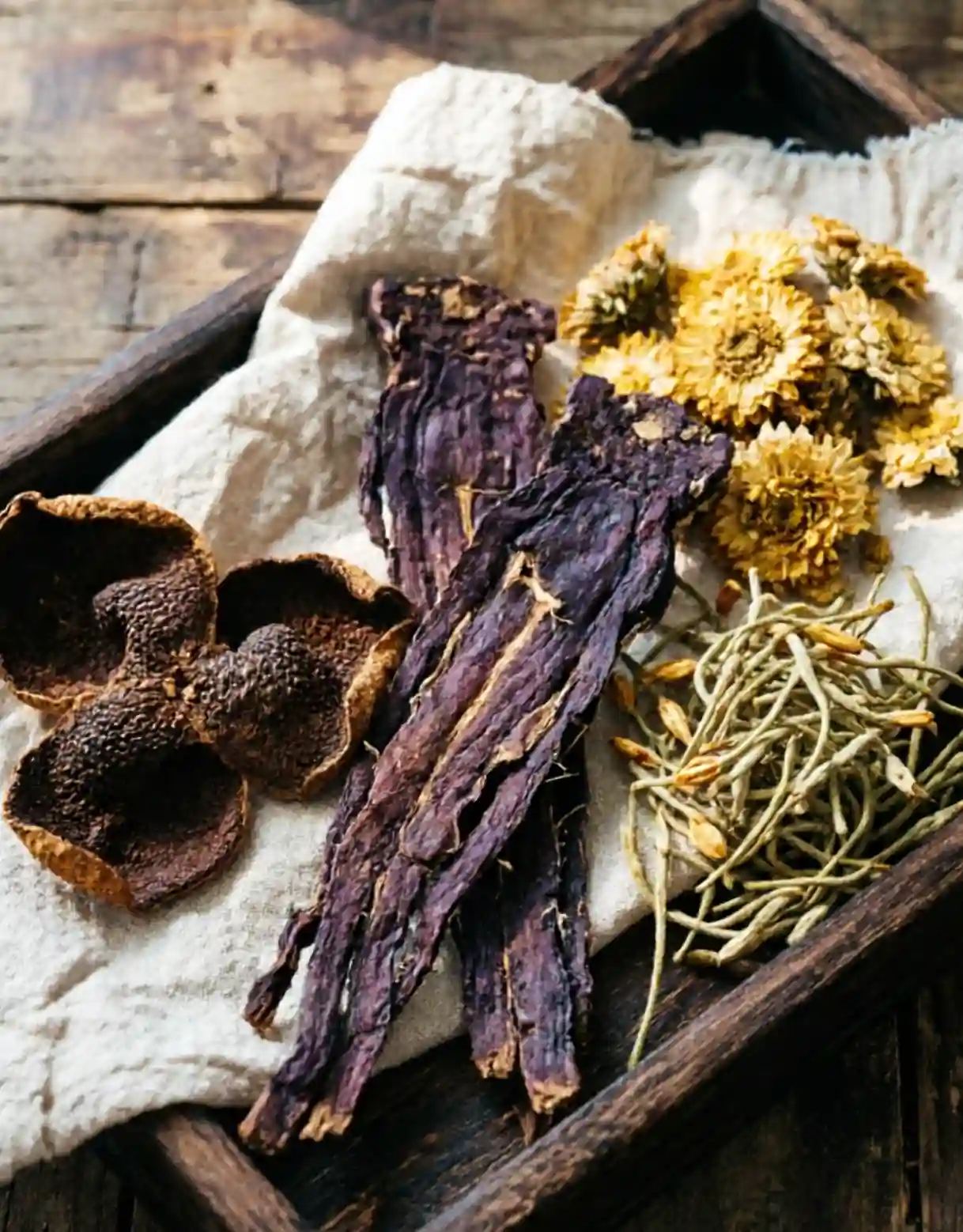
The rhizome is irregularly nodular or slightly bead-like cylindrical, sometimes curved. Usually unbranched, 3-10 cm long, diameter 1-2 cm. Surface yellowish-brown to grayish-brown, with fine longitudinal grooves, wrinkles, and a few residual rootlets; nodes often have constricted shallow transverse indentations, internodes have circular stem scars, often with residual stem base at one end, occasionally stem scars, sometimes with white flocculent crystals precipitated on the surface. Texture firm, easy to break; fracture slightly uneven, off-white or yellowish-white, scattered with numerous orange-yellow or brownish-red oil cavities (commonly known as "cinnabar dots"), which may precipitate fine white needle-like crystals upon prolonged exposure. Odor: characteristic aromatic; Taste: slightly sweet, bitter, and acrid.
Chemical Constituents
This product contains atractylodin, 2-carene, atractylenolide, patchoulene, elemene, acetylatractylodinol, and dehydrocostuslactone among other components.
Pharmacology
Anti-gastritis, anti-gastric ulcer; regulates gastrointestinal motility; protects against liver damage; anti-hypoxia; blocks nicotinic receptors.
Properties and Channel Entry
Acrid, bitter, and warm. Enters the Spleen, Stomach, and Liver channels.
Functions and Indications
Dries Dampness and strengthens the Spleen, expels Wind and disperses Cold, brightens the eyes. Used for Dampness obstructing the Middle Jiao, epigastric and abdominal distention and fullness, diarrhea, edema, beriberi with flaccidity, Wind-Damp Bi pain, Wind-Cold common cold, night blindness, and blurred vision with dry eyes.
Dosage and Administration
Internal: decoct in water, 3-9 g; or made into pills or powder.
Precautions and Contraindications
For internal use: decoct 3-10 g.
Prescriptions
1. For treating dampness-related body pain: Cangzhu, soak in rice-washed water, slice, decoct in water, take the concentrated juice and make into a paste. Take with plain boiled water. (Jianbian Danfang) 2. For treating bone and tendon pain due to damp-heat: Huangbai (stir-fried), Cangzhu (soaked in rice-washed water and stir-fried). Grind the two ingredients into powder, mix with boiling water and ginger juice. Both substances have strong and vigorous properties; for those with exterior excess and qi excess, add a little wine to assist. (Danxi Xinfa, Ermiao San) 3. For treating morning diarrhea: Cangzhu 60 g, Xiaojiao 30 g (remove the eyes, stir-fried). Grind into very fine powder, form into pills with vinegar paste, the size of wutong seeds. Take 30 pills each time, before meals, with warm water. (Baoming Ji, Jiaozhu Wan) 4. For treating summer sudden diarrhea, strengthening the Spleen and warming the Stomach, promoting appetite, and treating food damage with chest and abdominal fullness: Shenqu (stir-fried), Cangzhu (soaked in rice-washed water overnight, dried over fire) each equal parts, grind into powder. Form into pills with flour paste, the size of wutong seeds. Take 30 pills each time, regardless of meal times, swallow with rice water. (Jufang, Quzhu Wan) 5. For tonifying deficiency, brightening the eyes, strengthening bones and harmonizing the blood: Cangzhu (soaked in rice-washed water) 120 g, Shudihuang (dried over fire) 60 g. Grind into powder, form into pills with wine paste, the size of wutong seeds. Take 30-50 pills each time with warm wine, three times daily. (Puji Fang)