Pinyin: Guanzhong
Aliases
Guanjie, Hujuan, Yaozao, Fengweicao.
Source
Dryopteridaceae family plant *Dryopteris crassirhizoma* Nakai.Dryopteris crassirhizomaNakai's dried rhizome and petiole base.
Botanical Description
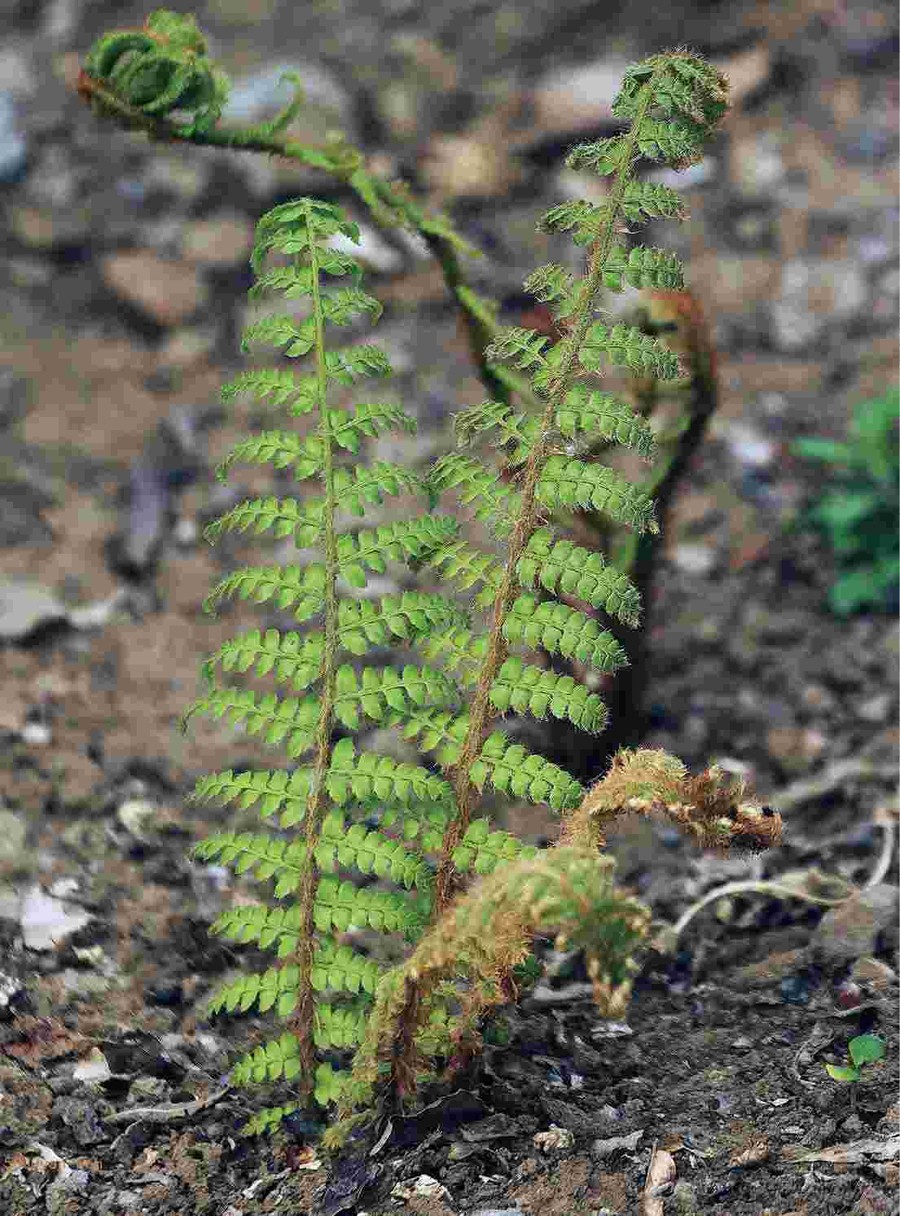
Perennial herb, 50-100 cm tall. Rhizome thick, oblique, with numerous hard petiole remnants and black fine roots, densely covered with brown, long-lanceolate large scales. Leaves clustered at the rhizome apex; petiole base to rachis densely covered with brown linear to subulate narrow scales, leaf blade herbaceous, oblanceolate, 60-100 cm long, 20-25 cm wide slightly above the middle, bipinnatisect or bipinnatifid, pinnae sessile, segments closely arranged, oblong, rounded or truncate at apex, subentire or with blunt serrations at apex; upper surface dark green, lower surface pale green, lateral veins pinnately branched. Fertile leaves similar to sterile leaves. Sori borne on pinnae above the middle of the leaf, on the lower side of small veins below the middle, indusium reniform or orbicular-reniform, brown.
Habitat and Distribution
It grows in swampy areas under forests or in shady, moist places under forests at altitudes of 300-1200 m. It is distributed in Northeast China, Inner Mongolia, Hebei, and Beijing.
Harvesting and Processing
Harvest in autumn, dig up, remove leaf stalks, fibrous roots, and soil sediment, then dry in the sun.
Medicinal Properties
The whole body is slightly conical in shape, resembling a pineapple, 10-20 cm long, 4.5-8 cm in diameter, with a surface densely covered with neat remnants of petiole bases and yellowish-brown membranous scales, along with curved fibrous roots. The petiole remnants are flat-cylindrical and slightly curved. The texture is hard, the broken surface is brown, with 5-10 (-13) small vascular bundles near the edge arranged in a ring. After peeling off the petiole remnants, the rhizome is visible, with a hard texture and a cross-section showing 5-13 yellowish-white vascular bundles arranged in a ring. The odor is distinctive, and the taste is slightly astringent and bitter.
Chemical Constituents
This product primarily contains chemical constituents such as filicic acid, flavaspidic acid, albaspidin, dryocrassin, diploptene, and adianton.
Pharmacology
Has anthelmintic effect; can stimulate isolated uterus; can counteract early pregnancy and induce abortion; exhibits estrogen-like effects, and has anti-tumor, anti-pathogenic microorganism, and other effects.
Properties and Channel Entry
Bitter, slightly cold, with mild toxicity. Enters the Liver and Stomach channels.
Functions and Indications
Clears Heat and resolves toxicity, stops bleeding, and kills parasites
Dosage and Administration
Internal use: decoction, 5-15 g; or in pill or powder form
Precautions and Contraindications
Caution for Spleen and Stomach deficiency-cold, Yin deficiency with internal Heat, and pregnant women.
Prescriptions
1. Prevention of colds and influenza: For adults, take 9 g of *Dryopteris crassirhizoma* and an appropriate amount of licorice (or 4.5 g each of *Dryopteris crassirhizoma* and *Morus alba* leaves) each time. Prepare as a granular infusion. Infuse with boiling water and take twice a week for 4 consecutive months (from October to January of the following year). [*Chinese Herbal Medicine Communications* 1973, (6): 40] 2. Treatment of enterobiasis (pinworm infection): Take 9-12 g of *Dryopteris crassirhizoma*. Decoct in water for oral administration. Additionally, use 30 g of *Dryopteris crassirhizoma* decocted in water to wash the anus before bedtime. (*Shaanxi Chinese Herbal Medicine*) 3. Treatment of acute mastitis (before suppuration): Grind *Dryopteris crassirhizoma* alone into a fine powder. Apply externally to the affected area. It may also be taken orally. (*Puji Prescriptions*) 4. Treatment of tinea (ringworm): Take equal parts of *Dryopteris crassirhizoma*, *Evodia rutaecarpa*, and *Cinnamomum cassia* bark. Grind into a fine powder. First, scratch the lesion with the fingers, then apply the powder, or mix with vinegar for topical application. (*Baiyi Selected Prescriptions*)