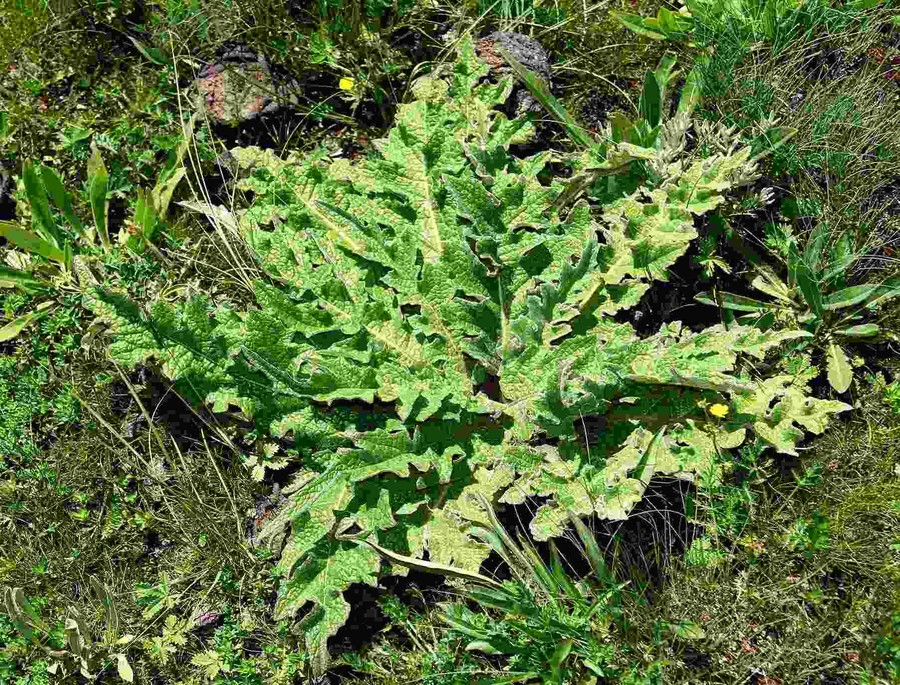
Pinyin: Chuanmuxiang
Aliases
Muxiang
Source
1. For pneumonia: Renshen 6 g, decoct in water and take orally. Internal use: decoct 3-10 g, large dose 10-30 g.Vladimiria souliei(Franch.) Ling. dried root.
Botanical Description
Perennial herb. Taproot cylindrical, 1-2 cm in diameter, outer bark brown, rarely branched. Nearly stemless. Leaves basal, forming a rosette flat on the ground; petiole 8-20 cm long, covered with white pubescence; leaf blade ovate, oblong-lanceolate or elliptic, 12-30 cm long, 8-20 cm wide, pinnately parted or lobed, rarely undivided, with 5-7 pairs of lobes, ovate-lanceolate, margin serrate, with small lobes at base. Both surfaces strigose, sparsely arachnoid and glandular beneath. Capitula 6-8, densely clustered; involucre broadly campanulate, 6 cm in diameter, phyllaries in 6 series, all bracts rigid, apex caudate-acuminate and spinose, margin sparsely ciliate; florets tubular, corolla purple, 35-40 mm long, limb 1 cm long, 5-lobed, lobes 6 mm long, tube 3 cm long; stamens 5, anthers sagittate, apex with a long tail; ovary inferior. Achenes cylindrical, with persistent pappus; pappus bristles, tapering upward, pale brownish-yellow, outer series curled downward, reflexed, closely appressed to the achene, inner series erect. Flowering and fruiting from July to October.
Habitat and Distribution
Grows in alpine grasslands at elevations of 3700-3800 m. Distributed in Sichuan, Xizang (Tibet) and other regions.
Habitat and Distribution
Grows in alpine grasslands at elevations of 3700-3800 m. Distributed in Sichuan, Xizang (Tibet) and other regions.
Harvesting and Processing
Harvested in autumn, remove fibrous roots, sediment, and gelatinous material from the root head, then dry.
Medicinal Properties
The product is cylindrical or semi-cylindrical with longitudinal grooves, slightly curved, 10-30 cm long, diameter 1-3 cm. The surface is yellowish-brown or brownish-brown, with longitudinal wrinkles, and where the outer bark has peeled off, fine veins resembling a loofah sponge are visible; occasionally, the root head has a black, sticky, gelatinous substance, commonly known as "oil head." The texture is relatively light, hard and brittle, easily broken; the fracture surface is yellowish-white or yellow, with scattered deep yellow oily spots and fissures; the xylem is broad with radial striations; some centers appear withered and decayed. Odor: faintly aromatic; Taste: bitter, sticky when chewed.
Chemical Constituents
This product primarily contains volatile oils, including dehydrocostuslactone and guaia-4(15),10(14),11(13)-triene-12,6.α- Internal use: lactone, 3β- Acetoxyguai-4(15),10(14),11(13)-trien-12,6α- Lactones, germacra-1(10)E,4E,11(13)-triene-12,6α- lactones and other constituents.
Properties and Channel Entry
Pungent, bitter, and warm. Enters the Spleen, Stomach, Large Intestine, and Gallbladder channels.
Functions and Indications
Relieves Qi stagnation and alleviates pain. Used for distension and pain in the chest, hypochondrium, and epigastric region, borborygmus and diarrhea, and tenesmus.
Usage
Dosage
Oral: decocted in water, 1.5-9 g, to be added later in the decoction; ground into powder, 0.5-0.9 g.