Pinyin: Jingdaji
Aliases
Hongya Daji, Zi Daji, Xiama Xian, Daji.
Source
Plant of the family Euphorbiaceae, genus *Euphorbia*Euphorbia pekinensisThe dried root of Rupr.
Botanical Description
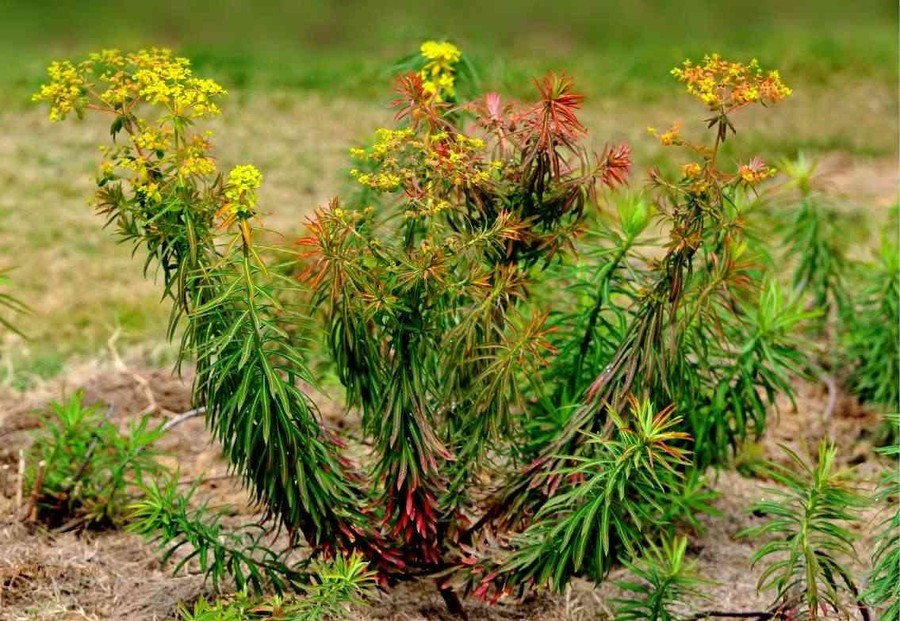
Perennial herb, 30-90 cm tall. Whole plant contains white latex. Root robust, conical, with lateral roots; stem branched from upper part, surface covered with white short pubescence. Leaves alternate, nearly sessile; blade narrowly oblong-lanceolate, apex obtuse or acute, base attenuate, margin entire, with prominent midvein, glabrous above, hairy along midvein beneath. Cyathium terminal or axillary, terminal ones usually 5, arranged in compound umbels; base with 5 leaf-like bracts; each branch further branched 2 to several times, with 4 or 2 nearly rounded bract leaves at branching points, opposite; axillary ones with solitary peduncle; bract leaves ovate-oblong, apex acute; involucre of cyathium campanulate or turbinate, 4-5-lobed, glands 4-5, oblong, fleshy, hairy at base inside, with membranous oblong appendage between two glands; male and female flowers both without perianth; male flowers numerous, filament base slightly thicker than pedicel, with joint between them, anther spherical, transversely dehiscent; female flower 1; style apex 2-lobed. Capsule trigonous-globose, densely covered with verrucose spines. Seed ovoid, smooth. Flowering June to September, fruiting July to October.
Habitat and Distribution
Grows on mountain slopes, roadsides, wastelands, grasslands, forest edges, and under sparse forests. Distributed throughout China except in Xinjiang, Guangdong, Hainan, Guangxi, Yunnan, and Tibet.
Harvesting and Processing
Harvested in autumn and winter, washed clean, and dried in the sun.
Medicinal Properties
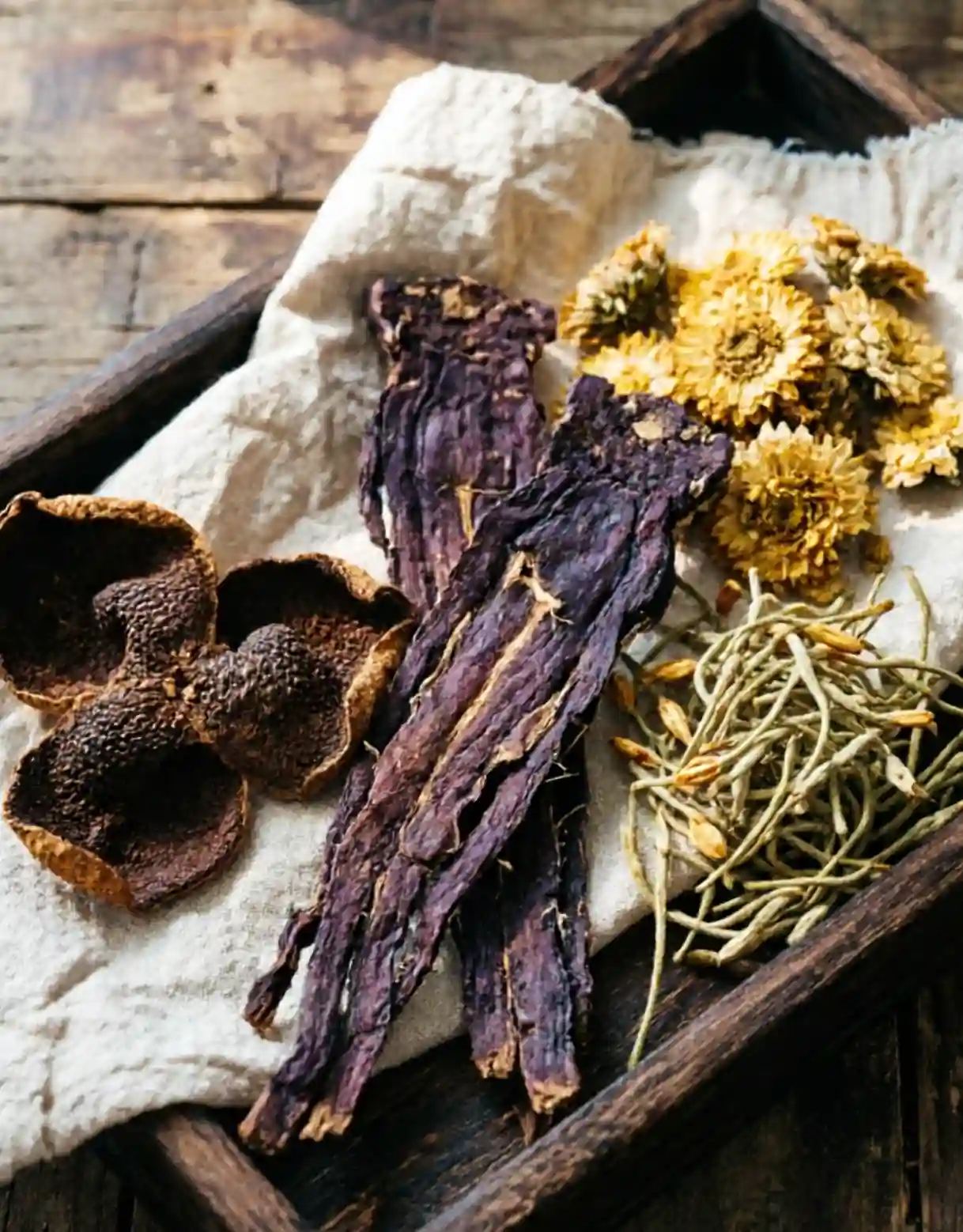
The root is irregularly long-conical, slightly curved, often with branches, 10-20 cm long, 1-4 cm in diameter; the root crown often shows stem remnants and bud scars, the surface is grayish-brown or brownish, rough, with longitudinal grooves and transverse lenticels, lateral roots are few and twisted, texture is hard, not easily broken, the fracture surface is brownish-yellow or off-white, fibrous. Odor: faint; Taste: slightly bitter and astringent.
Chemical Constituents
This product mainly contains euphorbone, alkaloids, euphorbia pigment A, and euphorbia pigment B.
Pharmacology
Has cathartic, diuretic, and antihypertensive effects; can stimulate isolated pregnant uterus. Toxic, with strong irritant properties.
Properties and Channel Entry
Bitter, cold, toxic. Enters the Lung, Spleen, and Kidney channels.
Functions and Indications
Internal use: decoct 3-10 g. For external use: appropriate amount, grind into powder and apply to the affected area.
Dosage and Administration
Oral administration: decoct in water, 0
Precautions and Contraindications
Contraindicated in patients with deficiency-cold yin-type edema and in pregnant women. Use with caution in weak individuals. Should not be used together with Gancao (Glycyrrhizae Radix et Rhizoma).
Prescriptions
1. For abdominal distension as hard as stone, or scrotal swelling: *Jing Daji* (root of *Euphorbia pekinensis*), *Yuanhua* (flower bud of *Wikstroemia chamaedaphne*), *Gansui* (root of *Euphorbia kansui*), and *Haizao* (thallus of *Sargassum*), equal parts. Grind into powder, mix with vinegar for topical application, or mix with white flour to apply on the lower abdomen; first chew *Gancao* (root of *Glycyrrhiza uralensis*) with warm water, then apply the medicine on the abdomen. (From *Chishui Xuanzhu*). 2. For jaundice with difficult urination: *Jing Daji* 30 g, *Yinchen* (herb of *Artemisia capillaris*) 60 g, soak in water and take on an empty stomach. (From *Bencao Huiyan*, citing Da's formula). 3. For wind-induced urticaria: *Jing Daji* powder 90 g, boil with 2 dou (liters) of water down to 1 sheng (liter), then apply the decoction topically. (From *Sheng Hui Fang*). 4. For lymph node tuberculosis: *Jing Daji* 60 g, 7 eggs. Place the herb and eggs together in a clay pot, boil with water for 3 hours, remove the eggs, eat 1 egg each morning, 7 days as one course of treatment. (From *Selected Materials of the National New Chinese Medicine Therapy Exhibition*). 5. For toothache with loosening: Bite *Jing Daji* on the painful area, effective. (From *Compendium of Materia Medica*, citing *Sheng Sheng Bian*).