Pinyin: Dangshen
Aliases
Shangdang Renshen, Fangfeng Dangshen, Shitou Shen, Huang Shen.
Source
Plant of the family Campanulaceae, Codonopsis pilosulaCodonopsis pilosulaDried root of (Franch.) Nannf.
Botanical Description
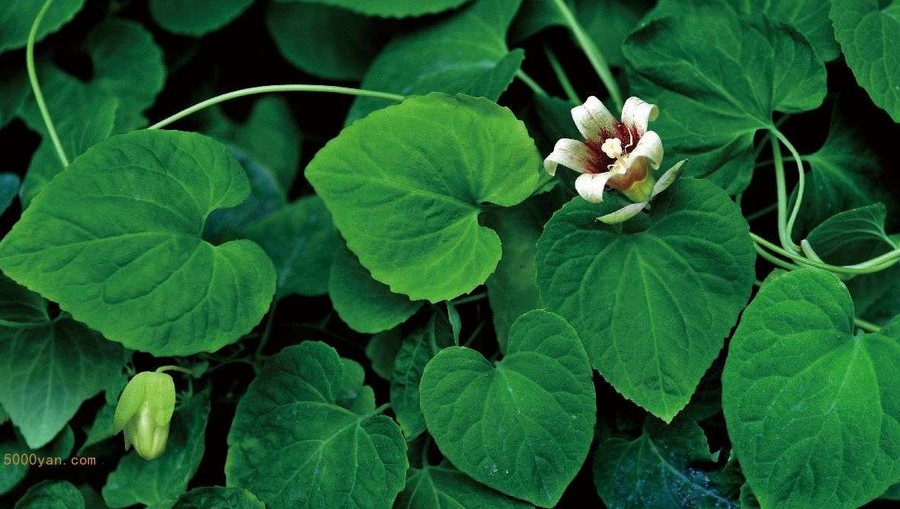
A perennial herb. Root cylindrical, 1-1.7 cm in diameter, with an enlarged root crown at the apex bearing numerous tuberous stem scars; outer bark milky yellow to pale grayish brown, with longitudinal and transverse wrinkles. Stem twining, long and much branched, sparsely covered with white coarse stiff hairs on the lower part; upper part smooth or nearly smooth. Leaves opposite, alternate, or falsely whorled; petiole 0.5-2.5 cm long; leaf blade ovate to broadly ovate, 1-7 cm long, 0.8-5.5 cm wide, apex obtuse or acute, base truncate or shallowly cordate, margin entire or slightly undulate, upper surface green, with coarse appressed hairs, lower surface pale green, sparsely pubescent. Flowers solitary, pedicel slender; calyx green, lobes 5, oblong-lanceolate, 1-2 cm long, apex obtuse, smooth or slightly downy; corolla broadly campanulate, 2-2.5 cm in diameter, pale yellowish green with pale purplish violet spots, apex 5-lobed, lobes triangular to broadly triangular, erect; stamens 5, filaments expanded below the middle; ovary inferior, 3-loculed, style short, stigma 3, very broad, funnel-shaped. Capsule conical, with persistent calyx. Seeds small, ovoid, brown, glossy. Flowering period August to September, fruiting period September to October.
Habitat and Distribution
This is a description of habitat and distribution, not a prescription
Harvesting and Processing
Harvest in autumn, dig out, wash clean, and sun-dry.
Medicinal Properties
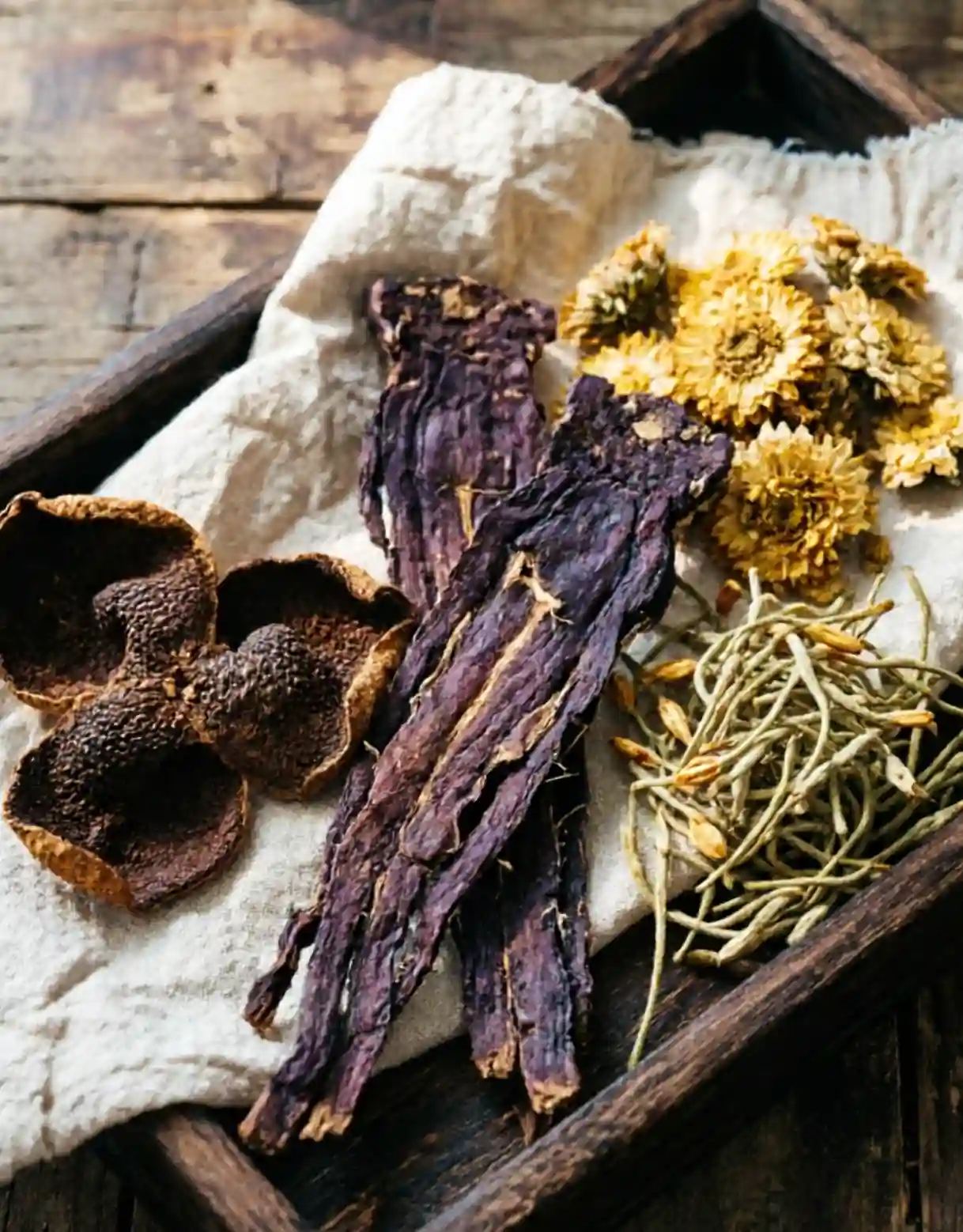
This product is long cylindrical, slightly curved, 10-35 cm long, 0.4-2 cm in diameter. The surface is yellowish-brown to grayish-brown, with multiple wart-like protruding stem scars and buds at the root head, each stem scar having a sunken dot-like apex; below the root head there are dense annular transverse striations, gradually becoming sparse downward, some reaching half the length, cultivated products have few or no annular transverse striations; the entire body has longitudinal wrinkles and scattered transverse elongated lenticel-like protrusions, often with blackish-brown gelatinous material at the broken ends of branch roots. The texture is slightly hard or somewhat tough, the cut surface is slightly flat, with fissures or radial striations, the cortex is pale yellowish-white to pale brown, the xylem is pale yellow. It has a special aromatic odor and a slightly sweet taste.
Chemical Constituents
This product mainly contains carbohydrates, amino acids, and also contains syringin, n-hexyl-β-D-pyranoglucoside, taraxasterol, and friedelin and other constituents.
Studies have shown that Codonopsis pilosula exhibits a variety of pharmacological effects
Enhances the body's stress response and immune function, delays aging, and has anti-ulcer effects. It can increase the tension and strengthen contractions of isolated guinea pig and rabbit intestines, and can antagonize intestinal spasms induced by 5-hydroxytryptamine, but has no significant effect on those induced by acetylcholine. It significantly reduces spontaneous activity in mice and prolongs the sleep time induced by sodium pentobarbital or cyclobarbital. It can improve or enhance the acquisition and consolidation of memory in mice, as well as reverse memory acquisition disorders caused by anisodine. It increases red blood cell count and hemoglobin levels in rabbits while decreasing total white blood cell count. It also has anti-tumor, hyperglycemic, and antibacterial effects.
Properties and Channel Entry
Sweet, neutral. Enters the Spleen and Lung channels.
Functions and Indications
Strengthens the Spleen and benefits the Lungs, nourishes Blood and generates body fluids. Used for Spleen and Lung deficiency weakness, poor appetite and fatigue, cough and deficient panting, Qi and Blood insufficiency, sallow complexion, palpitations and shortness of breath, body fluid damage with thirst, and internal Heat wasting-thirst.
Dosage and Administration
Oral: decocted in water, 6-15 g; or prepared as an extract, pill, or powder
Precautions and Contraindications
Contraindicated in excess patterns and heat patterns; in patterns of righteous deficiency with pathogenic excess, should not be used alone; incompatible with Lilu (Veratrum nigrum).
Prescriptions
1. For clearing Lung Qi, tonifying Primordial Qi, opening the voice, and strengthening sinews and strength: Dangshen (soft and sweet variety, sliced) 500 g, Shashen (sliced) 250 g, Longan Aril 120 g. Decoct in water to a thick decoction, until drops form pearls, store in a porcelain container. Take one wine cup each time on an empty stomach, rinsed down with boiling water, or can be added to other decoctions. (Shangdangshen Gao from De Pei Ben Cao). 2. For pediatric spontaneous sweating: use Dangshen 30 g, Huangqi 20 g daily. Decoct in water to 50 ml, take in 3 divided doses; for children under 1 year old, reduce by half. [Jiangsu Journal of Traditional Chinese Medicine, 1988, (9): 25]. 3. For damage to the Spleen and Stomach due to taking cold and harsh purgative drugs, resulting in mouth and tongue sores: Dangshen (dry-fried), Huangqi (honey-fried) each 6 g, Fuling 3 g, Gancao (raw) 1.5 g, Baishao 2.1 g. Decoct in plain water and take warm. (Shenqi Anwei San from Hou Ke Zi Zhen Ji). 4. For pediatric oral sores: Dangshen 30 g, Huangbai 15 g. Grind together into a fine powder and blow or apply to the affected area. (Qinghai Province Chinese Medicine Verified Prescriptions Compilation). 5. For prolapse of the rectum: Dangshen 30 g, Shengma 9 g, Gancao 6 g. Decoct in water twice, take once in the morning and once in the evening. (National Compilation of Chinese Herbal Medicine).