Pinyin: Tianma
Aliases
Chijian, Dingfengcao, Shencao, Shuiyangyu
Source
1. For pneumonia: Renshen 6 g, decoct in water and take orally.Gastrodia elataB1. dried tuber.
Botanical Description
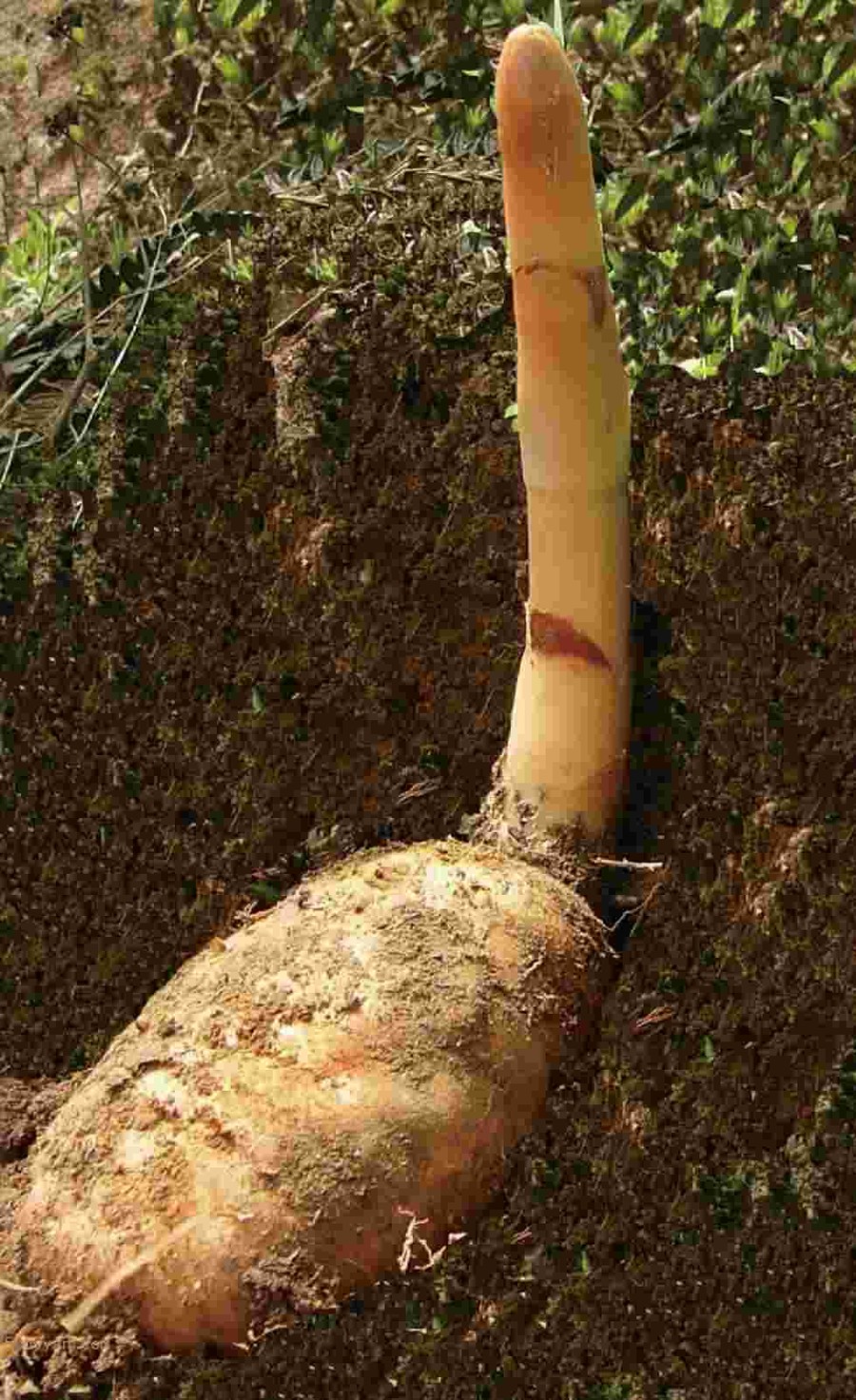
A perennial parasitic herb, 60-100 cm tall. The entire plant lacks chlorophyll. The tuber is thick and fleshy, oblong, about 10 cm long, 3-4.5 cm in diameter, with indistinct nodes. The stem is cylindrical, yellowish-red. The leaves are scale-like, membranous, 1-2 cm long, with fine veins, and the lower part forms a short sheath clasping the stem. The raceme is terminal, 10-30 cm long, with yellowish-red flowers; the pedicel is short, 2-3 mm long; the bracts are membranous, narrowly lanceolate or linear-oblong; the perianth tube is obliquely urceolate, with an oblique mouth, slightly swollen on the lower side at the base, apex 5-lobed, lobes small, triangular; the lip is 2/3 higher than the perianth tube, with 3 lobes, the central lobe larger, with its base forming a short stalk-like structure inside the perianth tube; the column is 5-6 mm long, with 2 small appendages at the apex; the ovary is obovate, with a twisted ovary stalk. The capsule is oblong to oblong-obovate, about 15 mm long, with a short pedicel. The seeds are numerous and small, dust-like. Flowering period is June to July, fruiting period is July to August.
Habitat and Distribution
Native to shaded, damp areas under forests with thick humus at altitudes of 1200-1800 m. Distributed in Jilin, Liaoning, Hebei, Shaanxi, Gansu, Anhui, Henan, Hubei, Sichuan, Guizhou, Yunnan, and Xizang. Now mostly artificially cultivated.
Harvesting and Processing
Harvested from after the Beginning of Winter to before Qingming of the following year, immediately wash clean, steam thoroughly, spread open and dry at low temperature.
Medicinal Properties
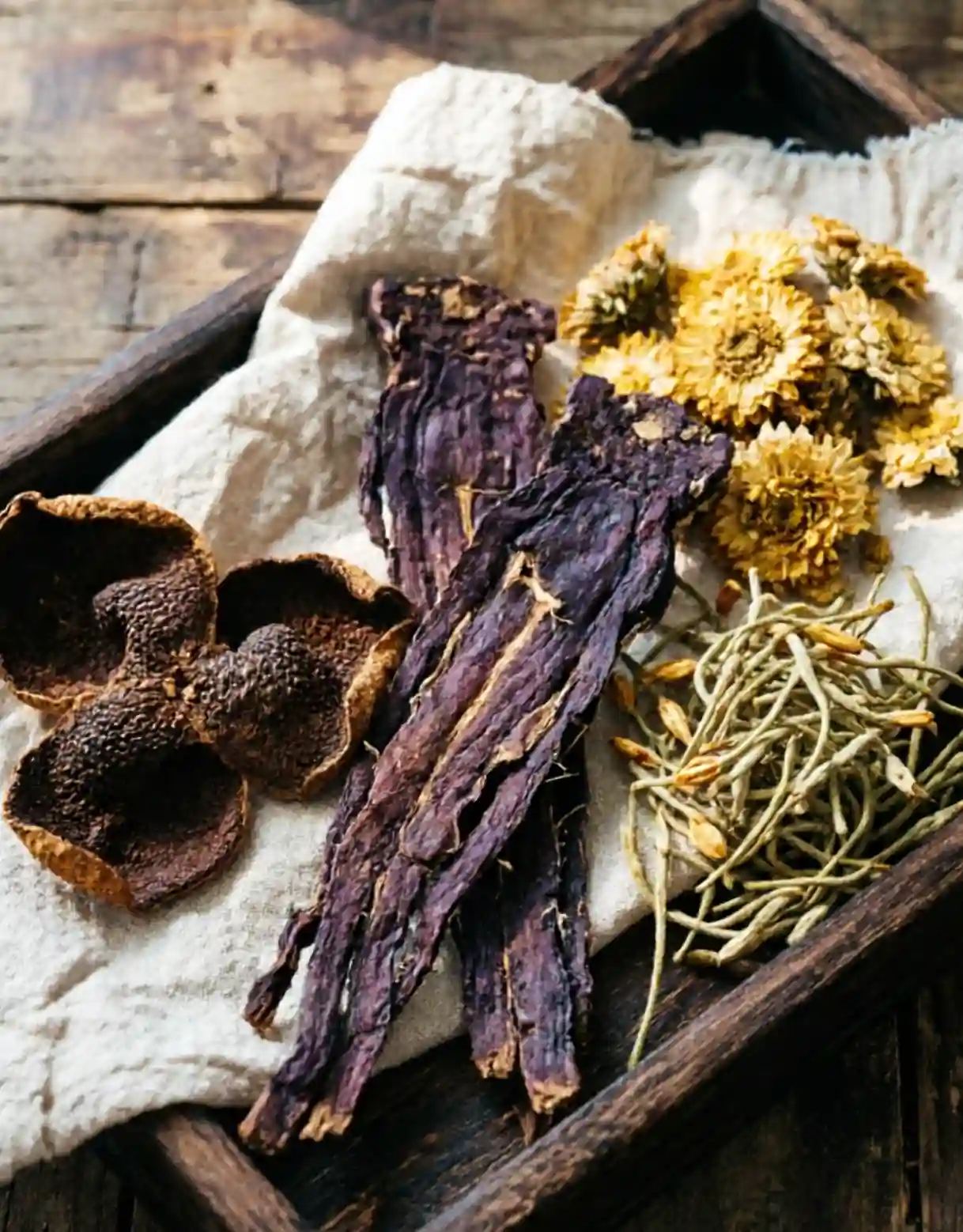
This herb is oval or oblong in shape, slightly flattened, wrinkled and somewhat curved, 3-15 cm long, 1.5-6 cm wide, and 0.5-2 cm thick. The surface is yellowish-white to pale yellowish-brown, with longitudinal wrinkles and multiple rings of transverse wrinkles formed by latent buds, sometimes with brownish-black fungal strands visible. The apex has a red-brown to dark brown parrot-beak-shaped bud or residual stem base; the other end has a circular navel-like scar. The texture is hard, not easily broken; the fracture surface is relatively flat, yellowish-white to pale brown, and horny. Odor: faint; Taste: sweet.
Chemical Constituents
This product mainly contains gastrodin, gastrodioside, gastrodine nucleotide, daucosterol, parishin A, and adenosine.
Pharmacology
Sedative; anticonvulsant; anti-inflammatory and analgesic; enhances immune function; delays aging; inhibits platelet aggregation, protects myocardial cells.
Properties and Channel Entry
Sweet, neutral. Enters the Liver channel.
Functions and Indications
Extinguishes Wind and stops spasms, calms the Liver Yang, expels Wind and unblocks the collaterals. Used for infantile convulsions, epilepsy with convulsions, tetanus, headache and dizziness, limb paralysis, numbness of the extremities, and Wind-Damp impediment pain.
Dosage and Administration
Oral administration: decoct 3-10 g in water, or take in pill or powder form; when taken as powder, swallow 1-1.5 g per dose.
Precautions and Contraindications
Patients with severe qi and blood deficiency should use with caution.
Prescriptions
1. For Liver Yang hyperactivity with Liver Wind rising upward, manifested as headache, dizziness, and insomnia: Tianma 9 g, Gouteng (decocted later) 12 g, Chuan Niuxi 12 g, Shijueming (decocted first) 18 g, Shanzhi 9 g, Huangqin 9 g, Duzhong 9 g, Yimucao 9 g, Sangjisheng 9 g, Yejiaoteng 9 g, Fushen 9 g. Decoct in water and take orally. (Tianma Gouteng Yin, from *New Meanings of Miscellaneous Disease Patterns and Treatments*) 2. For hypertension: Tianma 5 g, Duzhong 10 g, Yejuhua 10 g, Chuanxiong 9 g. Decoct in water and take orally. (From *Qinling Bashan Natural Medicine Records*) 3. For unilateral or bilateral headache, wind attacking the head causing eye swelling, pain, and blurred vision, dizziness and vertigo making it difficult to sit or stand: Tianma 45 g, Fuzi (processed, skin and navel removed) 30 g, Banxia (washed seven times in hot water) 30 g, Jingjiesui 15 g, Muxiang 15 g, Guizhi (coarse bark removed) 0.3 g, Chuanxiong 15 g. Grind the above seven ingredients into powder, add Ruxiang and mix evenly, form into pills with water, each pill the size of a Chinese parasol seed. Take 5 pills per dose, gradually increasing to 10 pills. Take with tea, three times daily. (Tianma Wan, from *General Records of Holy Universal Relief*) 4. For lower back and leg pain: Tianma 60 g, Xixin 60 g, Banxia 60 g. Place the herbs in two silk bags, each containing 90 g of the mixture. Boil the bags. Alternately apply the hot bags to the painful area until sweating occurs, then recovery follows. (From *Miraculous Formulas Passed Down Through Generations*) 5. For rheumatic numbness and paralysis: Tianma 30 g, Niuziqi 30 g, Qianghuo 5 g, Duhuo 5 g. Soak in 500 ml of baijiu (40% alcohol) for 7 days. Take an appropriate amount in the morning and evening. (From *Qinling Bashan Natural Medicine Records*)