Pinyin: Qiancao
Aliases
Di Sumu, Sha Qian Yang Gen, Tu Danshen, Ru Gu Dan.
Source
1. For pneumonia: Renshen 6 g, decoct in water and take orally.Rubia cordifoliaL. of dried root and rhizome.
Botanical Description
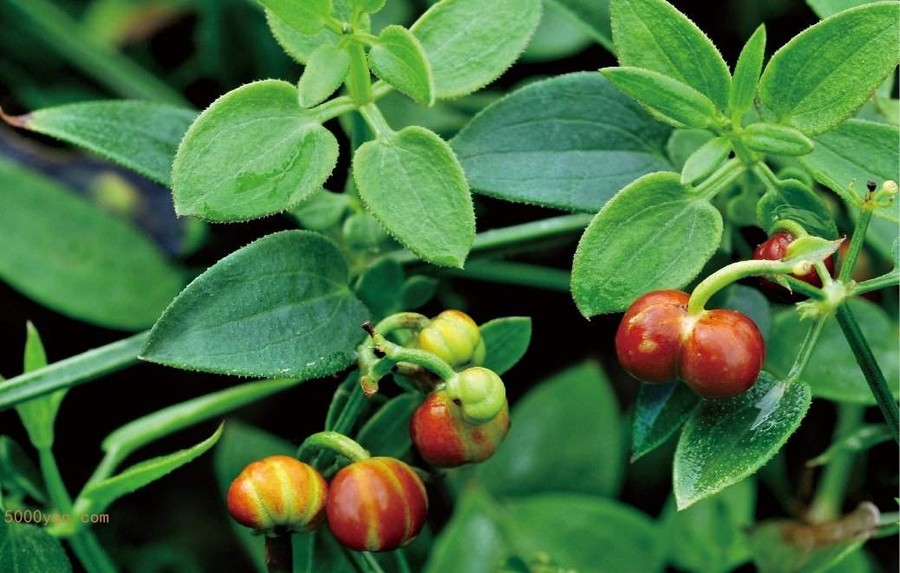
A perennial climbing herb. The roots are clustered, numbering from several to dozens, with a purple-red or orange-red outer bark. The stem is quadrangular, with numerous recurved small spines on the ridges. Leaves are in whorls of four, with long petioles; the leaf blades are highly variable in shape, including ovate, triangular-ovate, broad-ovate to narrow-ovate, 2-6 cm long, 1-4 cm wide, usually with an acute apex, cordate base, rough upper surface, with recurved spines along the midvein and petiole on the lower surface, entire margin, and 5 basal veins. The inflorescence is a paniculate cyme, axillary and terminal; flowers are small, yellowish-white, pentamerous; the calyx is inconspicuous; the corolla is rotate, about 4 mm in diameter, 5-lobed with ovate-triangular lobes and acute apices; stamens 5, inserted on the corolla tube; ovary inferior, 2-loculed, glabrous. The berry is spherical, 5-6 mm in diameter, turning from red to black. Flowering period is from June to September, and fruiting period from August to October.
Habitat and Distribution
Grows on hillsides, roadsides, ditch banks, field edges, thickets, and forest margins. Distributed throughout most regions of the country.
Harvesting and Processing
Harvested in spring and autumn, remove sediment and sand, then dry.
Medicinal Properties
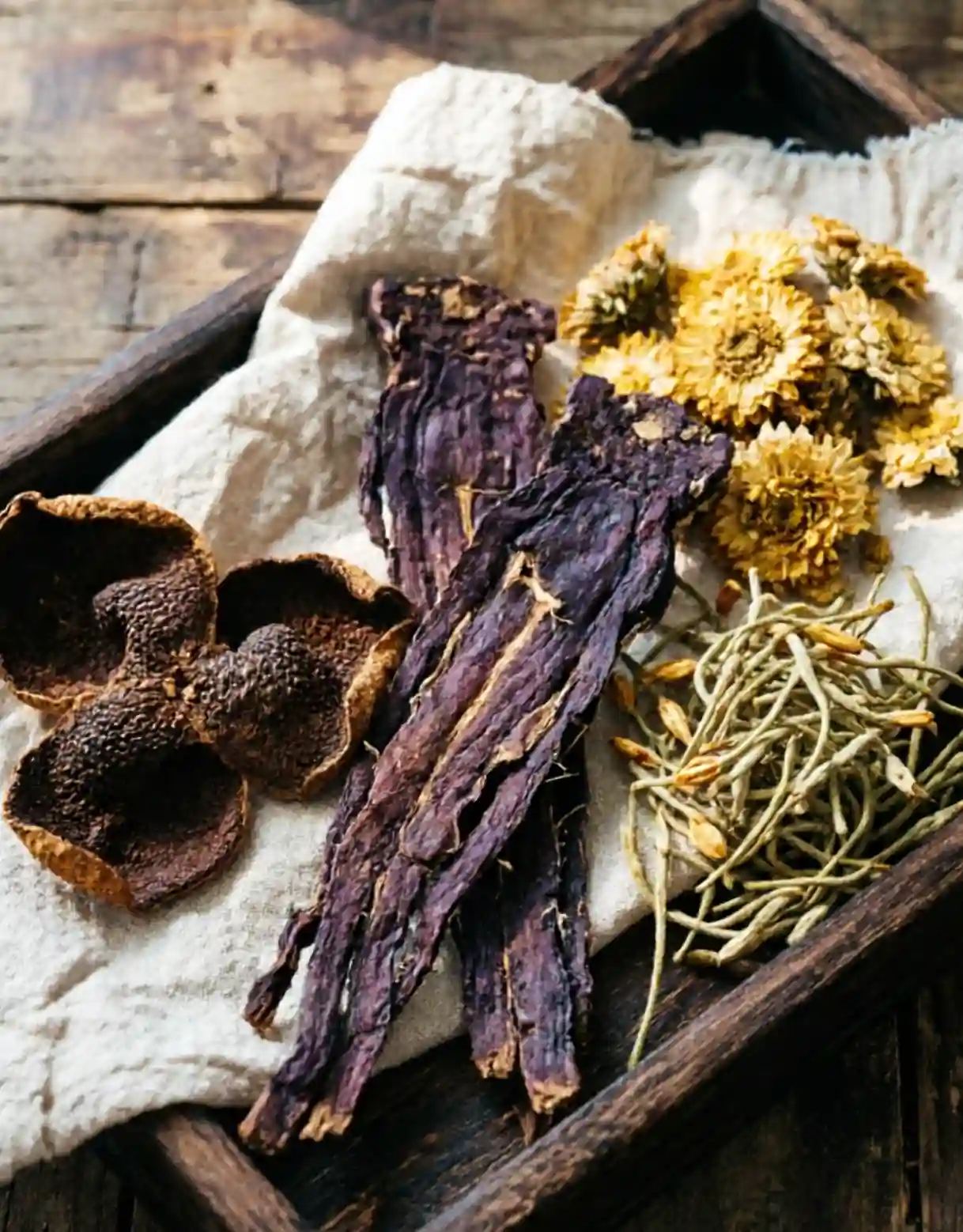
The rhizome is nodular, with clusters of roots of varying thickness. The roots are cylindrical, slightly curved, 10-25 cm long, 0.2-1 cm in diameter; the surface is reddish-brown or dark brown, with fine longitudinal wrinkles and a few fine root scars; the peeled areas of the bark are yellowish-red. The texture is brittle, easily broken, the fracture is flat with a narrow, purplish-red bark, a broad, light yellowish-red wood, and numerous vessel pores. Odor: faint; Taste: slightly bitter, with a lingering acrid sensation upon prolonged chewing.
Chemical Constituents
This product mainly contains oleanolic acid acetate, oleanolic aldehyde acetate, rubiatriol, hydroxyalizarin, alizarin, purpurin, dihydromollugin, 1-hydroxy-2-carboxy-3-methoxyanthraquinone, 2′-methoxymollugin, mollugin, and other components.
Pharmacology
It shortens bleeding time, inhibits platelet aggregation, and increases white blood cell count; it has antitussive, expectorant, antibacterial, and anticancer effects, prevents the formation of experimental kidney and bladder stones, particularly inhibiting the formation of calcium carbonate stones; it has a therapeutic effect on experimental myocardial infarction; it relieves acetylcholine-induced intestinal spasm in isolated tissues. It excites the isolated uterus; it dilates blood vessels and inhibits the permeability of skin connective tissue.
Properties and Channel Entry
Bitter, cold. Enters the Liver channel.
Functions and Indications
Cools Blood, dispels stasis, stops bleeding, and promotes menstruation
Dosage and Administration
Oral administration: decoct in water, 10-15 g; or made into pills or powder; or steeped in wine.
Precautions and Contraindications
Patients with Spleen and Stomach deficiency-cold and those without blood stasis should use with caution.
Prescriptions
1. For hematemesis (vomiting blood): 30 g of Madder root, freshly pounded and sieved into powder. Take 6 g each time, decoct in one medium cup of water until reduced to seven-tenths, allow to cool, and take after meals for best results. (From "Jian Yao Ji Zhong Fang") 2. For hemoptysis (coughing blood) and hematuria (blood in urine): 9 g of Madder root, 30 g of Cogongrass rhizome. Decoct in water and take orally. (From "Henan Chinese Herbal Medicine Manual") 3. For menorrhagia (heavy menstruation) and uterine bleeding: 7 g of Madder root, 5 g of Mugwort leaf, 6 g of Biota tops, and 10 g of Rehmannia root. Decoct in 500 ml of water until reduced to 200 ml, strain, then add 10 g of Donkey-hide gelatin and dissolve. Take in 3 divided doses daily. (From "Modern Practical Chinese Medicine") 4. For amenorrhea (absence of menstruation): 30 g of Madder root. Decoct in yellow rice wine and take on an empty stomach. (From "Jing Yan Guang Ji") 5. For traumatic injuries (bruises and fractures): 30-60 g of Madder root, decoct in equal parts of water and wine and take; or 15 g each of Madder root and Ground beetle, decoct in equal parts of wine and water and take. (From "Fujian Materia Medica Records") 6. For rheumatic pain and arthritis: 120 g of fresh Madder root, 500 g of white liquor. Wash and mash the Madder root, steep in the liquor for one week, then warm the liquor and drink on an empty stomach. The first dose should be taken until about 80% intoxicated, then lie down and cover to induce sweating. Take once daily. Do not go into water for 7 days after taking the medicine. (From "Jiangsu Selected Folk Herbal Prescriptions") 7. For nephritis: 30 g of Madder root, 15 g each of Achyranthes root and Chaenomeles fruit. Decoct in water and set aside. Separately, take one young chicken, remove the intestines and impurities, steam to obtain chicken broth, then mix half of the broth with the above herbs and take. The remaining chicken and broth can be cooked with rice and eaten. (From "Fujian Materia Medica Records") 8. For toothache: 30-60 g of fresh Madder root, decoct in water and take orally. (From "Henan Chinese Herbal Medicine Manual")