Pinyin: Qianjinba
Aliases
Jinji Luodi, Dali Huang, Qianjin Zhui.
Source
Fabaceae plant *Mohanxing Qianjinba* (Moghania philippinensis)Flemingia prostrataDried root of Roxb.
Botanical Description
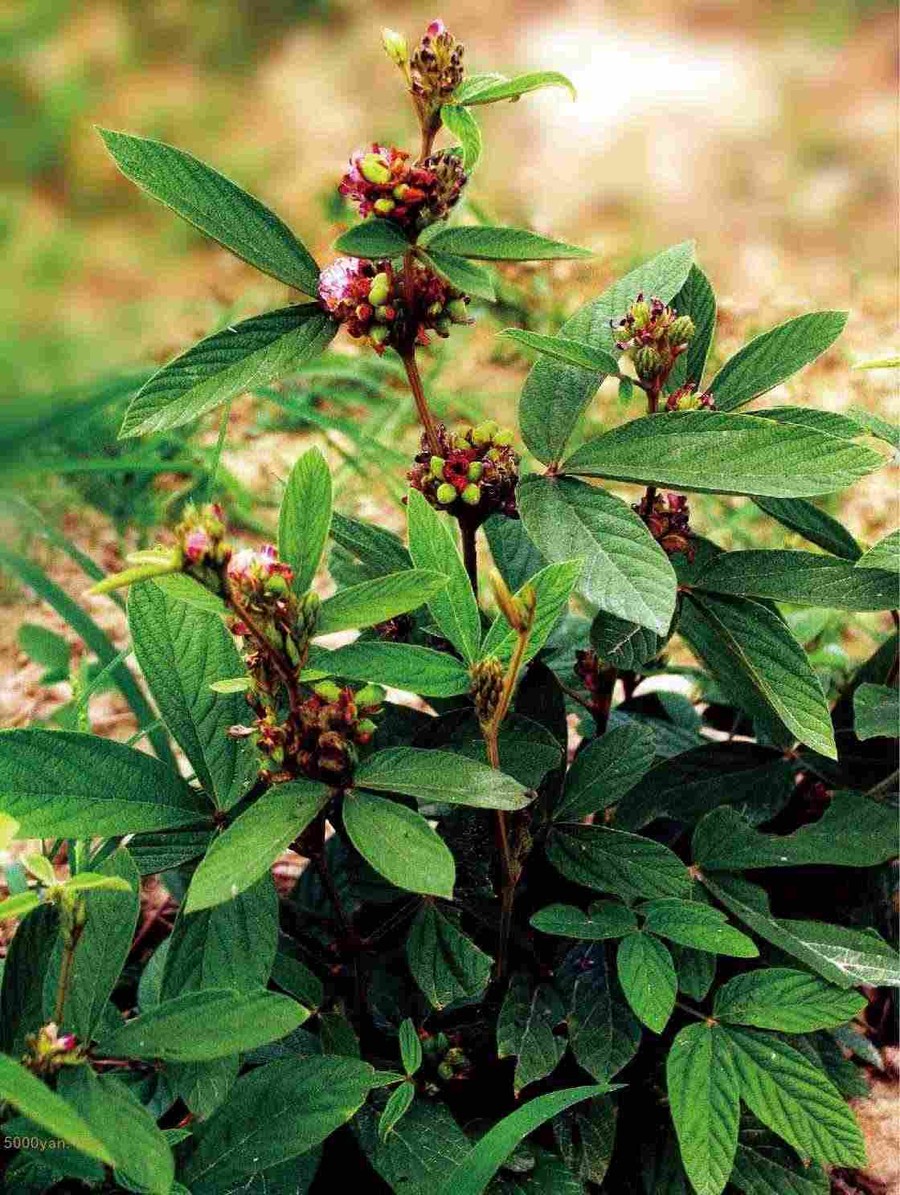
Erect or prostrate semi-shrub. Young branches angular, covered with short pubescence. Leaves alternate; petioles with long trichomes; stipules 2, triangular, sparsely hairy; trifoliate compound leaves, terminal leaflet ovate-lanceolate, apex obtuse, base rounded, sparsely pubescent above, densely hairy beneath, lateral leaflets obliquely based, with 3 basal veins; petiole pubescent. Racemes axillary, flowers dense; calyx teeth 5, lanceolate, the lower one longer, densely white hirsute with dense glands; corolla purple, slightly longer than calyx, standard elliptic, base narrowed, without distinct claw; stamens 10, diadelphous; ovary hairy. Legume oblong, with yellow short pubescence. Seeds 2, globose, black. Flowering period October to November.
Habitat and Distribution
1. For pneumonia: Renshen 6 g, decoct in water and take orally.
Harvesting and Processing
Harvest in autumn after the aboveground parts wither, dig up the root, wash clean, cut into segments, and dry in the sun.
Medicinal Properties
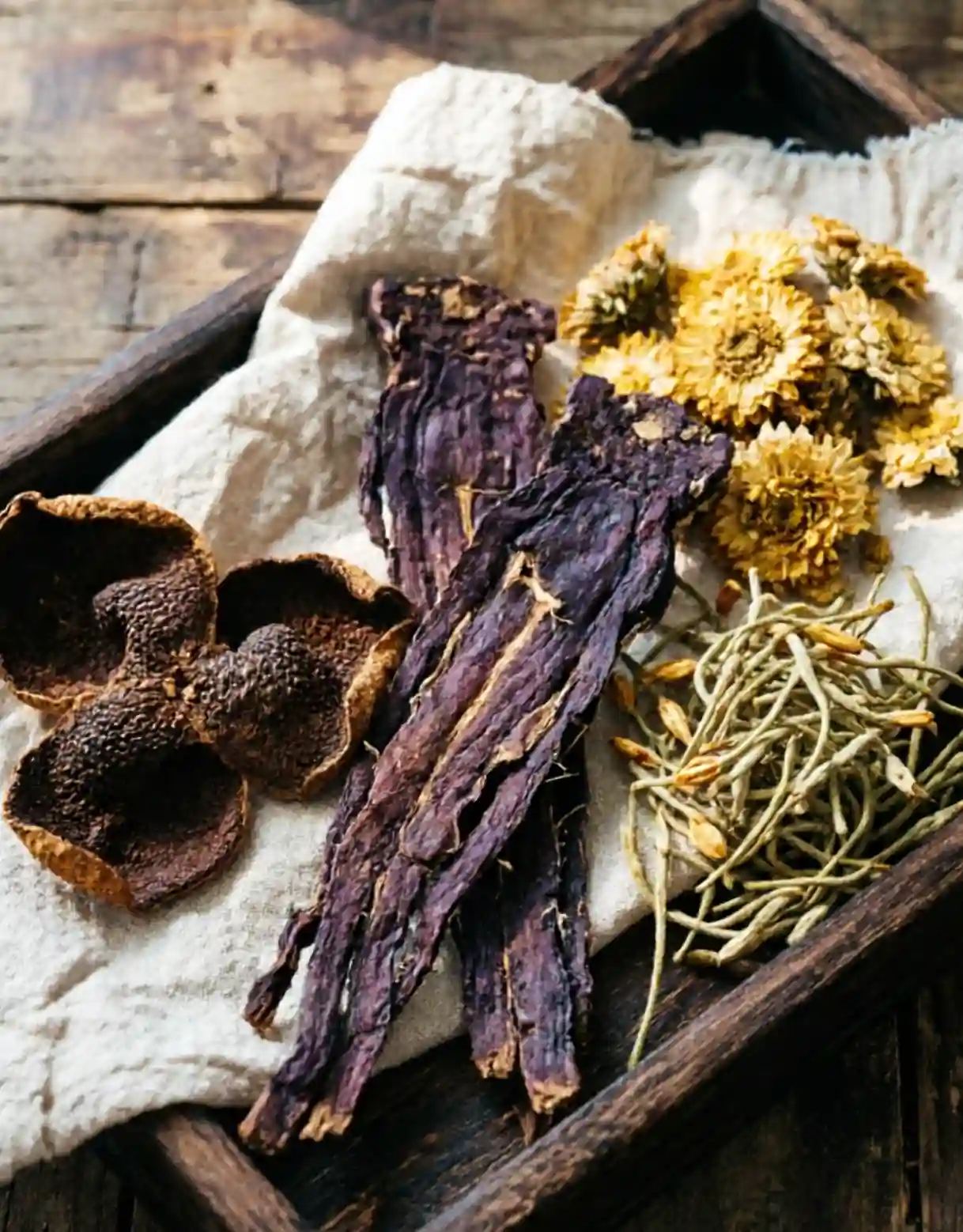
Root long cylindrical, upper part thick and gradually tapering toward the lower part, rarely branched, 30–70 cm long, upper part diameter 1–2 cm. Surface brownish-yellow, grayish-yellow to brownish-brown, with slightly protruding transverse lenticels and fine wrinkles, often forming a rounded shoulder shape near the top, lower part occasionally with rootlet scars; cork bark thin, easily scraped off when fresh, revealing brownish-red or brownish-brown bark after removal. Texture tough and hard, not easily broken. Transverse section shows brownish-red bark, broad wood portion, light yellowish-white, with fine radial striations. Odor faint, taste slightly sweet and astringent. Those with thick and long roots, clean of stem bases and rootlets, and yellowish-white fracture are considered superior.
Chemical Constituents
This product primarily contains flavonoid compounds, including flemingin C, flemingin D, flemingin, lupeol,β- beta-sitosterol, etc.
Properties and Channel Entry
Sweet, slightly astringent, neutral. Enters the Liver and Kidney channels.
Functions and Indications
Expels Wind and eliminates Dampness, strengthens tendons and bones, activates Blood and resolves toxicity. Indications: Wind-Dampness impediment pain, lumbar muscle strain, weakness of the limbs, traumatic injuries, and sore throat.
Dosage and Administration
Internal: decoction, 15-30 g. External: appropriate amount, apply with ground juice or grind into powder and mix for topical application.
Precautions and Contraindications
Caution should be exercised in pregnant women.
Prescriptions
1. For rheumatic arthritis with lower back and leg pain: *Flemingia philippinensis* 30 g, *Semiliquidambar cathayensis* 15 g. Decoct in water for oral administration. (Hong Kong Chinese Herbal Medicine) 2. For sciatica: *Flemingia philippinensis* root and *Urena lobata* root, 30 g each. Decoct in water for oral administration. (Fujian Materia Medica) 3. For postpartum lower back and knee pain: *Flemingia philippinensis* root 30 g, *Rubia cordifolia* and *Clematis chinensis* 9 g each. Decoct in water for oral administration. (Fujian Materia Medica) 4. For fatigue and weakness: *Flemingia philippinensis* root 15 g, *Ilex asprella* 30 g. Decoct in water for oral administration. (Fujian Materia Medica) 5. For traumatic injury: *Flemingia philippinensis* 20-30 g. Decoct in equal parts wine and water for oral administration. [Jiangxi Journal of Traditional Chinese Medicine, 1957, (10):6]