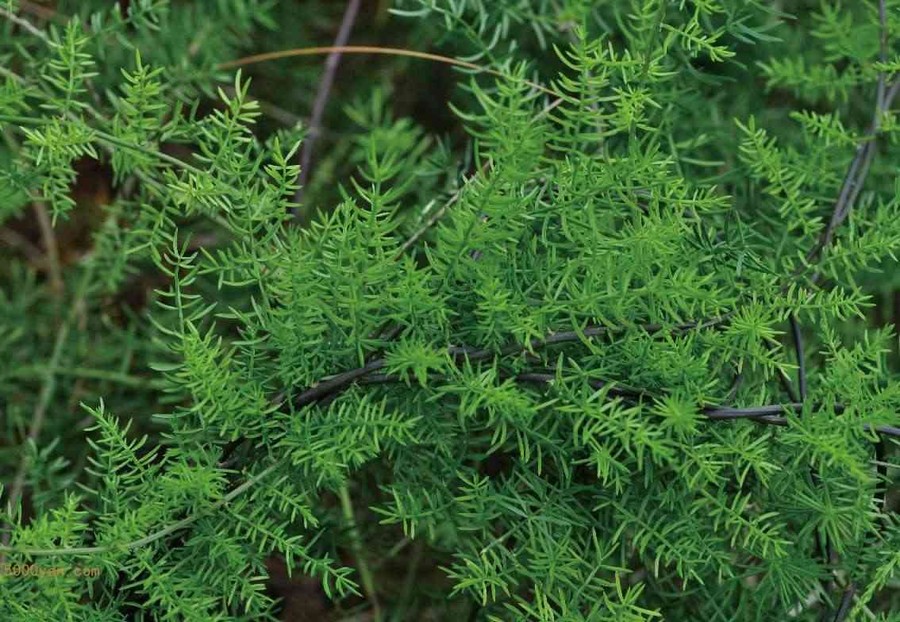
Pinyin: Tiandong
Aliases
Da Dang Men Gen, Tian Men Dong.
Source
Plant of the Liliaceae family TiandongAsparagus cochinchinensisDried root tuber of (Lour.) Merr.
Botanical Description
Perennial climbing herb, glabrous (hairless) throughout. Root tubers fleshy, clustered, long-elliptic or fusiform, 4-10 cm long, grayish-yellow. Stem slender, up to 2 m long, branches angular or with narrow wings; phylloclades usually in clusters of 3, flat, 1-3 cm long, 1-2 mm wide, apex acute. Leaves reduced to scales, apex long-acuminate, base with woody recurved spines, spines on stem 2.5-3 mm long, shorter or indistinct on branches. Flowers 1-3 clustered in leaf axils, unisexual, dioecious, pale green; pedicel 2-6 mm long; male flowers with 6 tepals, stamens slightly shorter than tepals, filaments not adnate to tepals, anthers ovoid; female flowers similar in size to male, with 6 staminodes. Berry globose, 6-7 mm in diameter, red when ripe; containing 1 seed. Flowering period May-July, fruiting period August.
Habitat and Distribution
It grows in shaded, damp mountain forests, forest edges, grassy areas, or shrub thickets, and is also cultivated. It is distributed in East China, Central China, South China, Southwest China, as well as Hebei, Shanxi, Shaanxi, Gansu, and Taiwan.
Harvesting and Processing
Harvested in autumn and winter, washed clean, stem base and fibrous roots removed, boiled or steamed in boiling water until thoroughly cooked, peeled while hot, washed clean, and dried.
Medicinal Properties
This product is long fusiform in shape, slightly curved, 5-18 cm long, 0.5-2 cm in diameter. The surface is yellowish-white to pale yellowish-brown, translucent, smooth or with varying degrees of longitudinal wrinkles, occasionally with remnants of grayish-brown outer bark. The texture is hard or soft and moist, sticky, with a horny fracture surface and a yellowish-white central column. Odor: faint; Taste: sweet, slightly bitter.
Chemical Constituents
This product contains glycosides, saponins and their aglycones, amino acids, and sugars as its chemical constituents.
Pharmacology
Antibacterial; kills mosquito larvae; antitumor.
Properties and Channel Entry
Sweet, bitter, cold. Enters the Lung and Kidney channels.
Functions and Indications
Nourishes Yin and moistens dryness, clears the Lungs and generates body fluids. Used for dry cough due to Lung dryness, paroxysmal cough with sticky sputum, soreness and weakness of the lower back and knees, bone steaming and tidal fever, internal heat with wasting and thirst, fluid damage from febrile disease, dry throat and thirst, and constipation due to intestinal dryness.
Dosage and Administration
Oral administration: 6-15 g; decocted into a paste, or made into pills or powder
Precautions and Contraindications
Contraindicated in cases of diarrhea due to deficiency-cold and cough due to wind-cold.
Prescriptions
1. For dry Heat in the Lungs and Stomach with phlegm-stuck cough: Tiandong (Asparagus Root, core removed) and Maidong (Ophiopogon Root, core removed), equal amounts. Boil the two ingredients into a paste, then collect with refined white honey; take a small amount at any time, swallow after warming in the mouth. (From Zhang's Medical Guide, "Er Dong Gao") 2. For leukorrhea in women: Tiandong (Asparagus Root), pound into juice, mix with well water and take orally. (From Pu Ji Fang) 3. To promote lactation: Tiandong (Asparagus Root) 60 g, stew with meat and take orally. (From Yunnan Chinese Herbal Medicine) 4. For restlessness and agitation: Tiandong (Asparagus Root) and Maidong (Ophiopogon Root) 15 g each, Shuiyangliu (Chosenia) 9 g, decoct in water and take orally. (From Hunan Materia Medica) 5. For tonsillitis and sore throat: Tiandong (Asparagus Root), Maidong (Ophiopogon Root), Banlangen (Isatis Root), Jiegeng (Platycodon Root), and Shandougen (Vietnamese Sophora Root) 9 g each, Gancao (Licorice Root) 6 g, decoct in water and take orally. (From Shandong Chinese Herbal Medicine Manual)