Pinyin: Baiwei
Aliases
Bailongxu, Longdan Baiwei, Baimawei, Laojunxu
Source
Apocynaceae plant Cynanchum atratumCynanchum atratumThe dried root and rhizome of Bge.
Botanical Description
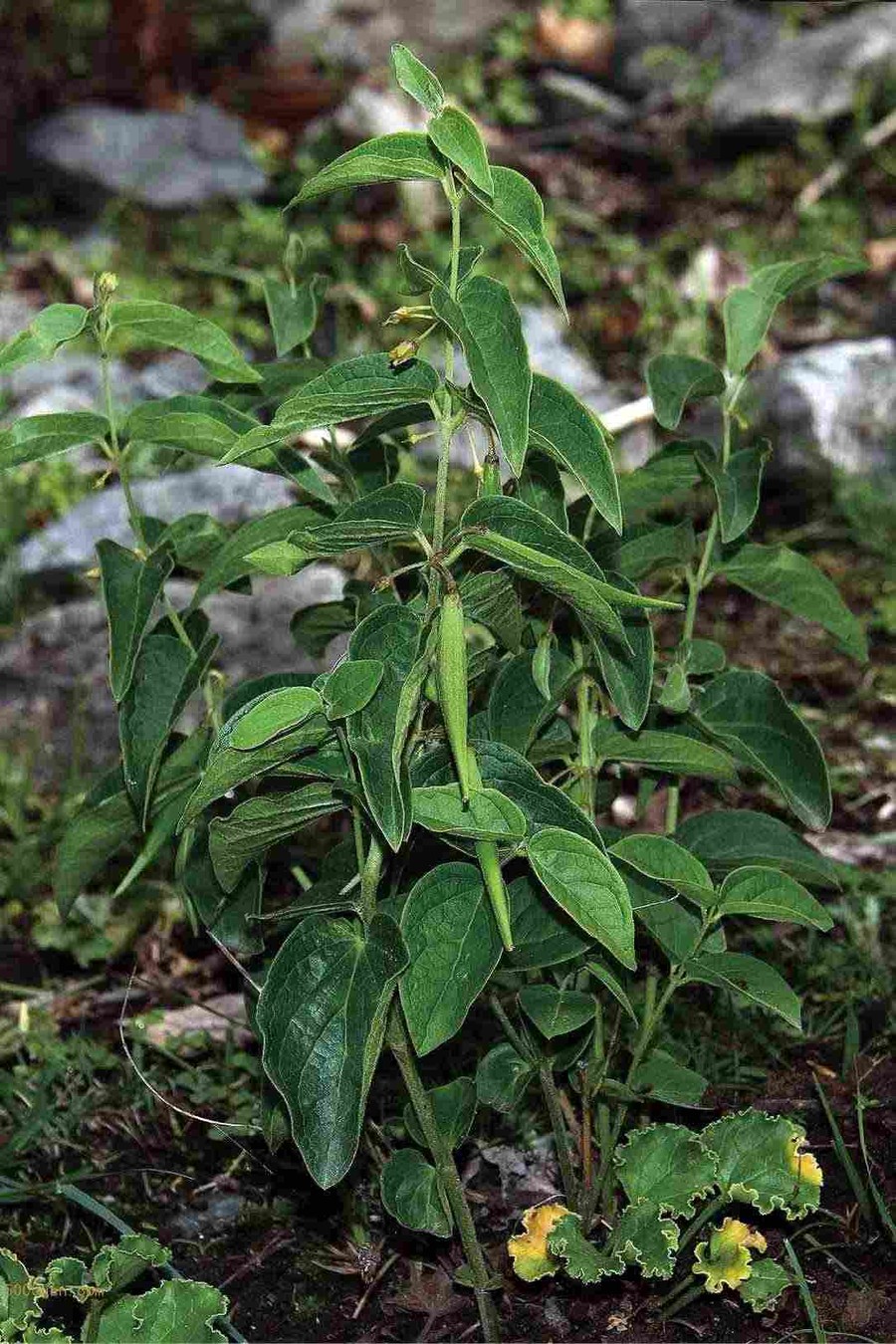
Perennial herb, 40-70 cm tall, with white latex. Rhizome short, bearing numerous slender, linear roots up to 20 cm or more in length, 2-3 cm in diameter, with yellowish-brown outer bark. Stem erect, green, cylindrical, usually unbranched, densely covered with gray-white short pubescence. Leaves opposite, with short petioles; leaf blade ovate or ovate-oblong, 5-10 cm long, 3-7 cm wide, apex shortly acuminate, base rounded, margin entire, both surfaces covered with white tomentum, especially dense on the abaxial side and veins; lateral veins 6-7 pairs. Numerous flowers, densely arranged in umbelliform cymes in the leaf axils at the stem apex; peduncle absent; flowers deep purple, about 10 mm in diameter; calyx green, deeply 5-lobed, tomentose externally, with 5 small glands at the base internally; corolla rotate, deeply 5-lobed, pubescent externally and ciliate; corona 5-lobed, lobes peltate, rounded, as long as the gynostegium; anther apex with a rounded membrane; pollinia one per locule, pendulous, oblong-swollen; stigma flat. Follicle solitary, 5-9 cm long, 5-15 mm in diameter, apex acuminate, base obtuse, middle swollen. Seeds numerous, ovoid, with narrow wings, about 4 mm long; coma white, about 3 cm long. Flowering period May to July, fruiting period August to October.
Habitat and Distribution
Grows on hillsides or forest edges. Distributed in Northeast, Central South, Southwest, and Hebei, Shanxi, Shaanxi, Shandong, Jiangsu, Anhui, Jiangxi, Fujian, Hubei, and other regions.
Harvesting and Processing
Harvested in spring and autumn, washed clean, and dried.
Medicinal Properties
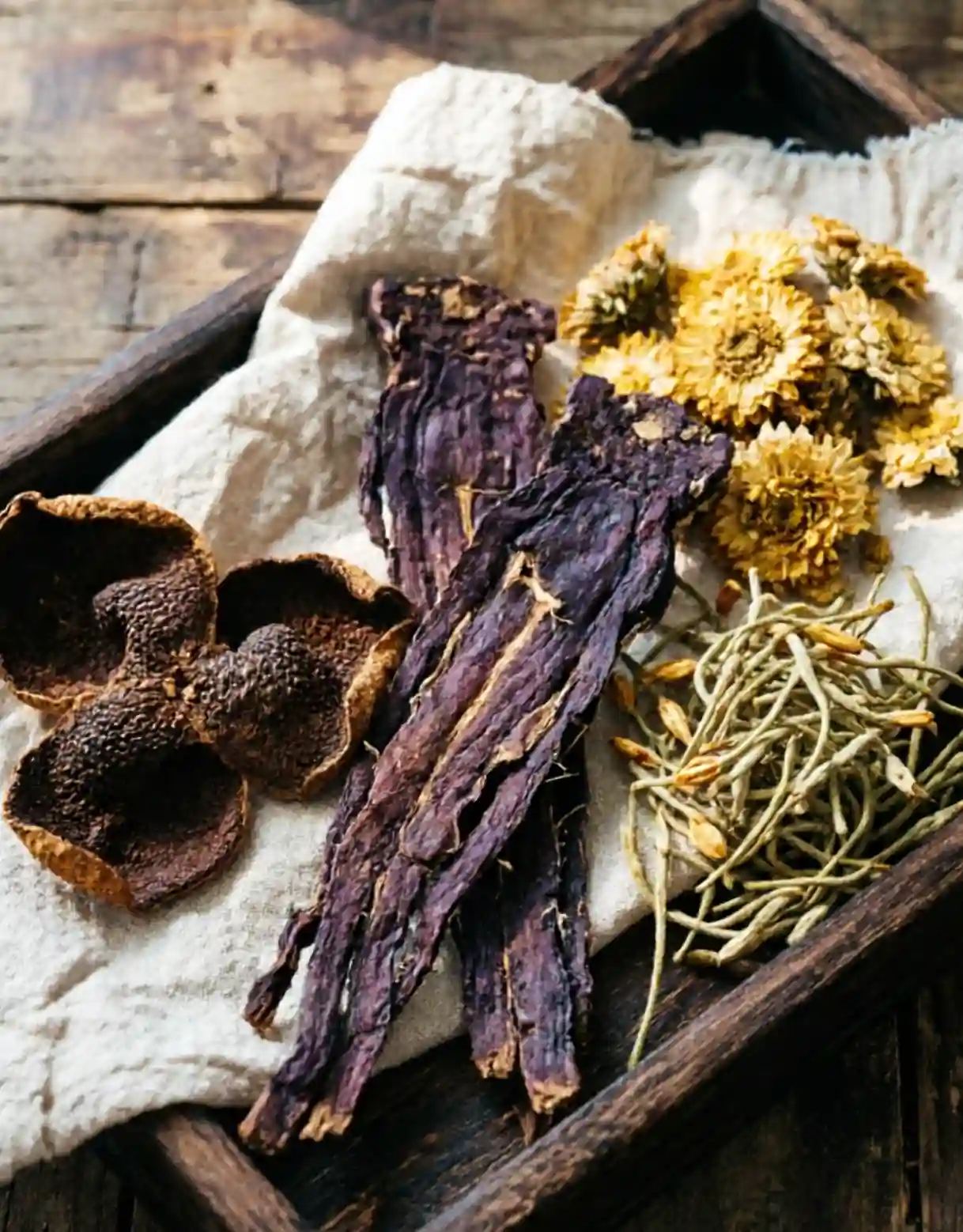
The rhizome is mostly curved, thick and short, with nodes; on the upper part there are circular stem scars, and on the lower part and both sides, numerous slender roots are clustered, each root 10-25 cm long and 1-2 mm in diameter; the surface is yellow-brown. The texture is brittle and easily broken, the bark at the cross-section is yellow-white, and the wood portion is yellow. The odor is faint, and the taste is slightly bitter.
Chemical Constituents
This product contains cynatratoside A, cynatratoside A, and gagaminine A.β- Xiangshusu acetate, ethyl oleate,β- beta-sitosterol, etc.
Pharmacology
Has antipyretic and anti-inflammatory effects. Toxic.
Properties and Channel Entry
Bitter, salty, and cold. Enters the Lung, Liver, and Kidney channels.
Functions and Indications
Clears Heat and cools Blood, promotes urination and unblocks painful urinary dysfunction, resolves toxicity and treats sores. Used for febrile disease with Heat injuring the Nutritive level causing fever, Yin deficiency fever, bone-steaming consumptive fever, postpartum Blood deficiency fever, painful urinary dysfunction due to Heat, bloody painful urinary dysfunction, and abscesses, sores, and swelling-toxin.
Dosage and Administration
Oral: decoct in water, 3-15 g; or made into pills or powder. External use: appropriate amount, grind into powder for application; or mash fresh product for topical application.
Precautions and Contraindications
Use with caution in cases of Blood-level without Heat, Middle Cold with loose stools, and Yang Qi floating externally.
Prescriptions
1. For deficiency-heat with night sweats: Baiwei 12 g, Digupi 12 g, Yinchaihu 9 g, Biejia 9 g. Decoct in water and take orally. (Hebei Chinese Herbal Medicine) 2. For tidal fever due to pulmonary tuberculosis: Baiwei 9 g, Lvcao fruit 15 g, Digupi 12 g. Decoct in water and take orally. (Qingdao Chinese Herbal Medicine Manual) 3. For rheumatic joint pain: Baiwei 15 g, Chou shanyang 15 g, Da e'er chang gen 15 g. Steep in wine and take orally. (Guizhou Herbal Medicine) 4. For bleeding from incised wounds: Apply Baiwei powder topically to the wound. (Rumen Shiqin) 5. For fire-eye (acute conjunctivitis): Baiwei 30 g. Decoct in water and take orally. (Hunan Materia Medica)