Pinyin: Chuanshegan
Aliases
Yuan Gen, Yuan Tou, Tu Zhi Mu, Leng Shui Dan, Wu Qi.
Source
Iris plant, Iridaceae familyIris tectorumMaxim. dried rhizome.
Botanical Description
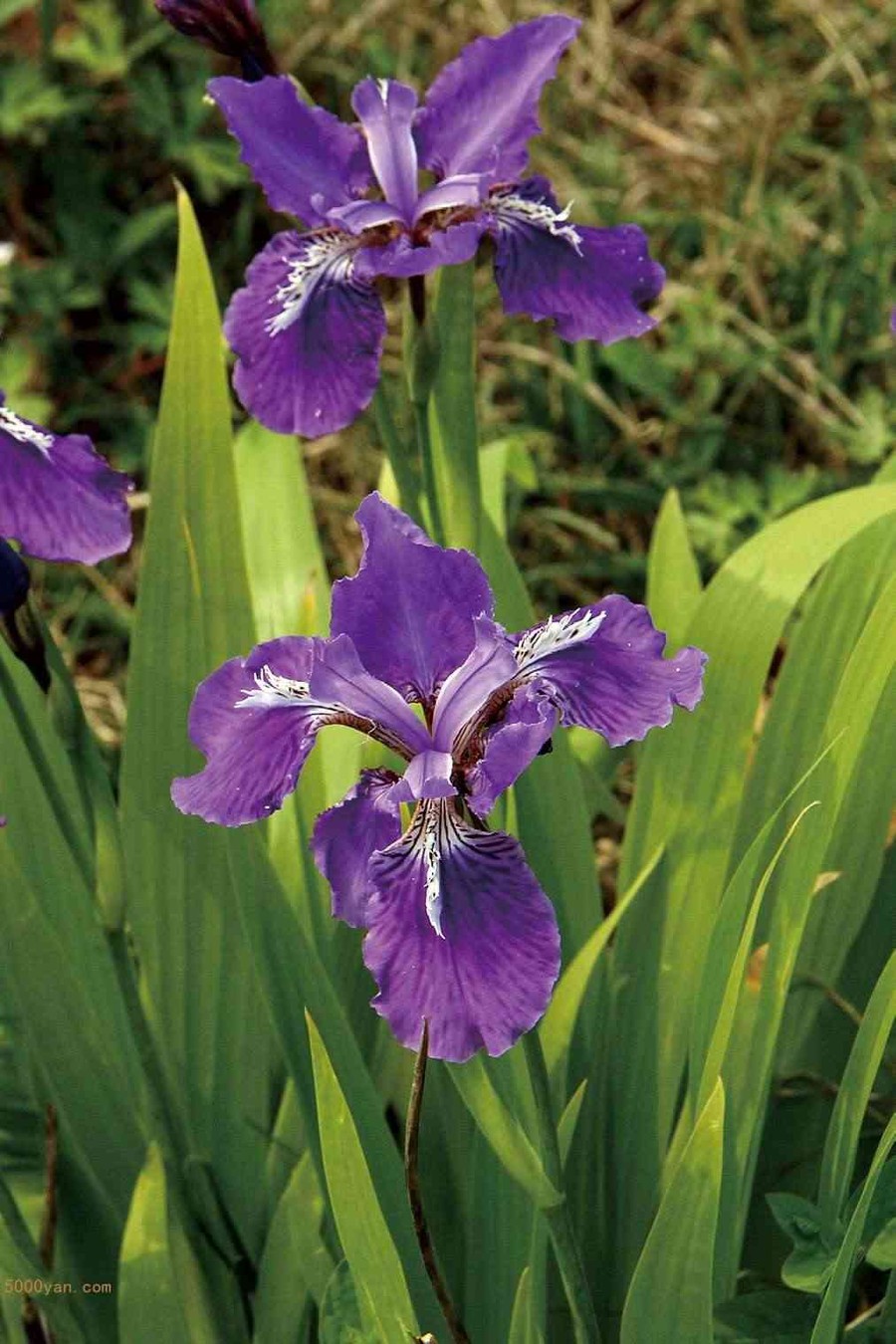
Perennial herb, 35-80 cm tall. The base of the plant has membranous leaf sheaths and fibers remaining from old leaves. The rhizome is short, thick, often snake-head-shaped, occasionally irregularly lumpy, with relatively dense annular rings. Leaves basal; leaf blades sword-shaped, 15-50 cm long, 1.5-3.5 cm wide, apex acuminate, base sheath-like, overlapping in 2 rows, with several indistinct longitudinal veins. Flower scape 20-40 cm tall, nearly as long as the leaves, with 1-2 cauline leaves in the middle-lower part, and 1-2 branches at the apex; bracts 2-3; pedicel 1-2 cm long; flowers blue-purple, up to 10 cm in diameter, perianth segments 6, arranged in 2 whorls, outer whorl segments obovate or nearly round, reflexed, with irregular orange-yellow cristate protrusions on the midvein, inner whorl segments smaller, obovate, arched and erect, perianth tube 3-4 cm long, stamens 3, 2.5-3 cm long, anthers yellow; ovary inferior, 3-locular, style branches 3, petaloid, blue, covering the stamens, apex 2-lobed, margin fringed. Capsule, elliptic to obovoid, 4-6 cm long, 2-2.5 cm in diameter, with 6 distinct ribs; seeds pyriform, blackish-brown, seed coat wrinkled. Flowering period April-May, fruiting period June-July.
Habitat and Distribution
Grows at forest edges, waterside wetlands, and sunny slopes. Distributed in Southwest China and Shanxi, Shaanxi, Gansu, Jiangsu, Anhui, Zhejiang, Jiangxi, Fujian, Hubei, Hunan, Guangxi, and other regions.
Harvesting and Processing
Can be harvested year-round; remove fibrous roots and sediment, then dry.
Medicinal Properties
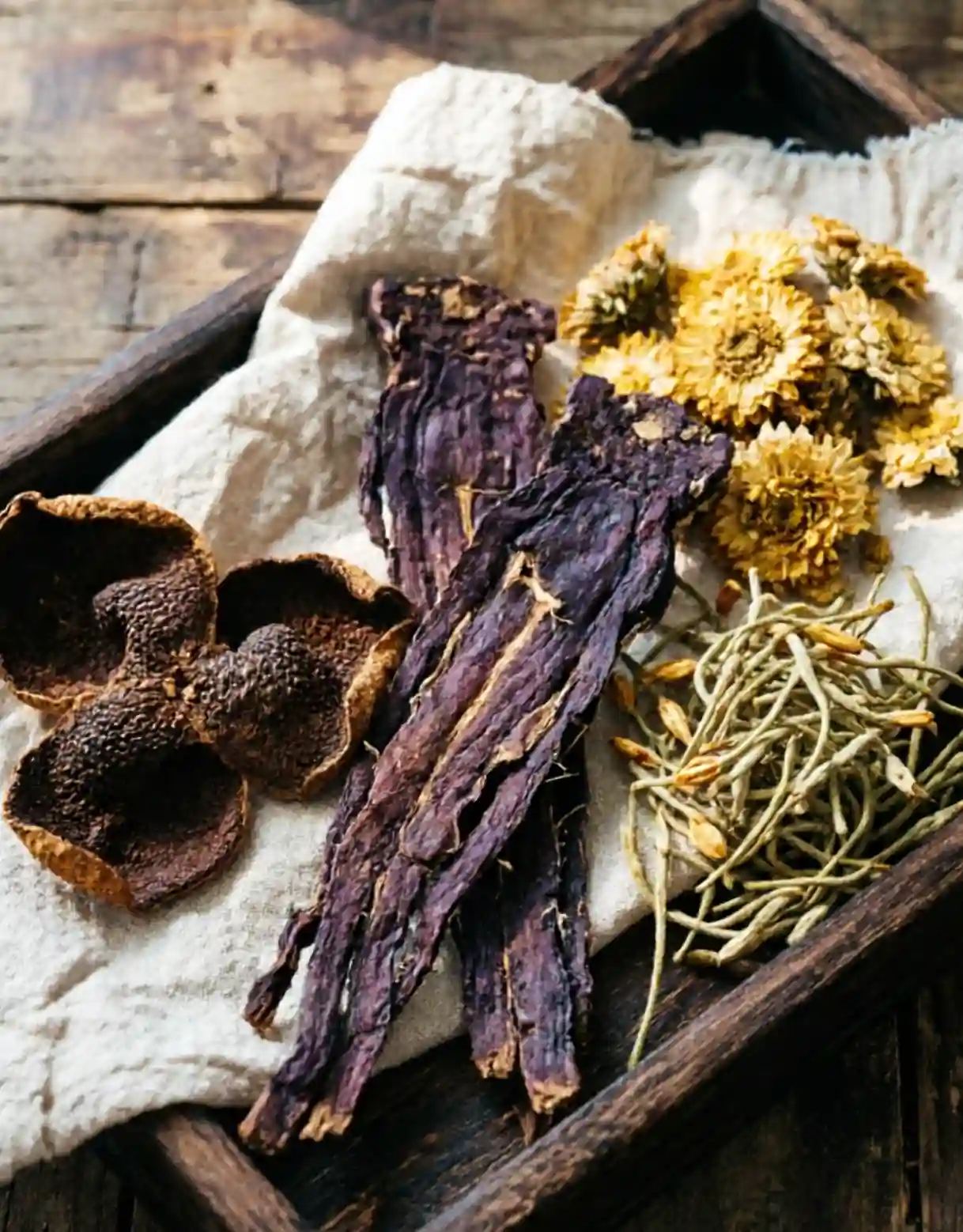
This product is irregularly strip-shaped or conical, slightly flat, with branches, 3-10 cm long, diameter 1-2.5 cm. The surface is grayish-yellowish-brown or brown, with annular lines and longitudinal grooves. Often with remnants of fibrous roots and sunken or dot-like protruding root scars. The texture is loose and fragile, easily broken, with a yellowish-white or yellowish-brown fracture. Odor: faint; Taste: sweet and bitter.
Chemical Constituents
This product primarily contains isoflavone glycosides.
Pharmacology
Has antipyretic, expectorant, anti-inflammatory, and anti-allergic effects; in vitro, it shows certain inhibitory effects on Staphylococcus aureus, Bacillus anthracis, Corynebacterium diphtheriae, and Group B Streptococcus; additionally, it has emetic and laxative effects.
Properties and Channel Entry
Bitter, cold. Enters the Lung channel.
Functions and Indications
Clears Heat and resolves toxicity, expels Phlegm, and benefits the throat. Used for heat toxin and fire constraint, swollen and painful throat, profuse phlegm and saliva, cough and wheezing.
Dosage and Administration
Oral: decoct in water, 6-10 g; or grind into juice or powder. External use: appropriate amount, mash for application.
Precautions and Contraindications
Contraindicated in cases of physical weakness with loose stools and during pregnancy.
Prescriptions
1. For dyspepsia and abdominal distension: Tudimu (Iris root) 3 g, grind into fine powder, take with boiled water or wine. (Guiyang Folk Herbal Medicine) 2. For stomach heat and halitosis: Iris root and rhizome, Zhizi (Gardenia) 9 g each, Yuxingcao (Houttuynia) 12 g. Decoct in water and take orally. (Wanxian Chinese Herbal Medicine) 3. For abdominal distension and constipation: Fresh Yuan root (Iris root) 30 g, wash clean, chew raw, take with winter wine; one dose will relieve constipation. (Jilin Herbal Compilation) 4. For hepatitis with jaundice: Iris root and rhizome 6 g. Decoct in water and take orally. (Jiangxi Herbal Manual) 5. For cough: Tudimu (Iris root) 3 g, Dashanyang (Rabdosia) 9 g. Decoct in water, take in 3 divided doses daily. (Guizhou Common Folk Herbal Manual) 6. For all types of sore throat: Iris root and rhizome 9 g, Shandougen (Sophora) 9 g, Jiangcan (silkworm) 3 g, Bohe (peppermint) 12 g (added later). Decoct in water and take orally. (Qingdao Chinese Herbal Medicine Manual) 7. For poisonous snake bite: Iris root and Zhumagen (Boehmeria root), appropriate amounts each, mash and apply to the wound. (Jiangxi Herbal Manual) 8. For malaria: Iris root and rhizome 9 g, with Shengjiang (fresh ginger) as a guide. Decoct in water and take orally. (Northern Common Chinese Herbal Medicine Manual)