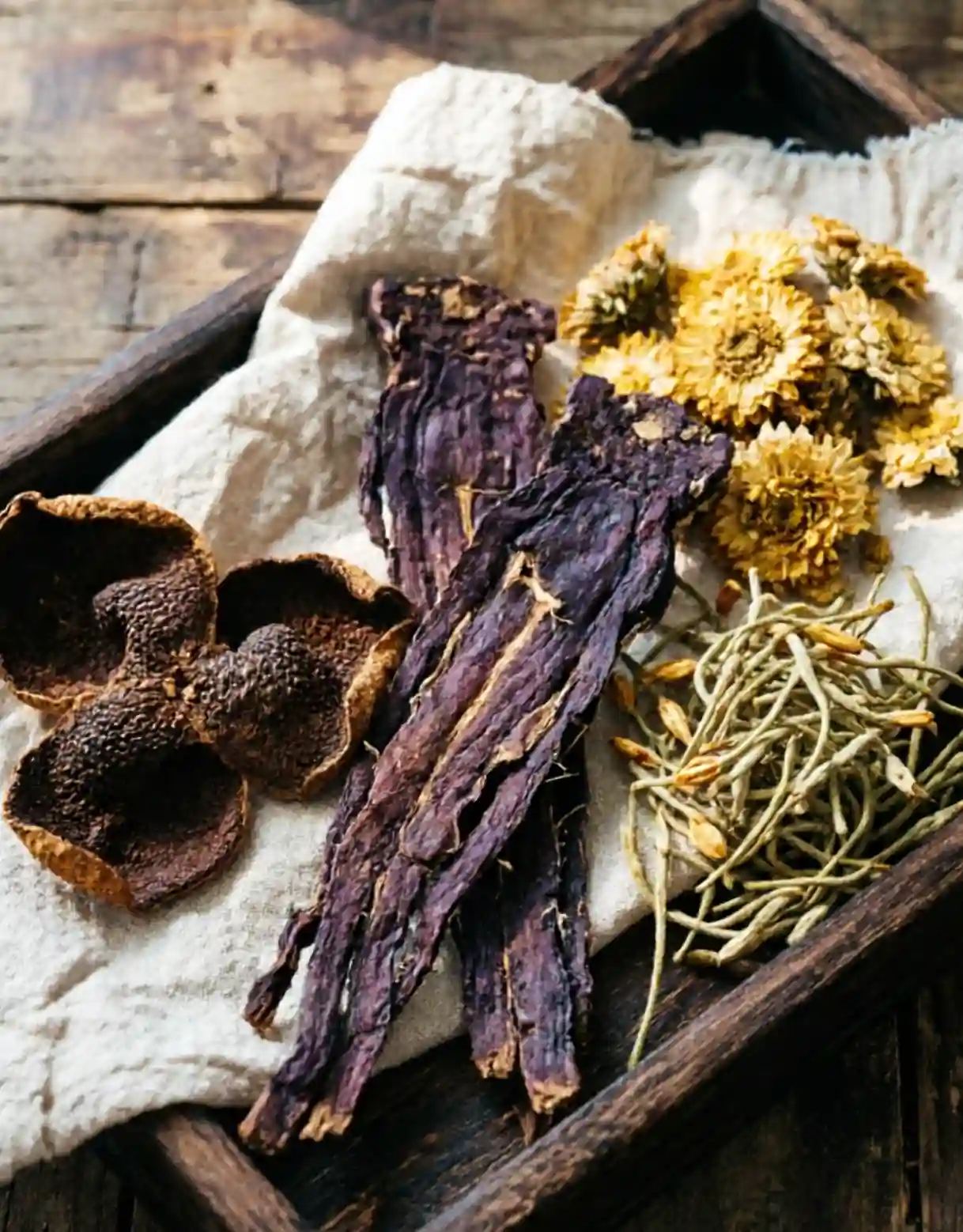
Pinyin: Loulu
Aliases
Guiyouma, Qiloulu, Datouweng, Longconggen
Source
Herb of the Asteraceae family *Rhaponticum uniflorum*Rhaponticum uniflorumThe dried root of (L.) DC.
Botanical Description
Perennial herb, (6-)30-100 cm tall. Rhizome thick, main root cylindrical, 1-2 cm in diameter, upper part densely covered with residual petioles. Stem erect, unbranched, clustered or solitary, striate, with white cottony or short hairs. Basal leaves long-petiolate, petiole 6-20 cm, densely cottony; basal and lower stem leaves all elliptic, 12-25 cm long, 5-10 cm wide, pinnately divided into lyre-shaped segments, segments often bipinnately divided or deeply lobed, both surfaces with arachnoid or rough hairs; middle and upper leaves smaller, shortly petiolate or sessile. Capitulum solitary, terminal, about 5 cm in diameter; involucre broadly campanulate, base concave; phyllaries in multiple rows, with scarious appendages, outer ones short, ovate, middle ones with broad, palmately divided appendages, inner ones lanceolate, apex acute; corolla pale purple, about 2.5 cm long, lower part linear, upper part slightly expanded into a tube, apex 5-lobed; stamens 5, anthers connate; ovary inferior, style exserted, stigma 2-lobed, purple. Achene, obconical, 5-6 mm long, brown, 4-angled; pappus bristly, with plumose short hairs. Flowering period May-July. Fruiting period June-August.
Habitat and Distribution
Born in mountain slopes, hillsides, under pine forests or birch forests at an altitude of 390-2700 m. Distributed in Northeast China and Inner Mongolia, Hebei, Shanxi, Shaanxi, Gansu, Qinghai, Shandong, Henan, Sichuan and other places.
Harvesting and Processing
Harvested in spring and autumn, remove the fibrous roots and soil, then dry in the sun.
Medicinal Properties
This specimen is conical or flattened in irregular pieces, mostly twisted, varying in length, with a diameter of 1-2.5 cm. The surface is dark brown, grayish-brown, or blackish-brown, rough, with longitudinal grooves and diamond-shaped reticulate fissures. The outer layer is easily exfoliated, the root head is enlarged with remnants of stems and scale-like leaf bases, and the apex has grayish-white pubescence. The texture is light, brittle, and easily broken; the fracture is uneven, grayish-yellow, with fissures, some showing star-shaped cracks in the center, grayish-black or brownish-black. The odor is distinctive, and the taste is slightly bitter.
Chemical Constituents
This product containsβEcdysterone, cadopatine, isocadopatine, rhapontisterone, liquiritin, volatile oils, and other constituents.
Pharmacology
It can resist atherosclerosis; lower blood sugar; inhibit the generation of lipid peroxides; exert antioxidant effects; inhibit rat type B monoamine oxidase activity; and provide hepatoprotective effects.
Properties and Channel Entry
Bitter, cold. Enters the Stomach channel.
Functions and Indications
Clears Heat and resolves toxicity, disperses abscesses, promotes lactation, relaxes tendons and opens the channels. Used for breast abscess with swelling and pain, deep-rooted carbuncles on the back, scrofula and skin sores, blocked lactation, and Dampness Bi (painful obstruction) with muscle contracture.
Dosage and Administration
Internal: decoct in water, 9-15 g. External: appropriate amount, grind into powder and mix with vinegar for application; or mash fresh herb for application.
Precautions and Contraindications
Contraindicated in yin-type sores and ulcers, and prohibited during pregnancy.
Prescriptions
1. For abscesses and sores: Loulu (Radix Rhapontici seu Echinops) 15 g, Lianqiao (Fructus Forsythiae) 9 g, Huangbai (Cortex Phellodendri) 12 g, Dahuang (Radix et Rhizoma Rhei) and Gancao (Radix Glycyrrhizae) 3 g each. Decoct in water and take orally. (Hebei Chinese Herbal Medicine). 2. For acute mastitis with redness and swelling: Loulu (Radix Rhapontici seu Echinops), Pugongying (Herba Taraxaci), and Jinyinhua (Flos Lonicerae Japonicae) 15 g each, Tubeimu (Rhizoma Bolbostematis) 9 g, Gancao (Radix Glycyrrhizae) 6 g. Decoct in water and take orally. (Shanxi Chinese Herbal Medicine). 3. For epidemic parotitis (mumps): Loulu (Radix Rhapontici seu Echinops) 4.5 g, Banlangen (Radix Isatidis) 3 g, Niubangzi (Fructus Arctii) 1.2 g, Gancao (Radix Glycyrrhizae) 1.5 g. Decoct in water and take orally. (Xinjiang Chinese Herbal Medicine Manual). 4. For uterine cancer: Loulu (Radix Rhapontici seu Echinops) 24 g, Malanzi (Semen Iridis Chinensis, stir-fried) 18 g. Decoct in water and take orally, one dose daily. (Secret and Proven Chinese Prescriptions). 5. For postpartum insufficient lactation: Loulu (Radix Rhapontici seu Echinops) and Wangbuliuxing (Semen Vaccariae) 15 g each, Lulutong (Fructus Liquidambaris) 12 g, Tongcao (Medulla Tetrapanacis) 6 g. Decoct in water and take orally. (Hebei Chinese Herbal Medicine).

