Pinyin: Taizishen
Aliases
Haier Shen, Tong Shen, Si Ye Shen
Source
1. For pediatric malnutrition with emaciation: Taizishen 15 g, decoct in water and take orally. 2. For neurasthenia: Taizishen 15 g, decoct in water and take orally.Pseudostellaria heterophyllaDried root tuber of (Miq.) Pax ex Pax et Hoffm.
Botanical Description
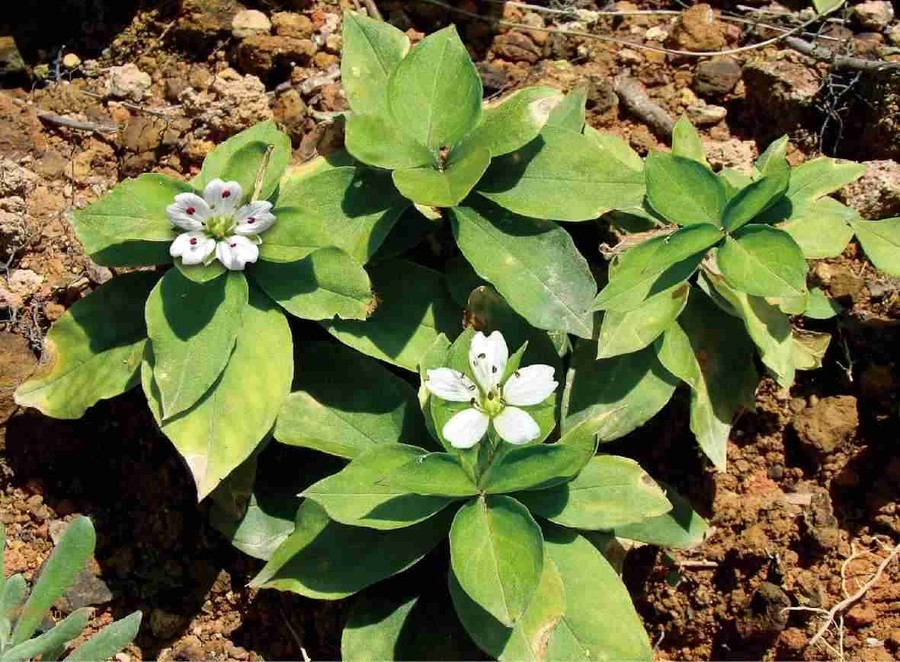
Perennial herb, 15-20 cm tall. Underground fleshy, straight, fusiform tuberous root with sparse fibrous roots around. Stem single, unbranched, lower part purplish, nearly square, upper part green, cylindrical, with distinctly swollen nodes, glabrous (hairless). Leaves simple, opposite; lower stem leaves smallest, oblanceolate, apex acute, base gradually narrowed into petiole, entire margin, gradually larger upward; topmost leaves largest, usually two pairs closely arranged in a whorl of 4, long-ovate or ovate-lanceolate, 4-9 cm long, 2-4.5 cm wide, apex acuminate, base narrowed into petiole, sparse hairs on veins of leaf back, margin slightly undulate. Flowers dimorphic; near-ground flowers small, cleistogamous, pedicel purple with short pubescence, sepals 4, purple on back, white membranous margin, no petals; topmost flowers larger and open, pedicel slender, 1-2 (-4) cm long, with short pubescence, erect at anthesis, pendulous after flowering, sepals 5, lanceolate, green, long hairs on back and margin; petals 5, white, apex shallowly 2-lobed or obtuse; stamens 10; ovary ovoid, style 3. Capsule subglobose. Seeds few, brown, flattened orbicular or oblong-reniform, with verrucose projections. Flowering April, fruiting May-June.
Habitat and Distribution
Grows on mountain slopes, under forests, and in rock crevices. Distributed in Northeast, North, Northwest, East China, as well as Hubei, Hunan, and other regions.
Harvesting and Processing
Harvest when most stems and leaves wither in summer, wash clean, remove fibrous roots, blanch briefly in boiling water then sun-dry, or sun-dry directly.
Medicinal Properties
This product is in the form of a slender fusiform or slender strip, slightly curved, 3-10 cm long and 0.2-0.6 cm in diameter. The surface is yellowish-white, relatively smooth, with slight longitudinal wrinkles and fibrous root scars in depressions. There is a stem scar at the apex. The texture is hard and brittle, with a flat, pale yellowish-white, horny cross-section; or it is off-white with a powdery texture. The odor is faint, and the taste is slightly sweet.
Chemical Constituents
This product contains pseudostellarin B, palmitic acid, linoleic acid, phosphatidylglycerol, daucosterol, Pseudostellaria heterophylla polysaccharides, behenic acid, and other constituents.
Properties and Channel Entry
Sweet, slightly bitter, neutral. Enters the Spleen and Lung channels.
Functions and Indications
Tonifies Qi and strengthens the Spleen, generates body fluids and moistens the Lungs
Dosage and Administration
Oral: decoct in water, 10-15 g.
Precautions and Contraindications
Contraindicated in cases of excess pathogenic conditions.
Prescriptions
1. For lung deficiency with cough: Taizishen 15 g, Maidong 12 g, Gancao 6 g. Decoct in water and take orally. (Hubei Chinese Herbal Medicine Record) 2. For qi and blood deficiency after illness: Taizishen 15 g, Huangqi 12 g, Wuweizi 3 g, tender white biandou 4 g, Dazao 4 pieces. Decoct in water and take as tea. (Anhui Chinese Herbal Medicine) 3. For weakness and dry mouth after illness: Taizishen, Sheng Dihuang, Baishao, Sheng Yuzhu, each 9 g. Decoct in water and take orally. (Zhejiang Medicinal Flora) 4. For palpitations: Taizishen 9 g, Nanshashen 9 g, Danshen 9 g, Kushen 9 g. Decoct in water and take orally, one dose daily. [Liaoning Journal of Traditional Chinese Medicine 1984, (1): 25] 5. For neurasthenia: Taizishen 15 g, Danggui, Suanzaoren, Yuanzhi, Zhi Gancao, each 9 g. Decoct and take orally. (Anhui Chinese Herbal Medicine)