Pinyin: Gaoben
Aliases
Gaoben, Guiqing, Gaoban.
Source
Plant from the Apiaceae family, *Ligusticum sinense*.Ligusticum sinenseDried rhizome and root of Oliv.
Botanical Description
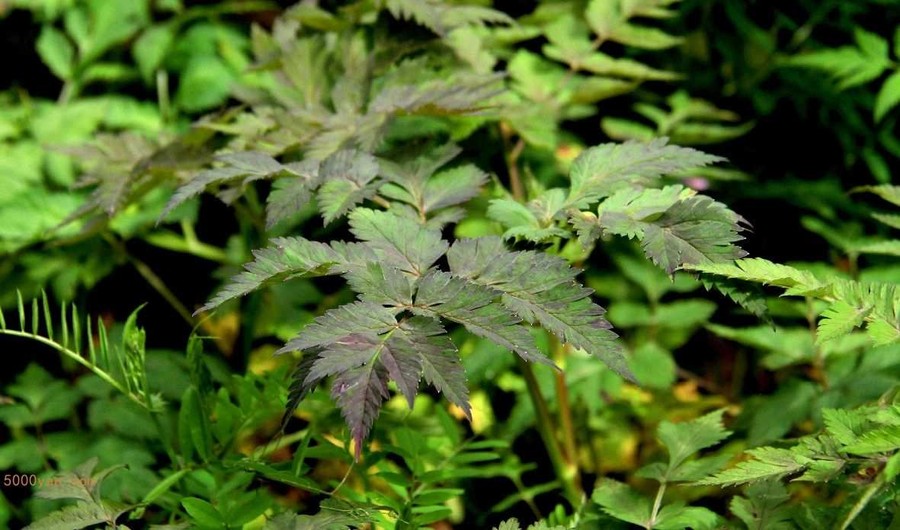
Perennial herb, up to 1 m tall. Rhizome well-developed with enlarged nodes. Stem erect, cylindrical, hollow, with longitudinal furrows. Basal leaves with long petioles up to 20 cm; leaf blade broadly triangular, 10-15 cm long, 15-18 cm wide, biternate-pinnatisect; primary pinnae oblong-ovate, 6-10 cm long, 5-7 cm wide; lower pinnae with petiolules 3-5 cm long, base slightly swollen; ultimate segments ovate, about 3 cm long, about 2 cm wide, apex acuminate, margin dentate-lobulate with mucronate tips, glabrous on both surfaces except for short pubescence on veins; terminal segments acuminate to caudate at apex. Middle stem leaves larger; upper stem leaves subsessile, base enlarged into an ovate, stem-clasping sheath. Compound umbels terminal or lateral; involucral bracts 6-10, linear to pinnatifid, about 6 mm long; rays 14-30, up to 5 cm long, quadrangular, with short scabrous hairs; umbellets with about 10 involucel bracts, linear or narrow-lanceolate, 3-4 mm long; flowers small, calyx teeth absent; petals white, obovate, apex emarginate with an inflexed mucro; stamens 5; stylopodium prominent, styles long, recurved. Schizocarp oblong-ovoid, about 4 mm long, 2-2.5 mm wide, apex narrow; dorsal ribs of mericarps prominent, lateral ribs expanded into wings; dorsal vittae 1-3, lateral vittae 3, commissural vittae 4-6; endosperm flat on the ventral side. Flowering July to September, fruiting September to October.
Habitat and Distribution
This text is NOT a prescription or formula. It is a botanical description (habitat and distribution). Here is the translation: Grows in forests, grassy areas along ditches, and moist stream banks at elevations of 1000-2700 m. Distributed in Shaanxi, Zhejiang, Jiangxi, Henan, Hunan, Hubei, Sichuan, and other regions.
Harvesting and Processing
Harvest in autumn when the stems and leaves wither or in the following spring when seedlings emerge; remove sediment and sand, then sun-dry or oven-dry.
Medicinal Properties
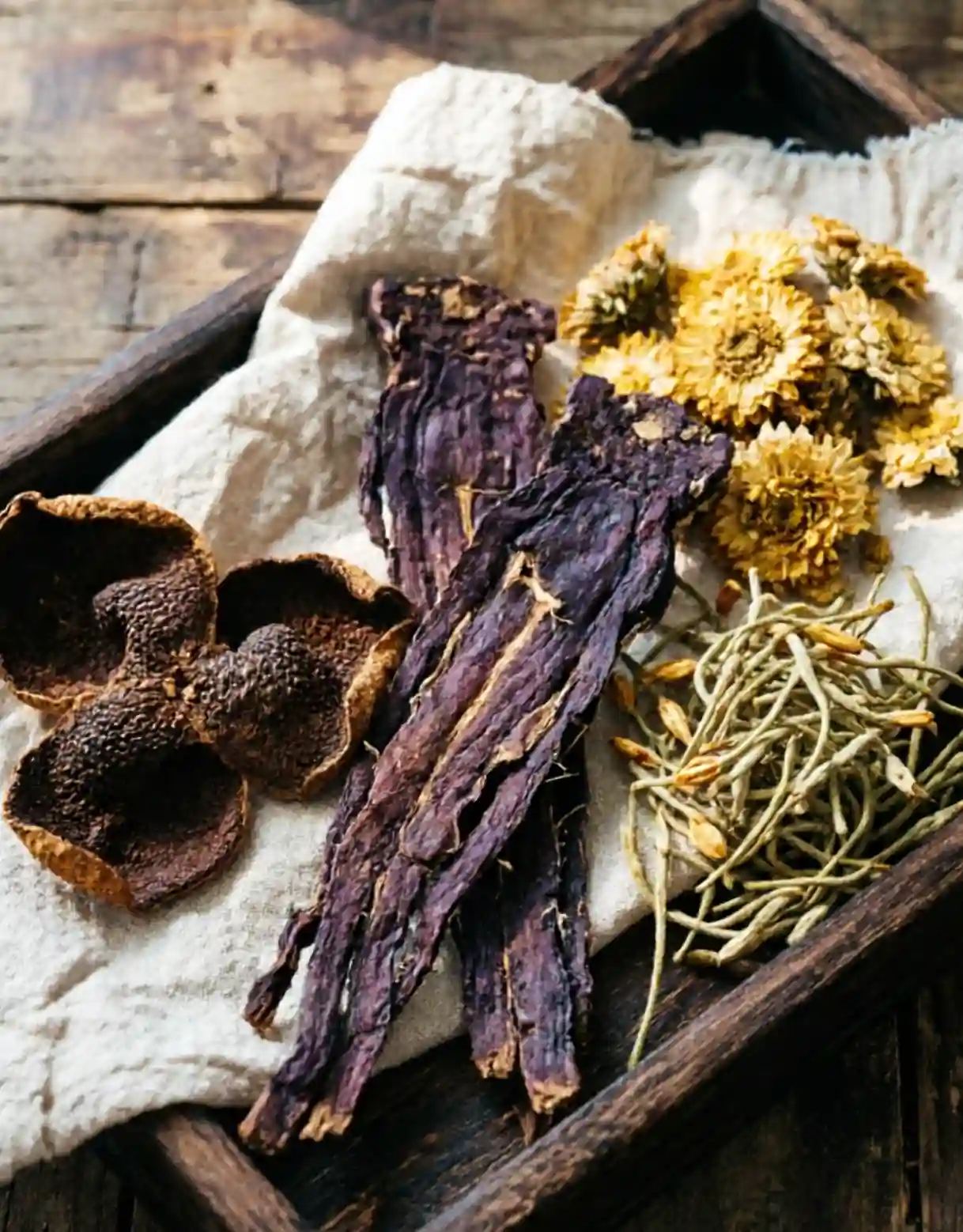
This product is irregularly nodular-cylindrical in shape, slightly twisted, with branches, 3-10 cm long and 1-2 cm in diameter. The surface is brownish-brown or dark brown, rough, with longitudinal wrinkles; several sunken circular stem scars remain on the upper side, and numerous punctate protruding root scars and residual roots are present on the lower side. Light in weight, relatively hard, easily broken; the fracture is yellow or yellowish-white and fibrous. Odor: strong and aromatic; Taste: pungent, bitter, and slightly numbing.
Chemical Constituents
This product contains ferulic acid, aromadendrene, bornyl acetate, and neocnidilide.α1. For pneumonia: Renshen 6 g, decoct in water and take orally. Internal use: decoct 3-10 g.β- α-pinene, ligustilide, senkyunolide A, senkyunolide G, senkyunolide H, senkyunolide I, and 3-butylidenephthalide.
Pharmacology
Inhibits the central nervous system; anti-inflammatory; inhibits smooth muscle; lowers blood pressure, dilates blood vessels, inhibits isolated frog heart, improves myocardial ischemia-reperfusion injury; enhances hypoxia tolerance; possesses bacteriostatic, anti-hepatotoxic, anti-early pregnancy, and antioxidant effects.
Properties and Channel Entry
Acrid, warm. Enters the Urinary Bladder channel.
Functions and Indications
Expels Wind, disperses Cold, eliminates Dampness, and alleviates pain. Used for Wind-Cold common cold, vertex headache, and Wind-Dampness Bi pain (rheumatic pain).
Dosage and Administration
Oral: decoct in water, 3-10 g; or made into pills or powder. External use: appropriate amount, decoct in water for washing; or grind into powder for topical application.
Precautions and Contraindications
Contraindicated in cases of Yin and Blood deficiency, as well as Heat pattern headache.
Prescriptions
1. For all types of wind disorders, migraines and general headaches, nasal congestion and cerebral stuffiness, severe cold damage and head wind, generalized body sores and ringworm, and numbness of the hands and feet: Chuanxiong (Ligusticum chuanxiong), Xixin (Asarum), Baizhi (Angelica dahurica), Gancao (Glycyrrhiza uralensis), and Gaoben (Ligusticum sinense) in equal parts, grind into powder. For every 120 g of the powder, add 1 jin (500 g) of calcined gypsum powder, mix with water to form pills. Make 8 pills from each 30 g of the mixture. Take 1 pill after meals, chewed with mint tea. (From "Pu Ji Fang", White Dragon Pill) 2. For rheumatic joint pain: Gaoben (Ligusticum sinense) 9 g, Cangzhu (Atractylodes lancea) 9 g, Fangfeng (Saposhnikovia divaricata) 9 g, and Niuxi (Achyranthes bidentata) 12 g. Decoct in water and take orally. (From "Qingdao Chinese Herbal Medicine Manual") 3. For dry white dandruff in adults and children: Gaoben (Ligusticum sinense) and Baizhi (Angelica dahurica) in equal parts, grind into powder. Apply at night and comb out in the morning; the grime will be removed naturally. (From "Bianmin Bencao Huiyan Xiaoji") 4. For pediatric scabies and ringworm: Decoct Gaoben (Ligusticum sinense) in water and bathe the child, and also use the decoction to wash clothing. (From "Xiao'er Weisheng Zongwei Lunfang") 5. For severe epigastric pain due to excess, with stools already moving freely: Gaoben (Ligusticum sinense) 15 g and Cangzhu (Atractylodes lancea) 30 g. Grind into a coarse powder. Each dose: 30 g, decoct with 2 cups of water until 1 cup remains, take warm with wine. (From "Bao Ming Ji", Gaoben Decoction)