Pinyin: Yinchaihu
Aliases
Yinxia Chaihu, Yinhu, Niudugen, Shashen'er.
Source
1. For pneumonia: Renshen 6 g, decoct in water and take orally.Stellaria dichotomaL.var.lanceolataDried root of Bge.
Botanical Description
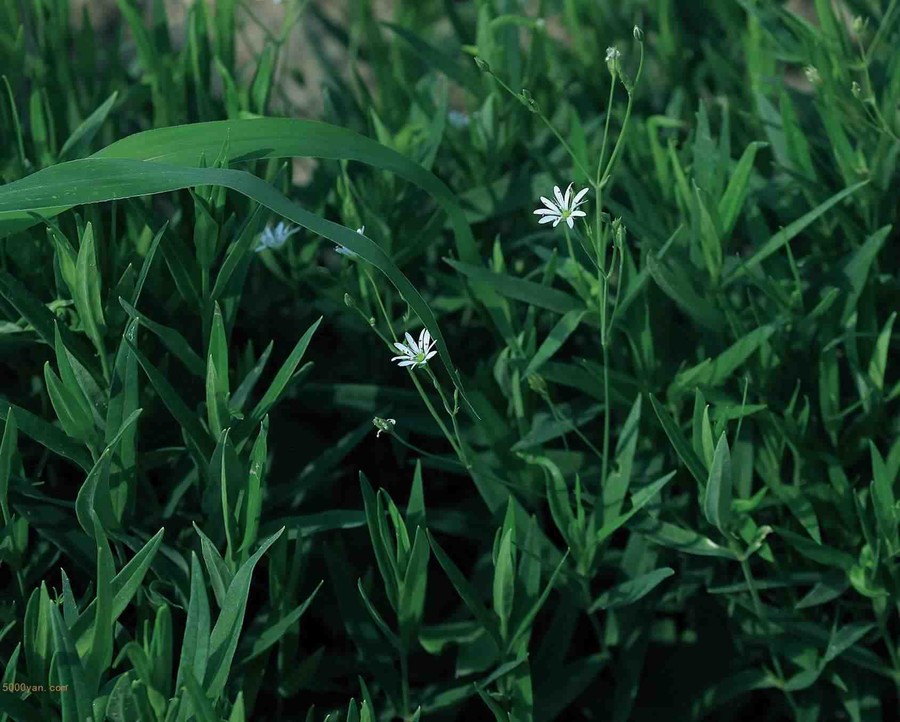
Perennial herb, 20-40 cm tall. Main root cylindrical, outer bark pale yellow, root crown with many warty stem base remnants. Stem erect and slender, upper part dichotomously branched, densely covered with short hairs or glandular hairs; nodes slightly swollen. Leaves opposite, sessile; leaf blade lanceolate, apex acute, base rounded, margin entire, sparsely short-haired or nearly glabrous above, short-haired below. Flowers solitary in leaf axils; sepals 5, lanceolate, green, margin white membranous; petals 5, shorter than sepals, white, entire, apex 2-cleft; stamens 10, in 2 whorls, filaments basally connate, yellow; ovary superior, styles 3, slender. Capsule subglobose, covered by persistent calyx, apex 6-toothed when mature. Seeds usually 1, ellipsoid, dark brown, seed coat with many small protuberances. Flowering June-July, fruiting August-September.
Habitat and Distribution
Born in dry grasslands and mountain crevices. Distributed in Northeast China, Inner Mongolia, Hebei, Shaanxi, Gansu, Ningxia, and other regions.
Harvesting and Processing
Harvest in spring or summer when the plant germinates, or in autumn after the stems and leaves wither; for cultivated varieties, harvest in mid-September of the third year or mid-April of the fourth year after planting, remove remaining stems, fibrous roots, and soil, and dry in the sun.
Medicinal Properties
Root is nearly cylindrical, 15-40 cm long, 1-2.5 cm in diameter, with most branch roots broken off. Surface is yellowish-white or pale yellow, with distinct longitudinal wrinkles, gradually twisting to the left toward the lower part, and sparsely dotted with pit-like depressions (fine root scars), commonly known as "sand eyes." The apex of the root head is slightly enlarged, densely covered with grayish-brownish-yellow, wart-like stem scars and sterile buds, commonly known as "pearl plate." Texture is hard and brittle, easily broken, with fissures on the fracture surface; the cortex is very thin, and the wood exhibits alternating yellow and white radial striations (due to alternating rays and xylem bundles). Odor: faint; Taste: bland, slightly sweet.
Chemical Constituents
This product mainly containsα- Spinasterol,βContains components such as β-sitosterol, stellaria cyclopeptide I, and 3,4-dimethoxycinnamic acid.
Properties and Channel Entry
Sweet, slightly cold. Enters the Liver and Stomach channels.
Functions and Indications
Clears deficiency Heat and eliminates infantile malnutrition Heat. Mainly treats Yin deficiency fever, bone-steaming consumptive fever, and fever due to infantile malnutrition with accumulation.
Dosage and Administration
Internal use: decoction, 5-10 g; or in pill or powder form.
Precautions and Contraindications
For external contraction of Wind-Cold with Blood deficiency and no Heat, use with caution.
Prescriptions
1. For bone-steaming consumptive fever: Yin Chai Hu (Starwort Root) 4.5 g, Hu Huang Lian (Picrorhiza) 3 g, Qin Jiao (Gentian Root) 3 g, Bie Jia (Turtle Shell, vinegar-fried) 3 g, Di Gu Pi (Wolfberry Root Bark) 3 g, Qing Hao (Sweet Wormwood) 3 g, Zhi Mu (Anemarrhena) 3 g, Gan Cao (Licorice) 1.5 g. Decoct in two bowls of water down to eight-tenths, take after meals. (Qing Gu San from *Zheng Zhi Zhun Sheng*). 2. For consumptive fever in men and women, with or without cough: Yin Chai Hu (Starwort Root) and Sha Shen (Glehnia or Adenophora Root) in equal parts, take 6 g per dose, decoct in water and take orally. (From *Ben Cao Hui Yan*). 3. For tidal fever in warm diseases, withered body, squamous and dry skin, emaciation without moisture: Yin Chai Hu (Starwort Root) 6 g, Bie Jia (Turtle Shell) 9 g. Decoct in water and take orally. (Yin Jia San from *Wen Bing Zhi Gui*).