Pinyin: Gancao
Aliases
Meicao, Migan, Tiancao
Source
Fabaceae plant Glycyrrhiza uralensisGlycyrrhiza uralensisThe dried root and rhizome of *Panax ginseng* C.A. Mey.
Botanical Description
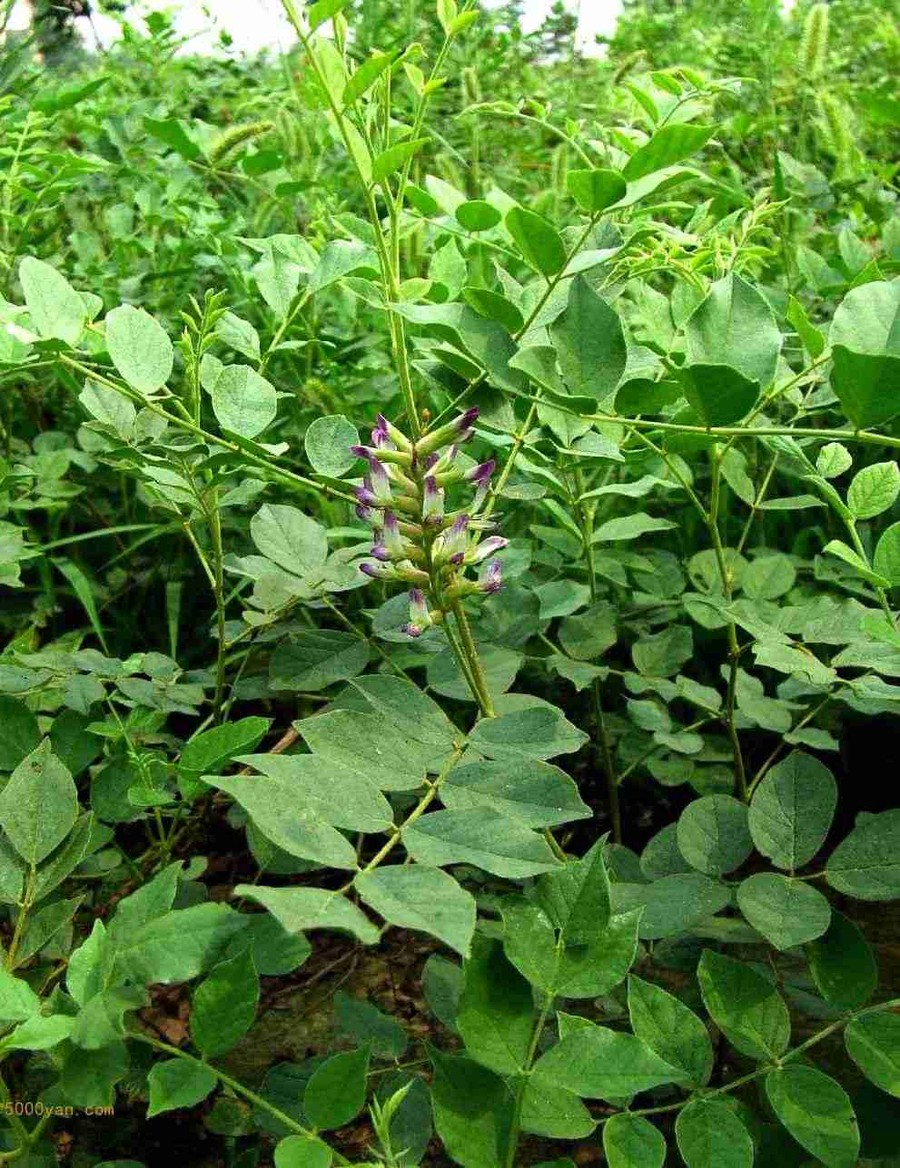
Perennial herb, 30-100 cm tall. Roots and rhizomes thick, bark reddish-brown. Stems erect, somewhat woody, with white short hairs and glandular setae. Odd-pinnate leaves 8-20 cm long; leaflets 7-17, ovate or broadly ovate, 2-5 cm long, 1-3 cm wide, apex acute or obtuse, base rounded, both surfaces covered with short hairs and glands; stipules broadly lanceolate, with white cilia. Racemes axillary, flowers dense; calyx campanulate, 5 calyx teeth, lanceolate, outer surface with short hairs and glandular setae; corolla blue-purple, 1.4-2.5 cm long, glabrous, standard petal large, ovate, with claw, keel petal straight, shorter than wing petals, all with long claws; stamens diadelphous (9+1). Legume linear, falcate or coiled, densely covered with glandular setae. Seeds 4-8, reniform. Flowering period July-August, fruiting period August-September.
Habitat and Distribution
Grows in sunny, dry calcareous grasslands, sandy riverbanks, and similar soils. Distributed in Northeast, North, and Northwest China.
Harvesting and Processing
Harvested in autumn, remove the reed head, stem base, branches, and fibrous roots, cut into appropriate lengths, sun-dry until half-dry, tie into small bundles, then sun-dry until completely dry.
Medicinal Properties
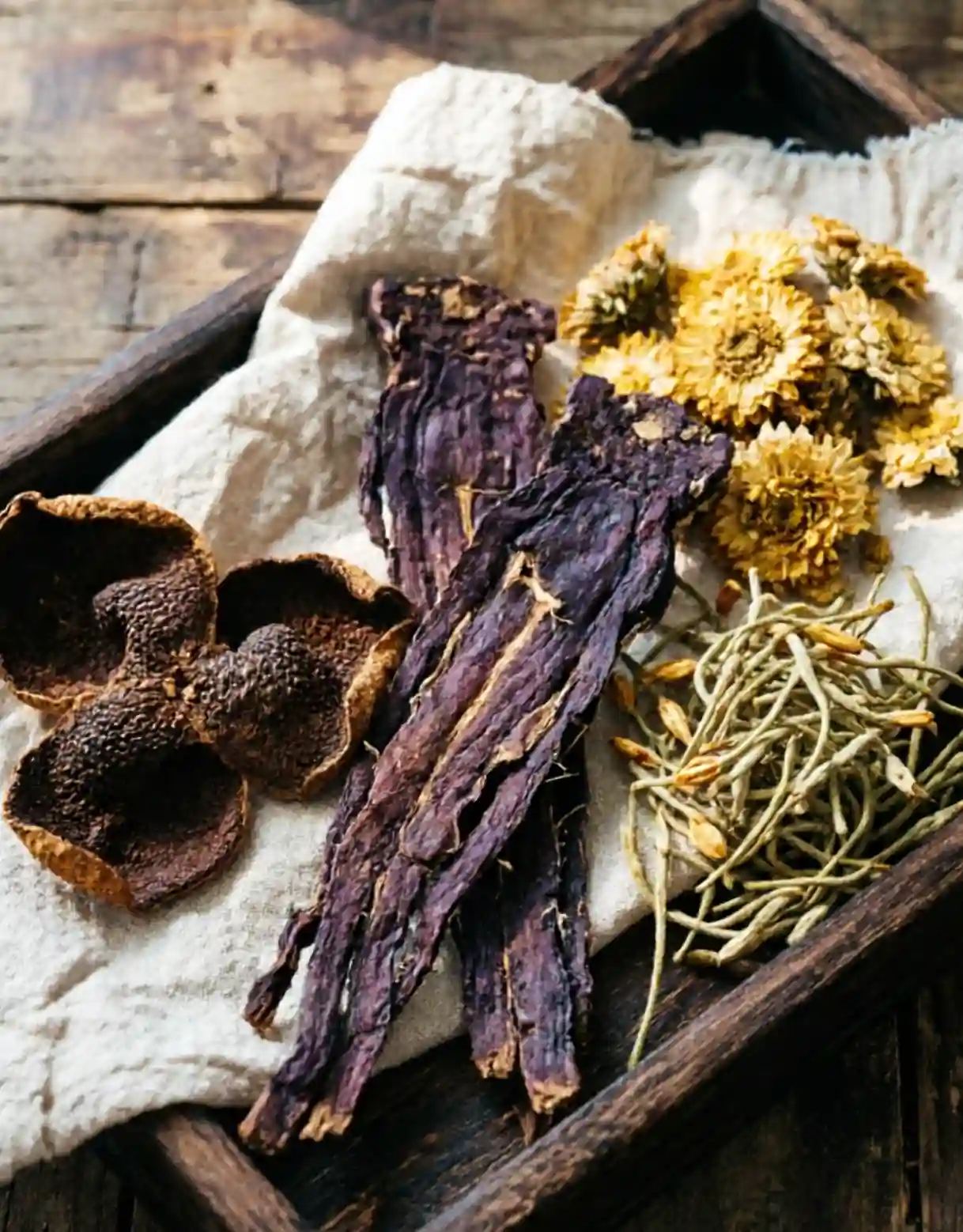
Root is cylindrical, 25-100 cm long, 0.6-3.5 cm in diameter. Outer bark varies in tightness. Surface is reddish-brown or grayish-brown, with prominent longitudinal wrinkles, furrows, lenticels, and sparse fine root scars. Texture is firm; cut surface is slightly fibrous, yellowish-white, with powdery texture; cambium ring is distinct; rays are radiate; some have fissures. Rhizome is cylindrical, with bud scars on the surface and a pith in the center of the cut surface. Odor is faint; taste is sweet and distinctive.
Chemical Constituents
This product mainly contains liquiritin, glycyrrhizic acid, glycyrrhizin, caryophyllene oxide, glycyrrhetol, 18αHydroxyglycyrrhetinic acid, Isoglycyrrhetinic acid, Licoricone, Formononetin, Neolicurochalcone D, Glabranin, and Isolicoflavonol, among other constituents.
Pharmacology
It has antiviral, antibacterial, adrenocortical hormone-like, anti-ulcer, hepatoprotective, promotes pancreatic juice secretion, inhibits isolated intestines, anti-inflammatory, anti-atherosclerotic, regulates immune function, antitussive and expectorant, antitumor, antimutagenic, detoxifying, antioxidant, protects vestibular function, and diuretic effects.
Properties and Channel Entry
Sweet, neutral. Enters the Heart, Lung, Spleen, and Stomach channels.
Functions and Indications
Tonifies the Spleen and supplements Qi, clears Heat and resolves toxicity, expels Phlegm and stops cough, relaxes tension and alleviates pain, harmonizes various medicinals. Used for Spleen and Stomach weakness, fatigue and lack of strength, palpitations and shortness of breath, cough with copious phlegm, epigastric and abdominal spasms and pain, limb spasms and pain, abscesses and sores, and to moderate the toxicity and harshness of other medicinals.
Dosage and Administration
Oral: Decoction, 2-6 g. When used to harmonize various herbs, the dosage should be small; when used as the main herb, the dosage should be slightly larger, around 10 g. For poisoning rescue, 30-60 g can be used. When added to tonifying formulas, it is best to use the prepared (honey-fried) form; when added to purging or heat-clearing formulas, it is best to use the raw form. External use: appropriate amount, decoct for washing or soaking, or grind into powder for application.
Precautions and Contraindications
Contraindicated in cases of damp-turbidity obstructing the middle burner presenting with epigastric and abdominal distension and fullness, vomiting, and edema. It should not be used in combination with Haizao (Sargassum), Jingdaji (Radix Knoxiae), Hongdaji (Radix Knoxiae Rubrae), Gansui (Radix Euphorbiae Kansui), and Yuanhua (Flos Genkwa).
Prescriptions
1. For typhoid fever with knotted and intermittent pulse and palpitations: Zhi Gancao (honey-fried licorice) 120 g, Shengjiang (fresh ginger, sliced) 90 g, Renshen (Panax ginseng) 60 g, Sheng Dihuang (fresh Rehmannia) 480 g, Guizhi (cinnamon twig, peeled) 90 g, Ejiao (donkey-hide gelatin) 60 g, Maimendong (Ophiopogon, core removed) 240 g, Maren (hemp seed) half a sheng, Dazao (jujube, split) 30 pieces. Decoct the first eight ingredients in 7 sheng of clear wine and 8 sheng of water, reduce to 3 sheng, strain, then dissolve the Ejiao completely. Take 1 sheng warm, three times daily. (Zhi Gancao Tang, *Shang Han Lun*) 2. For lung heat with sore throat and phlegm-heat: Gancao (licorice, dry-fried) 60 g, Jiegeng (Platycodon, soaked in rice-washed water overnight) 30 g. Each dose: 15 g, decoct in one and a half cups of water with half a slice of Ejiao. (*Xiao'er Yaozheng Zhijue*) 3. For leg and foot spasms or abdominal pain: Baishao (white peony) and Zhi Gancao (honey-fried licorice) 120 g each. Decoct in water, strain, and take in two divided doses. (Shao Yao Gancao Tang, *Shang Han Lun*) 4. For female hysteria with frequent sadness, crying, and yawning: Gancao (licorice) 90 g, Xiaomai (wheat) 1 sheng, Dazao (jujube) 10 pieces. Decoct the three ingredients in 6 sheng of water, reduce to 3 sheng, and take warm in three divided doses. Also tonifies Spleen Qi. (Gancao Xiaomai Dazao Tang, *Jin Gui Yao Lue*) 5. For poisoning from various drugs: Sheng Gancao (raw licorice) 60 g, freshly sliced. Decoct in 3 cups of water until 1.5 cups remain, strain, and cool. Take half a cup slowly, sipping frequently; repeat if not effective. (*Sheng Ji Zong Lu*)