Pinyin: Huangqin
Aliases
Fuchang, Ziqin, Tiaoqin, Huangjin Tiaogen.
Source
Plant of the Lamiaceae family: *Scutellaria baicalensis*Scutellaria baicalensisDried root of *Panax ginseng* C.A. Mey.
Botanical Description
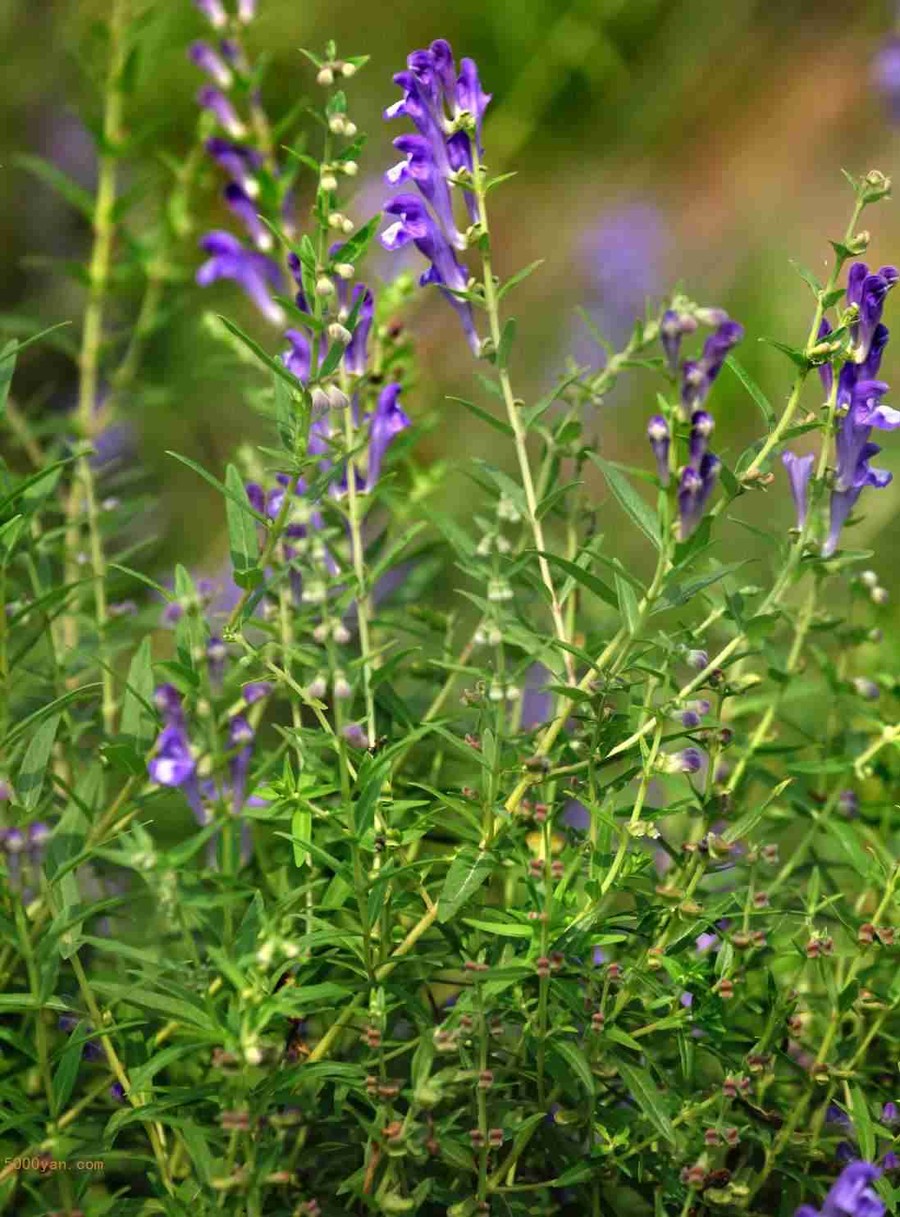
Perennial herb, 30-80 cm tall. Stem bluntly quadrangular, with fine striations, glabrous or with upward-curved to spreading minute hairs, green or often tinged with purple; branching from the base, numerous and slender. Leaves opposite, decussate; sessile or nearly sessile; leaf blade lanceolate to linear-lanceolate, 1.5-4.5 cm long, 3-12 mm wide, apex obtuse, base suborbicular, margin entire, upper surface dark green, glabrous or sparsely hairy, lower surface pale green, hairy along the midvein. Densely covered with black sunken glands. Racemes terminal or axillary, secund, 7-15 cm long; bracts leaf-like, ovate-lanceolate to lanceolate, 4-11 mm long, nearly glabrous; calyx bilabiate, purple-green, upper lip with a shield-like appendage on the back, enlarging in fruit, membranous; corolla bilabiate, blue-purple or purplish-red, upper lip galeate, apex slightly emarginate, lower lip broad, middle lobe triangular-ovate, 7.5 mm wide, lateral lobes appressed to the upper lip, corolla tube slender, base abruptly curved; stamens 4, slightly exserted, anther slits with white beard hairs; ovary brown, 4-parted, borne on an annular disc, style slender, apex slightly cleft. Nutlets 4, ovoid, 1.5 mm long, 1 mm in diameter, blackish-brown, with tubercles. Flowering June-September, fruiting August-October.
Habitat and Distribution
Born on sunny, dry mountain slopes and wastelands, commonly found along roadsides. Distributed in Northeast China, Inner Mongolia, Shanxi, Gansu, Henan, and other regions.
Harvesting and Processing
Harvested in spring and autumn, remove fibrous roots and sediment, sun-dry then rub off the coarse outer bark, and sun-dry thoroughly.
Medicinal Properties
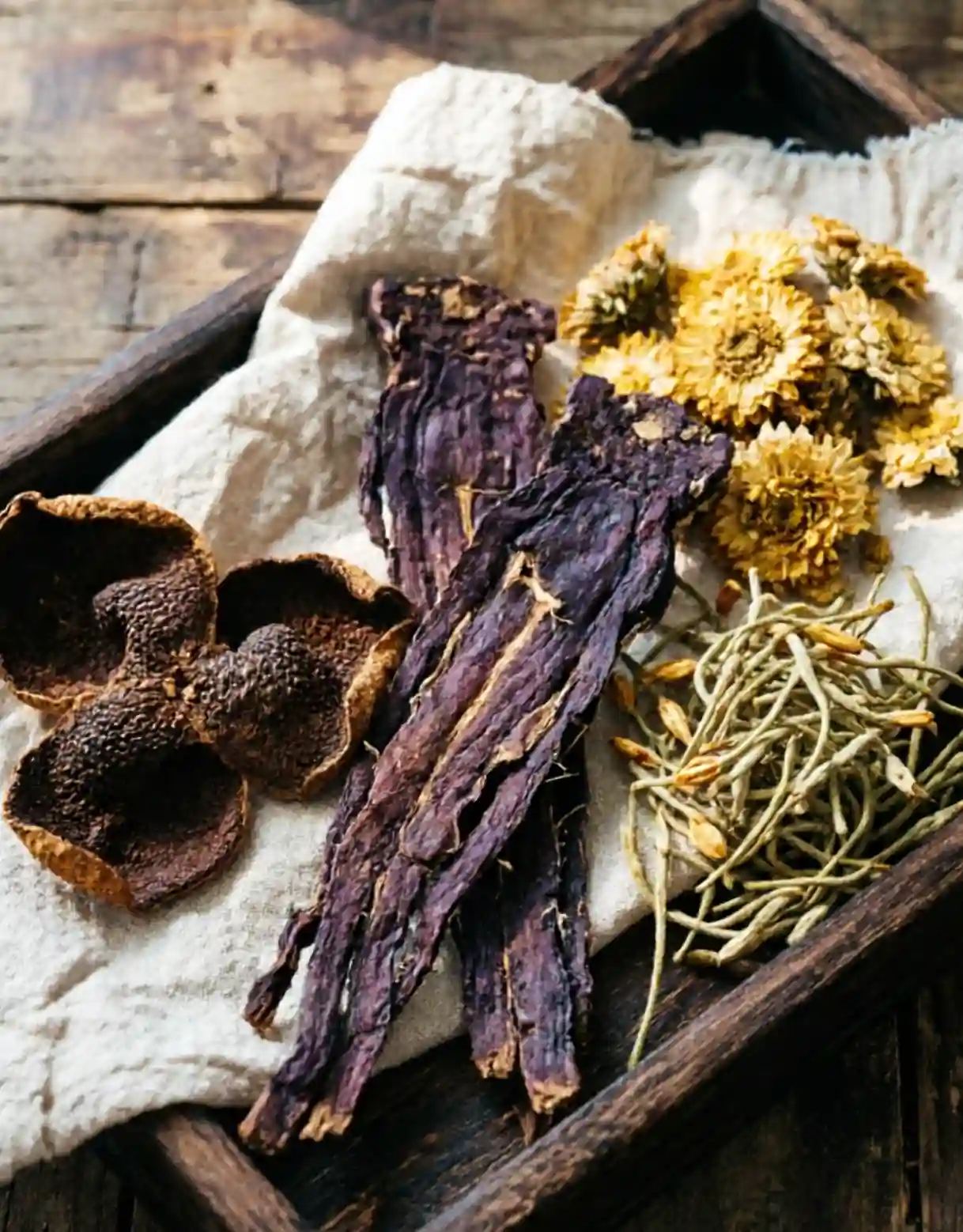
This product is conical in shape, twisted, 8-25 cm long, and 1-3 cm in diameter. The surface is brownish-yellow or deep yellow, with sparse warty rootlet scars; the upper part is relatively rough with twisted longitudinal wrinkles or irregular reticulate patterns, while the lower part has longitudinal striations and fine wrinkles. The texture is hard and brittle, easily broken, with a yellow fracture surface and a reddish-brown center; the center of old roots appears withered or hollow, dark brown or brownish-black. The odor is faint, and the taste is bitter.
Chemical Constituents
This product contains baicalin, baicalein, neobaicalein, wogonin, wogonoside, viscidulin, and dihydrooroxylin A.
Pharmacology
It has antimicrobial, anti-inflammatory, anti-allergic, antihypertensive, diuretic, lipid-lowering, antiplatelet aggregation and anticoagulant, sedative, antipyretic, hepatoprotective, and renal protective effects; at low doses it promotes immune cell proliferation, while at high doses it inhibits it; delays the onset of cataracts.
Properties and Channel Entry
Bitter, cold. Enters the Lung, Gallbladder, Spleen, Large Intestine, and Small Intestine channels.
Functions and Indications
Clears Heat and dries Dampness, drains Fire and resolves toxicity, stops bleeding, and calms the fetus. Used for damp-warm and summer-damp conditions with chest oppression, nausea, and vomiting; damp-heat epigastric fullness; diarrhea and dysentery; jaundice; lung heat cough; high fever with vexation and thirst; blood heat causing vomiting and epistaxis; carbuncles, swellings, and sores; and threatened miscarriage.
Dosage and Administration
Oral administration: decocted in water, 3-9 g; or made into pills or powder. External application: appropriate amount, decocted in water for washing; or ground into powder for topical application. Used raw for clearing Heat and purging Fire, and for detoxification; stir-fried with wine for treating Heat syndromes of the upper body; stir-fried with pig bile for purging Liver and Gallbladder Fire; stir-fried to charcoal for hemostasis.
Precautions and Contraindications
Contraindicated in cases of Spleen and Stomach deficiency cold with poor appetite and loose stools.
Prescriptions
1. For phlegm-fire cough with asthma and rapid breathing: Scutellaria baicalensis 9 g, Gardenia jasminoides (charred) and Perilla frutescens seeds 4.5 g each, Poria cocos and Prunus armeniaca seeds 3 g each. Decoct in water for oral administration. (Ben Cao Hui Yan) 2. For pulmonary tuberculosis with tidal fever and cough: Scutellaria baicalensis and Salvia miltiorrhiza 9-12 g each, Stemona sessilifolia 12-18 g. Decoct in water for oral administration. For prolonged treatment, tablets or pills are more convenient. (Shanghai College of Traditional Chinese Medicine, Fang Ji Xue - Qin Bu Dan) 3. For Shaoyang headache and Taiyang headache, regardless of unilateral or bilateral: Scutellaria baicalensis slices, soaked thoroughly in wine, dried and ground into powder. Take 3 g per dose, with tea or wine. (Lan Shi Mi Cang - Xiao Qing Kong Gao) 4. For stomach channel heat causing swollen and bleeding gums: Scutellaria baicalensis, Coptis chinensis, Rehmannia glutinosa, Paeonia suffruticosa bark, Cimicifuga foetida, and Gypsum fibrosum 3 g each. Decoct in water, take after meals. (Wai Ke Zheng Zong - Qing Wei San) 5. For fetal heat causing restlessness: Scutellaria baicalensis and Atractylodes macrocephala in equal parts. Both slightly stir-fried, ground into powder, mixed with honey to make pills the size of parasol seeds. Take 9 g each morning and evening, with plain boiled water. (Dan Xi Zhuan Yao)