Pinyin: Xiatianwu
Aliases
Yili Jindan, Fudi Yanhusuo, Luoshui Zhu.
Source
Papaveraceae plant *Corydalis decumbens* (Thunb.) Pers.Corydalis decumbensThe dried tuber of (Thunb.) Pers.
Botanical Description
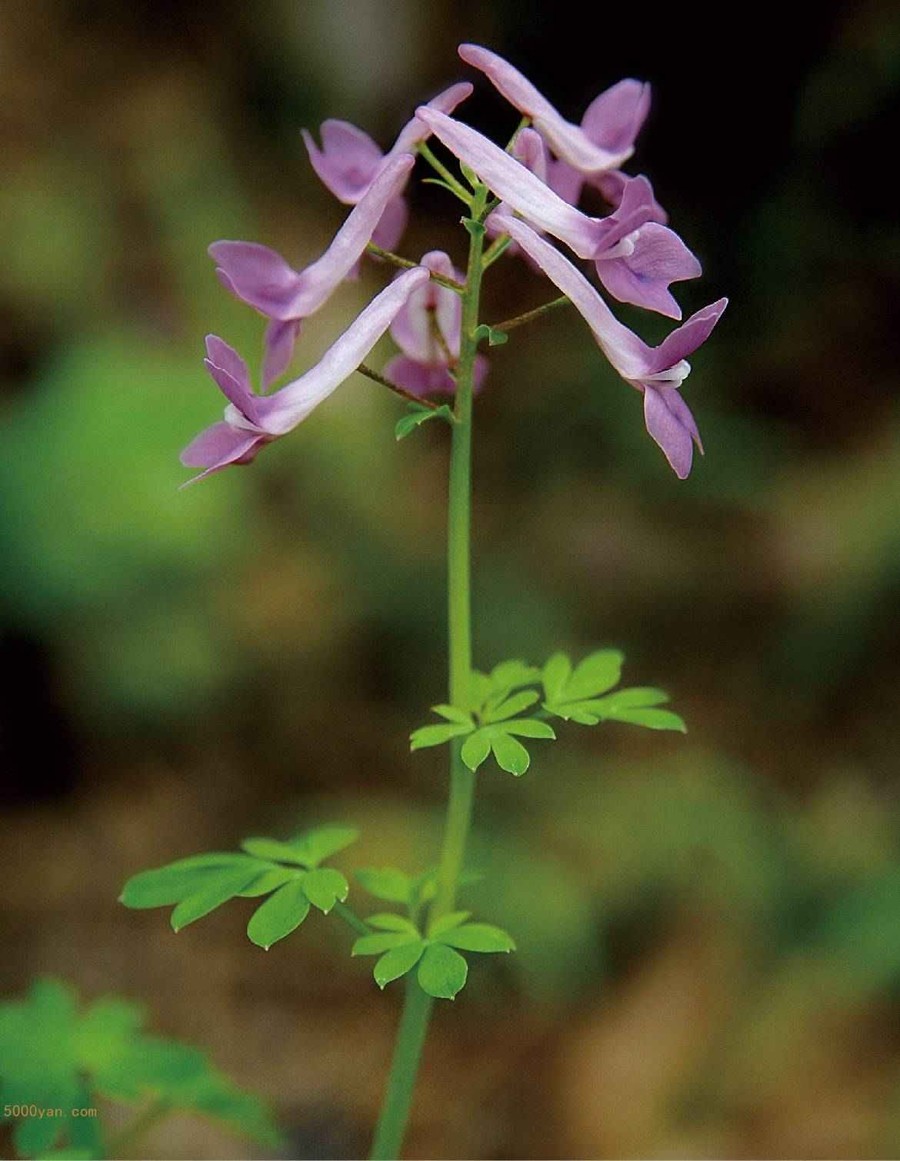
Perennial herb, glabrous (hairless), 16-30 cm tall. Tubers subglobose, 3-9 mm in diameter, dark brown; current year's tubers grow on top of previous year's tubers, which quickly become hollow. Adventitious roots arise from the tuber surface. Stems slender, 2-3 clustered, unbranched. Basal leaves usually 1; long petiolate; leaf blade triangular in outline, approximately 6 cm long, biternately dissected; ultimate segments sessile, narrowly obovate, entire, with white powder on the lower surface; cauline leaves 3-4, alternate or opposite, borne on the middle to upper stem, similar to basal leaves but smaller, with shorter petioles. Raceme terminal, 1.5-4 cm long, sparsely flowered; bracts ovate or narrowly obovate, 5-7 mm long, entire; lower pedicels up to 12 mm long; corolla light purplish red; outer upper petal 14-18 mm long, limb suborbicular, apex slightly emarginate, margin undulate; spur cylindrical, 6-8 mm long. Stigma with 4 papillae. Capsule slenderly oblong, slightly moniliform. Seeds minute, in 2 rows. Flowering April to May, fruiting May to June.
Habitat and Distribution
⚠️⚠️⚠️ This is NOT a prescription or formula. It is a description of the habitat and distribution of a plant. I will translate it as such. Born in hills at an altitude of 80-300 m, under forests on low slopes, beside streams, and at field edges in shady and damp areas. Distributed in Jiangsu, Anhui, Zhejiang, Jiangxi, Fujian, Taiwan, Henan, Hubei, Hunan, and other regions.
Harvesting and Processing
Harvested in spring or early summer after seedling emergence, remove the stems, leaves, and fibrous roots, wash clean, and dry.
Medicinal Properties
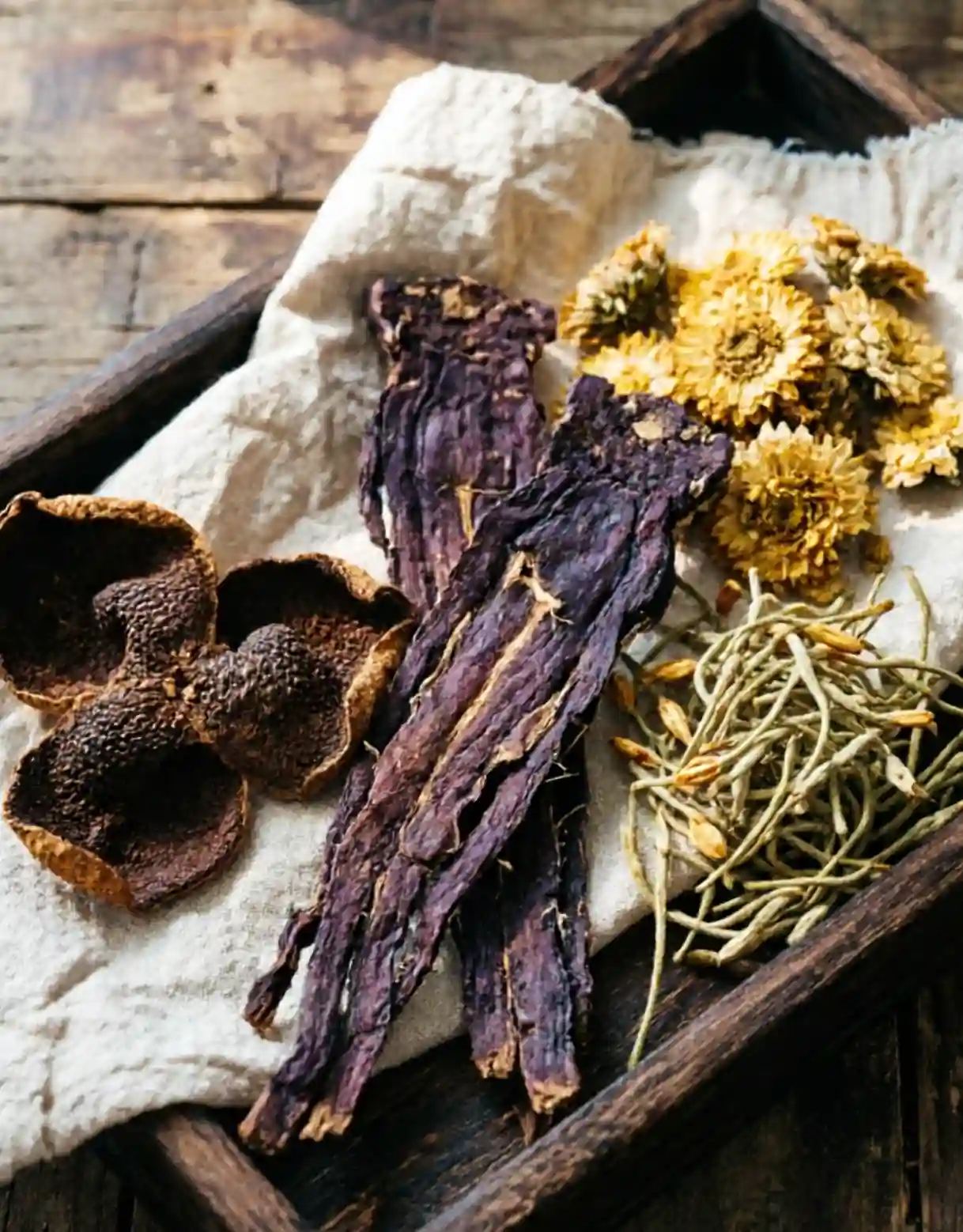
This product appears as spherical, oblong, or irregularly shaped lumps, 0.5-3 cm long and 0.5-2.5 cm in diameter. The surface is gray-yellow, dark green, or blackish-brown, with tuberculate protrusions and indistinct fine wrinkles; the apex is bluntly rounded. Stem scars are visible, surrounded by pale yellow punctate leaf scars and rootlet scars. The texture is hard; the cut surface is yellowish-white or yellow, granular or horny, some slightly powdery. Odor: faint; Taste: bitter.
Chemical Constituents
This product mainly contains protopine, palmatine hydrochloride, decumbenine, corydalmine, bicuculline, and palmatine.
Pharmacology
Can cause "catalepsy" in animals, manifested as stupor, drowsiness, and muscle rigidity; if the position is arbitrarily changed, the animal can maintain that posture; it can lower blood pressure and has the effects of dilating cerebral blood vessels and lower limb blood vessels; it can relax ileal smooth muscle, relieve spasms, inhibit platelet aggregation, and exert anticoagulant effects, among others.
Properties and Channel Entry
Bitter, slightly acrid, and warm. Enters the Liver channel.
Functions and Indications
Activates Blood and alleviates pain, relaxes tendons and activates collaterals, expels Wind and eliminates Dampness. Used for hemiplegia due to Wind-stroke, headache, traumatic injury, Wind-Damp Bi pain (rheumatic pain), and lower back pain.
Dosage and Administration
Oral administration: decoction, 4.5-15 g; or powdered, 1-3 g; also can be made into pills.
Prescriptions
1. For hypertension, hemiplegia caused by brain tumors or cerebral embolism: Fresh *Corydalis decumbens* (Rhizoma Corydalis Decumbentis) mashed. Take 4-5 large pieces or 8-9 small pieces each time, 1-3 times daily, with rice wine or boiled water. Continue for 3-12 months. (*Zhejiang Commonly Used Folk Herbs*) 2. For various types of hypertension: a. *Corydalis decumbens* ground into powder and taken with water, 2-4 g each time. b. *Corydalis decumbens*, *Uncaria rhynchophylla* (Gambir Plant), *Morus alba* (White Mulberry) root bark, *Prunella vulgaris* (Common Selfheal). Decoction. (*Jiangxi Chinese Materia Medica*) 3. For rheumatic arthritis: *Corydalis decumbens* powder, 9 g each time, 2 times daily. (*Jiangxi Chinese Materia Medica*) 4. For lumbar muscle strain: *Corydalis decumbens* whole herb 15 g, decoct. (*Jiangxi Chinese Materia Medica*)