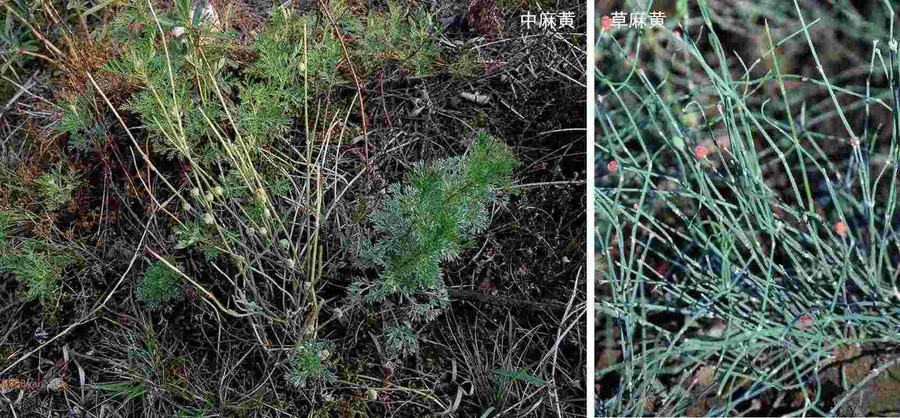
Pinyin: Mahuanggen
Aliases
Gougu gen, Beigan gen.
Source
Family Ephedraceae, plant Ephedra sinicaEphedra sinicaStapf or Ephedra intermediaEphedru intermediaDried root and rhizome of *Panax ginseng* C.A. Mey.
Botanical Description
1. Caomahuang (Ephedra sinica): Herbaceous shrub-like plant, 20-100 cm tall. Woody stem short, often resembling a rhizome, creeping on the ground or lying horizontally in the soil; branchlets straight or slightly curved, green, long cylindrical, fine longitudinal grooves often indistinct, nodes distinct, internodes 2.5-5.5 cm long, diameter 1.5-2 mm. Scale leaves membranous and sheath-like, 3-4 mm long, approximately 1/2 connate at the lower part, upper part 2-lobed, lobes sharply triangular, apex acute, often reflexed outward. Flowers in scaly catkins, usually dioecious; male catkins mostly compound spikes, often with peduncles; female catkins solitary, pedicellate, bracts enlarge at maturity, fleshy, red, berry-like. Seeds 2, enclosed within bracts, not exposed, black-red or gray-brown, triangular-ovoid or broadly ovoid, 4.5-5 mm long, diameter approximately 4 mm, surface with fine wrinkles. Flowering period May-June, seed maturity period July-August. 2. Zhongmahuang (Ephedra intermedia): Shrub, 20-100 m tall. Woody stem erect or creeping-ascending, relatively stout, much branched at base, cylindrical, often covered with white powder appearing gray-green, with opposite or whorled branches, internodes 3-6 cm long, diameter 1-3 mm, with fine shallow longitudinal grooves. Scale leaves membranous and sheath-like, approximately 1/3 connate at the lower part, lobes usually 3-lobed, rarely 2-lobed, lobes obtuse-triangular or narrow triangular-lanceolate. Male catkins usually sessile, several densely clustered at nodes forming a mass, rarely 2-3 opposite or whorled at nodes; female catkins 2-3, clustered, opposite or whorled at nodes, sessile or with short pedicels. Female catkins at maturity with bracts fleshy, red, berry-like, long-ovoid or ovoid, with a short stalk approximately 1 mm long. Seeds enclosed within fleshy red bracts, not exposed, seeds usually 3, rarely 2, ovoid or long-ovoid, 5-6 mm long, diameter approximately 3 mm. Flowering period May-June, seed maturity period July-August.
Habitat and Distribution
1. Caomahuang (Ephedra sinica): grows on hillsides, plains, dry wastelands, riverbeds, dry grasslands, near river beaches, and fixed sand dunes, often forming dense clusters. Distributed in North China as well as Jilin, Liaoning, Shaanxi, Xinjiang, and northwestern Henan. 2. Zhongmahuang (Ephedra intermedia): grows in arid deserts, sandy deserts, Gobi deserts, dry hillsides, or grasslands. Distributed in North China, Northwest China, and Liaoning, Shandong, and other areas, most commonly found in the Northwest region.
Harvesting and Processing
Harvested in late autumn, remove the remaining stems, fibrous roots, and sediment, then dry.
Medicinal Properties
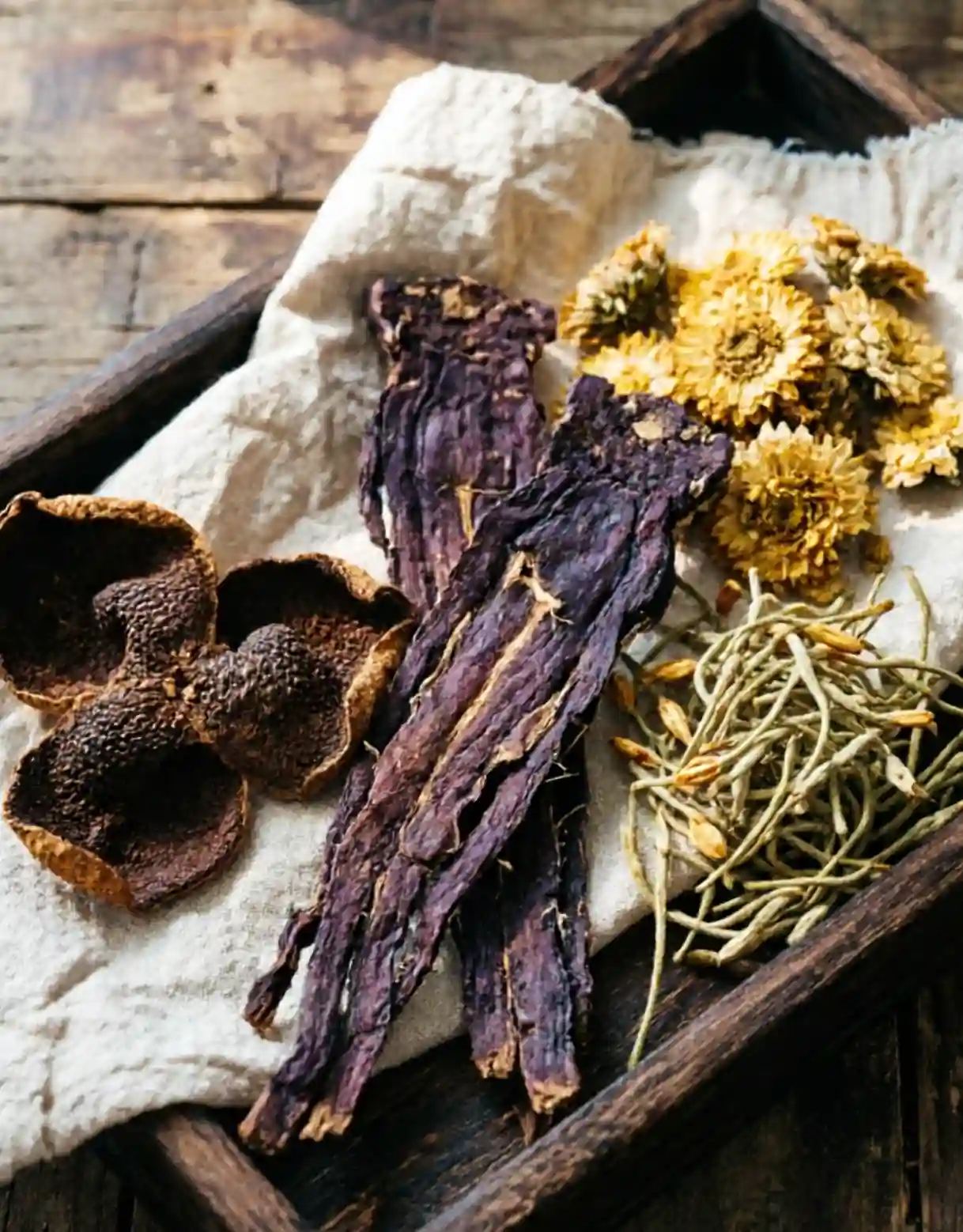
This product is cylindrical, slightly curved, 8-25 cm long, 0.5-1.5 cm in diameter. The surface is reddish-brown or grayish-brown, with longitudinal wrinkles and rootlet scars. The outer bark is rough and easily peels off in flakes. The rhizome has nodes, with internodes 0.7-2 cm long, and the surface has transversely elongated protruding lenticels. The texture is light, hard, and brittle; the bark in the transverse section is yellowish-white, the wood is pale yellow or yellow with radial rays, and the center has a pith. Odor: faint; Taste: slightly bitter.
Chemical Constituents
This product contains ephedrine A, ephedrine B, ephedrine C, ephedrine D, tyrosine betaine, feruloylhistamine, ephedrannin A, etc.
Pharmacology
Has antihypertensive and sweat-suppressing effects.
Properties and Channel Entry
Sweet, astringent, neutral. Enters the Heart and Lung channels.
Functions and Indications
Consolidates the exterior and stops sweating. Used for spontaneous sweating and night sweats.
Dosage and Administration
Internal use: decoction, 3-10 g; or made into pills or powder. External use: appropriate amount, ground into powder for topical application.
Precautions and Contraindications
Contraindicated in patients with exterior pathogens.
Prescriptions
1. For excessive spontaneous sweating: Mahuanggen (Ephedra root) and Huangqi (Astragalus) in equal parts. Grind into powder, mix with flying flour paste to form pills the size of wutong seeds. Take 100 pills with Fu Xiaomai decoction each time, stop when sweating ceases. (From "Tan Yeweng's Tested Prescriptions") 2. For night sweats due to deficiency consumption, unrelieved: Mahuanggen (Ephedra root, chopped), Muli (oyster shell, calcined), Huangqi (Astragalus, chopped) in equal parts. Coarsely grind and sieve the three ingredients. Take 9 g each dose, add one cup of water and three inches of scallion white, decoct until half a cup remains, strain, and take warm. (From "Shengji Zonglu" - Mahuanggen Tang) 3. For night sweats: Mahuanggen (Ephedra root) 0.9 g, and old worn-out fan (burned to ash) 0.3 g. Grind and sieve the two ingredients, take 0.9 g with milk, or one fangcun spoon for adults, three times daily. (From "Yixin Fang" citing "Fan Wang Fang" - Mahuang San) 4. For postpartum unrelieved excessive sweating: Danggui (Chinese Angelica, chopped, lightly stir-fried) 30 g, Mahuanggen (Ephedra root) 60 g, Huangqi (Astragalus, chopped) 30 g. Coarsely grind the above ingredients and sift into a powder. Take 12 g each dose, add one medium cup of water, decoct until six-tenths remain, strain, and take warm regardless of mealtime. (From "Sheng Hui Fang" - Mahuanggen San) 5. For foot sweating: Mahuanggen (Ephedra root) 30%, Muli (oyster shell) 30%, Urotropine 15%, Talcum powder 25%. Grind the above ingredients together into a fine powder, apply an appropriate amount to the feet. Generally, this can keep the feet sweat-free for 10-15 days. (From "Quanguo Zhongcaoyao Huibian")