Pinyin: Tufuling
Aliases
Yuyuliang, Baiyuliang, Fantuan'gen, Hongtuling.
Source
Liliaceae plant *Smilax glabra*Smilax glabraRoxb.
Botanical Description
A scrambling shrub, 1-4 m long. Stems smooth, spineless. Rhizomes thick, tuberous, often connected by stolons, 2-5 cm thick. Leaves alternate; petiole 5-20 mm long, approximately 1/4 to 3/5 of the total length, with narrow sheaths. Often bearing 2 slender tendrils, with the abscission point near the apex; leaf blade thin-leathery, narrowly elliptic-lanceolate to narrowly ovate-lanceolate, 6-12 (-15) cm long, 1-4 (-7) cm wide, apex acuminate, base rounded or obtuse, lower surface usually pale green. Umbels solitary, axillary, usually with more than 10 flowers; peduncle of male umbels usually distinctly shorter than the petiole, rarely nearly equal to the petiole, with a bud between the peduncle and petiole; receptacle enlarged, together with numerous persistent bracteoles somewhat rosette-shaped; flowers greenish-white, hexagonal-globose; outer tepals of male flowers suborbicular, hooded, with a longitudinal groove on the back center, inner tepals suborbicular, margins irregularly toothed; stamens appressed, nearly as long as inner tepals, filaments very short; peduncle of female umbels about 1 cm long, female flowers similar in appearance to male flowers, but inner tepal margins without teeth, with 3 staminodes. Berry 6-8 mm in diameter, black when ripe, with a powdery bloom. Flowering period May to November, fruiting period November to April of the following year.
Habitat and Distribution
It grows under forests, in shrub thickets, along riverbanks or in valleys below an altitude of 1800 m, and is also found at forest edges and in sparse forests. It is distributed in Gansu (southern region), south of the Yangtze River basin, as well as Taiwan, Hainan, and Yunnan.
Harvesting and Processing
Harvested year-round, washed, soaked, rinsed, sliced, and sun-dried; or blanched in boiling water for a few minutes, then sliced and sun-dried.
Medicinal Properties
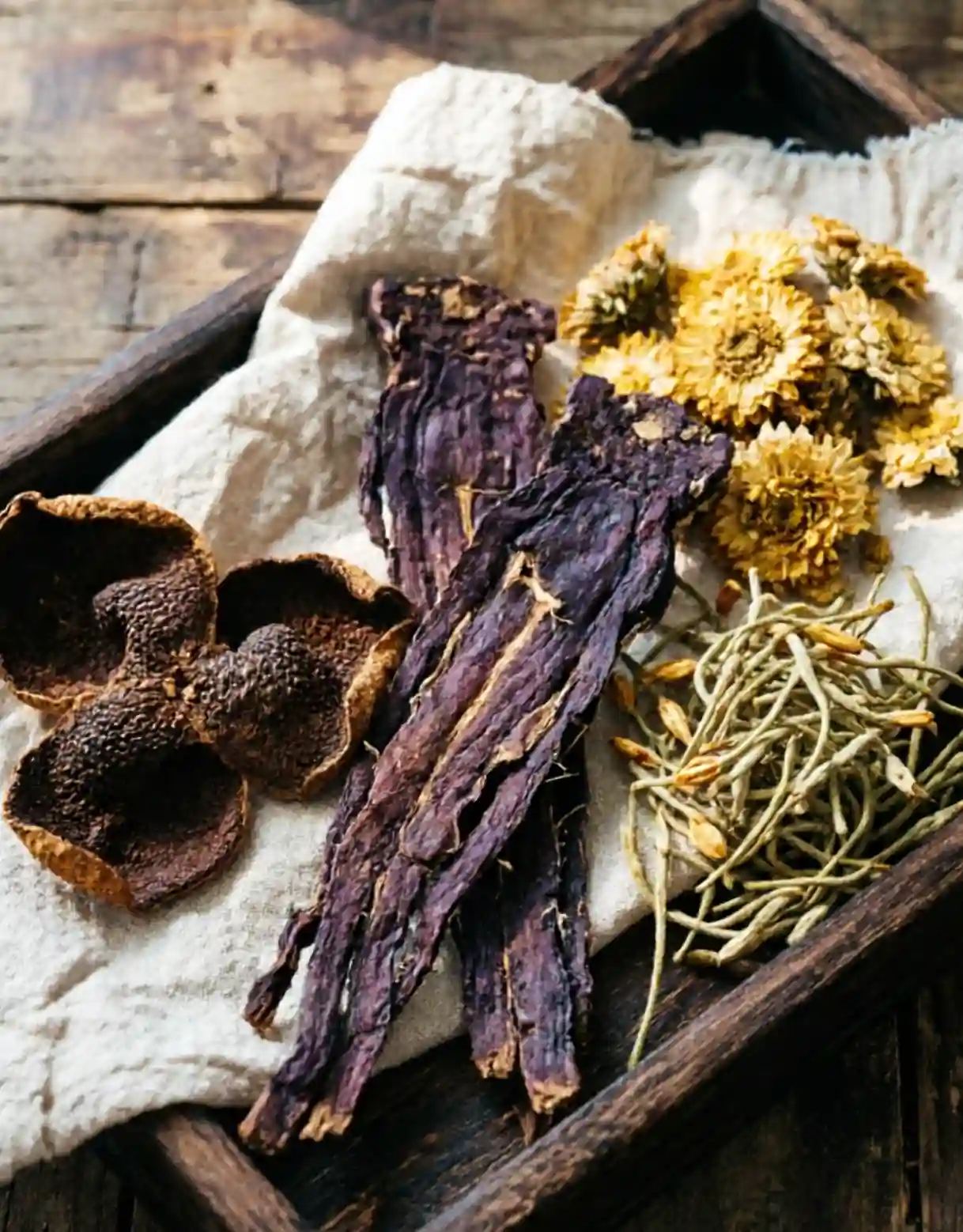
Rhizome nearly cylindrical or irregularly lumpy with nodular protrusions and short branches, 5-22 cm long, 2-5 cm in diameter. Surface yellowish-brown or grayish-brown, uneven, with hard fibrous root remnants, circular bud scars at branch tips, sometimes irregular cracks on the outer bark and residual scale leaves. Texture hard. Slices oblong or irregular, 1-5 mm thick, with uneven edges; cut surface off-white to light reddish-brown, powdery, with visible dotted vascular bundles and numerous small bright spots; texture slightly tough, dust flies when broken, and feels sticky when moistened with water. Odor: faint; Taste: slightly sweet and astringent.
Chemical Constituents
The rhizome contains astilbin and engeletin.OCaffeoylshikimic acid, shikimic acid, ferulic acid,β- Sitosterol, glucose.
Pharmacology
Has anti-tumor effects.βBeta-receptor blocking effect; has a detoxifying effect on gossypol.
Properties and Channel Entry
Sweet, bland, neutral. Enters the Liver and Stomach channels.
Functions and Indications
Detoxifies, eliminates Dampness, and facilitates joint movement
Dosage and Administration
Oral: decoct in water, 10-60 g. External: appropriate amount, grind into powder and apply.
Precautions and Contraindications
People with Liver and Kidney Yin Deficiency should use with caution. Avoid contact with iron utensils, and avoid tea while taking.
Prescriptions
1. For rheumatic bone pain, sores, swelling, and toxin: Tufuling 500 g, peeled, stewed with pork until tender, taken in divided doses with the residue. ("Zhejiang Folk Commonly Used Herbs") 2. For dermatitis: Tufuling 60-90 g, decoct in water, taken as tea. ("Jiangxi Herbal Medicine") 3. For lacquer allergy: Tufuling 15 g and Cang'erzi 15 g. Decoct in water, then add Liuyisan 30 g and take. ("Fujian Materia Medica Records") 4. For common warts: Tufuling 50 g, Shengdihuang 30 g, Kushen 15 g, Hongzicao 15 g, Huangqin 12 g, Gancao 10 g. 1 dose daily, decoct in water, taken orally in 4 divided doses. [Guangxi Traditional Chinese Medicine 1990, 13(3):20] 5. For chloasma: Tufuling 100 g, decoct in water, taken in 2 divided doses, 1 dose every 2 days. Avoid sun exposure during treatment. [Shanxi Traditional Chinese Medicine 1987, (6):8]

