Pinyin: Mufangji
Aliases
Tumuxiang, Jinyaoshi, Qingtenggen, Qingtanxiang
Source
1. Plant of the Menispermaceae family, Cocculus orbiculatus (L.) DC.Cocculus orbiculatusDried root of (L.) DC.
Botanical Description
Woody vine. Young branches densely covered with soft hairs, older branches nearly hairless, with straight striations on the surface. Leaves simple, alternate; petiole 1-3 cm long, covered with white soft hairs; leaf blade papery to nearly leathery, highly variable in shape, ranging from linear-lanceolate to broadly ovate-suborbicular, narrowly elliptic to suborbicular, oblanceolate to obcordate, sometimes ovate-cordate, 3-8 cm long, a few exceeding 10 cm, 1.5-5 cm wide, apex acuminate, acute, or obtuse with a small mucronate tip, sometimes slightly emarginate or 2-lobed, base cuneate, rounded, or cordate, margin entire or 3-lobed, sometimes palmately 5-lobed, both surfaces densely to sparsely pubescent, sometimes nearly hairless. Cymes solitary or arranged in panicles, axillary or terminal, up to 10 cm or longer, pubescent; flowers unisexual, dioecious; male flowers pale yellow; sepals 6, glabrous, outer ones ovate or elliptic-ovate, 1-2 mm long, inner ones broadly elliptic, up to 2.5 mm long; petals 6, oblanceolate-oblong, apex 2-lobed, base with auricles on both sides and infolded, 1-2 mm long; stamens 6, shorter than petals; female flowers with sepals and petals similar to male; staminodes 6, minute; carpels 6. Drupes subglobose, purple-red or blue-black when mature, 7-8 mm long. Flowering period May to August, fruiting period August to October.
Habitat and Distribution
It grows on hillsides, in thickets, forest edges, roadsides, or sparse forests. It is distributed in East, Central, South, and Southwest China, as well as Hebei, Liaoning, Shaanxi, and other areas, particularly common in the Yangtze River basin and regions to its south.
Harvesting and Processing
Harvested in spring and autumn, with autumn harvest yielding better quality; dig up the roots, remove stems, leaves, and rhizome crown, wash clean, and sun-dry.
Medicinal Properties
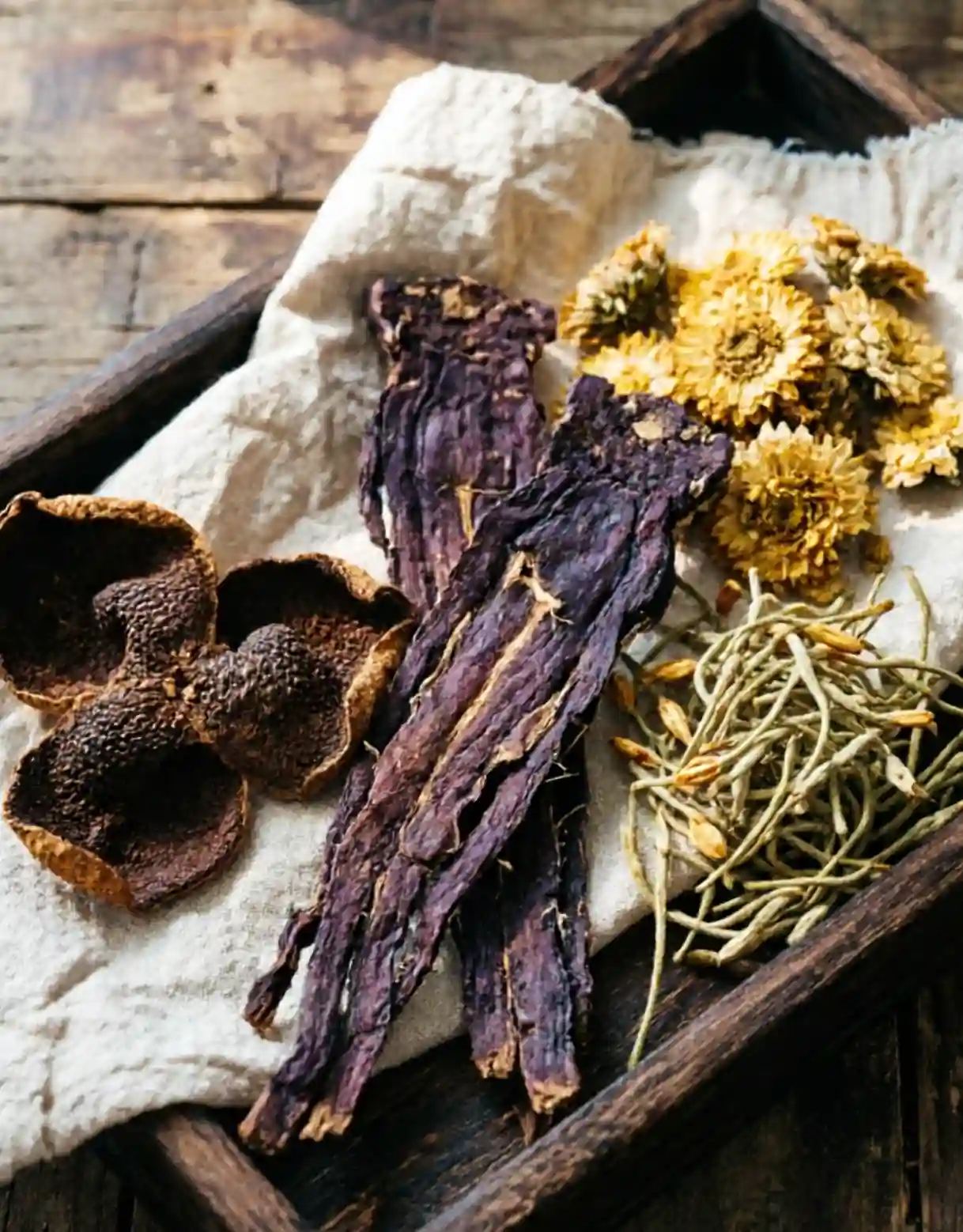
The root is cylindrical or twisted, slightly beaded with raised nodes, 10-20 cm long, 1-2.5 cm in diameter. The surface is blackish-brown with curved longitudinal grooves and a few rootlet scars; the texture is hard; the cut surface is yellowish-white with radiate striations and small pores. Odor: faint; Taste: slightly bitter. Those with uniform shape and firm texture are considered superior.
Chemical Constituents
This product contains cocculine, isococculine, magnoflorine, cocculamine, norcocculine, cocculidine, epistephanine, and cocculubine.
Pharmacology
Has analgesic, antipyretic, and anti-inflammatory effects; has muscle relaxant effects; has hypotensive, antiarrhythmic, platelet aggregation inhibitory effects, and sympathetic ganglion blockade effects; total alkaloids of Mufangji haveαReceptor blocking effect; cocculine at low doses stimulates the rabbit small intestine and uterus, while at high doses it causes anesthesia. Cocculine can cause constriction of the frog's pupil and respiratory paralysis in frogs, mice, and rabbits.
Properties and Channel Entry
Bitter, acrid, and cold. Enters the Urinary Bladder, Kidney, and Spleen channels.
Functions and Indications
Expels Wind and eliminates Dampness, unblocks the channels and activates collaterals, resolves toxicity and reduces swelling. Indicated for rheumatic Bi pain (painful joint obstruction), edema, painful urination, amenorrhea, traumatic injury, sore throat, sores and carbuncles with swelling and toxicity, eczema, and venomous snake bites.
Dosage and Administration
Internal: decoct in water, 5-10 g. External: appropriate amount, decoct in water for fumigation and washing; mash for topical application; or grind into a thick juice for application.
Precautions and Contraindications
For those with Yin deficiency, without Damp-Heat, and for pregnant women, use with caution.
Prescriptions
1. For postpartum rheumatoid joint pain: *Cocculus orbiculatus* 30 g, *Elaeagnus oldhamii* root 15 g. Decoct in water with a small amount of wine for oral administration. (*Fujian Materia Medica*) 2. For rheumatoid pain and intercostal neuralgia: *Cocculus orbiculatus* and *Achyranthes bidentata* 15 g each. Decoct in water for oral administration. (*Zhejiang Medicinal Plants Flora*) 3. For edema: *Cocculus orbiculatus*, *Astragalus membranaceus*, and *Poria cocos* 9 g each, *Cinnamomum cassia* twig 6 g, *Glycyrrhiza uralensis* 3 g. Decoct in water for oral administration. (*National Compendium of Chinese Herbal Medicine*) 4. For nephritic edema and urinary tract infection: *Cocculus orbiculatus* 9-15 g, *Plantago asiatica* seed 30 g. Decoct in water for oral administration. (*Zhejiang Medicinal Plants Flora*) 5. For nephropathy edema and cardiac edema: *Cocculus orbiculatus* 21 g, *Plantago asiatica* herb 30 g, *Coix lacryma-jobi* seed 30 g, *Dianthus superbus* 15 g. Decoct in water for oral administration. (*Qingdao Chinese Herbal Medicine Manual*) 6. For stranguria with hematuria: *Cocculus orbiculatus* 60 g, *Gryllotalpa orientalis* 2 pieces. Decoct in water for oral administration. (*Fujian Materia Medica*) 7. For stomach pain and summer heat-induced abdominal pain: *Cocculus orbiculatus* root 8 g, *Aristolochia debilis* root 6 g. Decoct in water for oral administration, or chew and swallow. (*Hunan Materia Medica*) 8. For venomous snake bites: *Cocculus orbiculatus* and *Abelmoschus manihot* root in appropriate amounts. Grind with white liquor and apply topically from top to bottom on the wound. (*Hunan Materia Medica*)

