Pinyin: Zexie
Aliases
Shuixie, Mangyu, Zezhi, Tian'edan.
Source
Alisma orientale (Sam.) Juzep., a plant of the Alismataceae family.Alisma orientalisDried tuber of (Sam.) Juzep.
Botanical Description
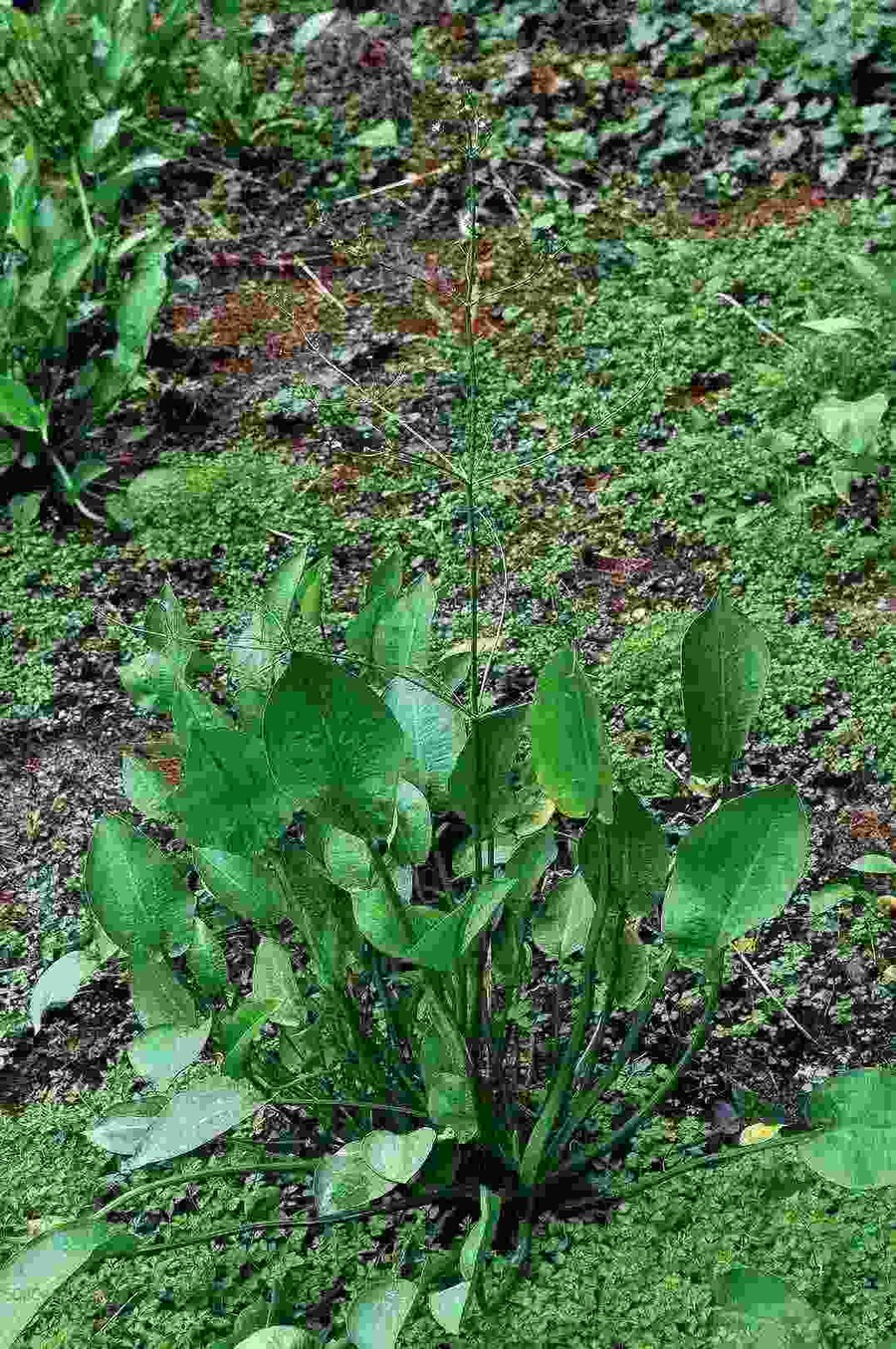
A perennial marsh plant, 50-100 m tall. It has an underground tuber, spherical, up to 4.5 cm in diameter, with a brown outer skin and densely covered with numerous fibrous roots. Leaves are basal; petioles up to 50 cm long, base expanded into a sheath-like form; leaf blades broadly elliptic to ovate, apex acute or short-pointed, base broadly cuneate, rounded, or slightly cordate, entire margins, smooth and glabrous on both surfaces; with 5-7 veins. The flower stem emerges from the leaf cluster; the inflorescence usually has 3-5 whorled branches, with lanceolate or linear bracts below the branches; the whorled branches often branch again, forming a compound umbel panicle. Pedicels vary in length; bracteoles lanceolate to linear, sharp; sepals 3, broadly ovate, green or slightly purple, persistent; petals obovate, membranous, smaller than sepals, white, deciduous; stamens 6; pistils numerous, separate; ovary obovate, laterally compressed, style lateral. Achenes numerous, flattened, obovate, with two shallow grooves on the back, brown, with persistent style. Flowering period: June to August. Fruiting period: July to September.
Habitat and Distribution
It grows at the edge of marshes or is cultivated. It is distributed in Northeast, East, Southwest, and Hebei, Xinjiang, Henan, and other regions.
Harvesting and Processing
Harvest in winter when the stems and leaves begin to wither, dig up, wash clean, dry, remove the fibrous roots and rough bark.
Medicinal Properties
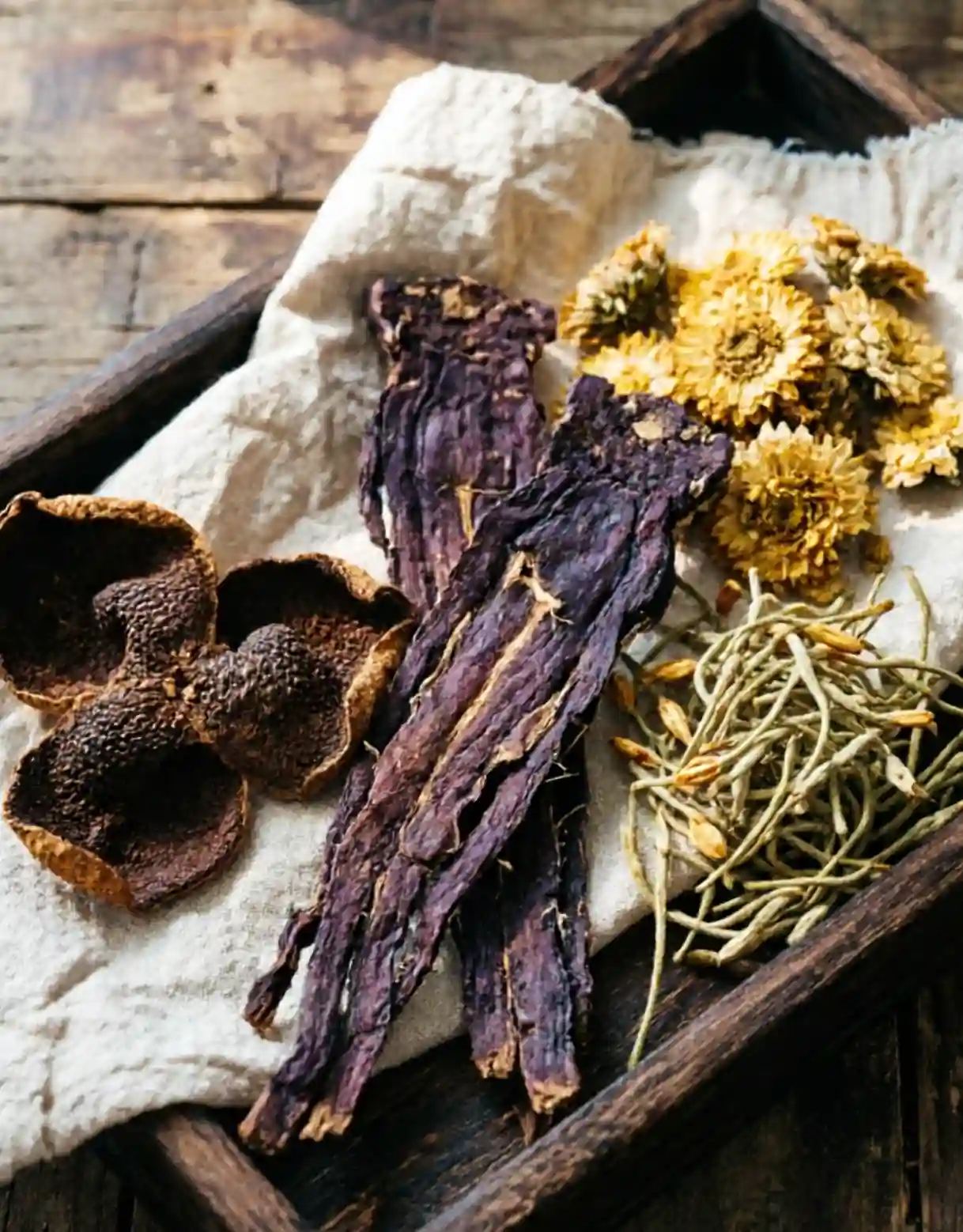
Tubers are subspherical, elliptical, or ovoid in shape, 2-7 cm long and 2-6 cm in diameter. The surface is yellowish-white or pale yellowish-brown, with irregular transverse annular shallow grooves and numerous small protruding rootlet scars, and sometimes with tumor-like bud scars at the base. The texture is firm and solid; the cut surface is yellowish-white, starchy, with numerous fine pores. Odor: faint; Taste: slightly bitter.
Chemical Constituents
This product mainly contains 23-acetyl alisol B, alisol, alisol oxide, alisol A, alisol B, alisol C, and alisol diterpenoid alcohol.
Pharmacology
It has diuretic, antihypertensive, blood lipid-lowering, anti-atherosclerotic, anti-fatty liver, anti-inflammatory, hypoglycemic, and anti-obesity effects.
Properties and Channel Entry
Sweet and bland, cold. Enters the Kidney and Urinary Bladder channels.
Functions and Indications
Promotes urination and leaches out Dampness, drains Heat and unblocks painful urinary dribbling, transforms turbidity and reduces lipids. Mainly indicated for difficult urination, painful urinary dribbling with Heat, edema and abdominal distension, diarrhea with scanty urine, phlegm-fluid retention causing dizziness, and hyperlipidemia.
Dosage and Administration
Internal use: decoction, 6-12 g; or in pill or powder form.
Precautions and Contraindications
For those with Kidney deficiency, seminal emission, and no Damp-Heat, it is contraindicated.
Prescriptions
1. For tympanites and edema: Baizhu (Atractylodes macrocephala) and Zexie (Alisma orientale) 15 g each. Grind the above into a fine powder, decoct 9 g and take with Fuling (Poria cocos) decoction. Alternatively, make into pills and take 30 pills. (Baizhu San from "Baoming Ji"). 2. For edema and dysuria: Zexie (Alisma orientale) and Baizhu (Atractylodes macrocephala) 12 g each, Cheqianzi (Plantago asiatica) 9 g, Fulingpi (Poria cocos peel) 15 g, Xiguapi (Watermelon peel) 24 g. Decoct in water and take orally. (From "Quanguo Zhongcaoyao Huibian"). 3. For acute enteritis: Zexie (Alisma orientale) 15 g, Zhuling (Polyporus umbellatus) 9 g, Baitouweng (Pulsatilla chinensis) 15 g, Cheqianzi (Plantago asiatica) 6 g. Decoct in water and take orally. (From "Qingdao Zhongcaoyao Shouce"). 4. For retained phlegm-fluid causing dizziness and vomiting of phlegm: Zexie (Alisma orientale) and Baizhu (Atractylodes macrocephala) 9 g each, Hedi (Lotus petiole base) 5 pieces, Juhua (Chrysanthemum morifolium) 6 g, Peilan (Eupatorium fortunei) 3 g. Steep and decoct as a tea substitute. (Qingxuan Tea from "Zhejiang Zhongyiyao" 1979, 8:288).