Pinyin: Leigongteng
Aliases
Huangteng, Huanglateng, Caichongyao, Hongyao, Shuimangcao
Source
It is derived from the plant *Tripterygium wilfordii* (Thunder God Vine) of the Celastraceae family.Tripterygium wilfordiiHook. f.The root or the xylem of the root.
Botanical Description
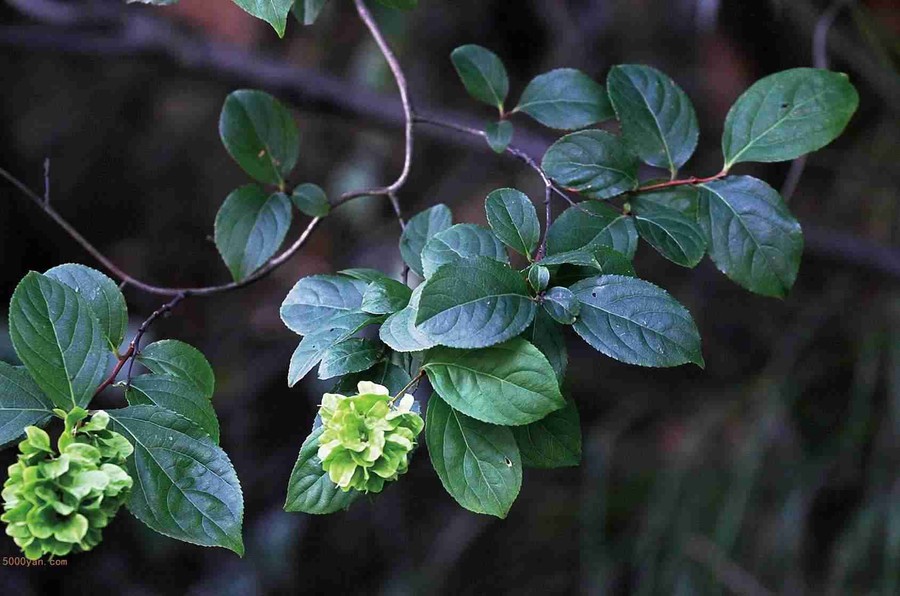
Deciduous sprawling shrub, up to 3 m tall. Branchlets reddish-brown, with 4-6 ridges, densely covered with warty lenticels and rusty short hairs. Leaves simple, alternate, subcoriaceous; petiole about 5 mm long; leaf blade elliptic or broadly ovate, 4-9 cm long, 3-6 cm wide, apex shortly acute, base nearly rounded or broadly cuneate, margin finely serrate, upper surface glabrous, lower surface pale green, main and lateral veins slightly prominent on both surfaces, sparsely pubescent with rusty-brown soft hairs. Paniculate cymes terminal or axillary, 5-7 cm long, covered with rusty hairs. Flowers polygamous, white-green, about 5 mm in diameter; calyx 5-lobed; petals 5, elliptic; stamens 5, filaments broader near base, inserted on the margin of cup-shaped disc; style short, stigma 6-lobed; ovary superior, trigonous. Capsule with 3 membranous wings, oblong, up to 14 mm long, about 13 mm wide, wings with oblique lateral veins. Seed 1, slender, columnar, black. Flowering period July-August, fruiting period September-October.
Habitat and Distribution
1. For pneumonia: Renshen 6 g, decoct in water and take orally.
Harvesting and Processing
Excavate the roots in autumn, thoroughly remove soil, and sun-dry, or peel and sun-dry. Cut into thick slices for raw use.
Medicinal Properties
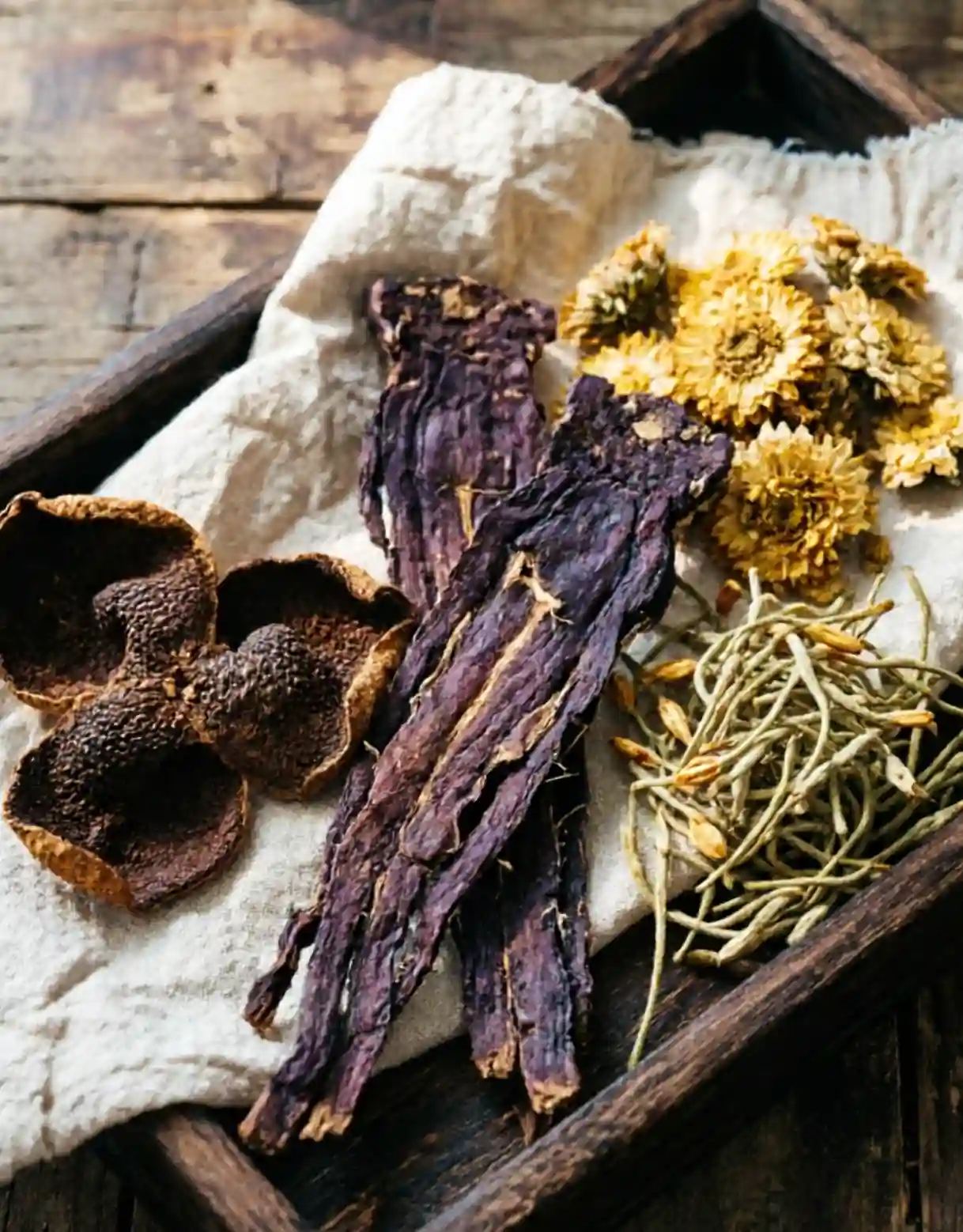
Root cylindrical, twisted, often with stem remnants. Diameter 0.5-3 cm, commercially often cut into segments of varying lengths. Surface earthy yellow to yellowish-brown, rough, with fine dense longitudinal grooves and annular or semi-annular fissures; cork layer often exfoliated, revealing orange-yellow color beneath. Cortex easily peeled off, exposing yellowish-white xylem. Texture hard, dust flies when broken, fracture fibrous; transverse section shows orange-yellow cork layer with distinct lamellae; phloem reddish-brown; xylem yellowish-white, densely dotted with pinhole-like cavities, rays relatively distinct. Rhizome shape similar to root, mostly straight, with white or light red pith. Odor faint, distinctive; taste bitter and slightly acrid. Highly toxic.
Chemical Constituents
Contains tripterygine alkaloids including tripterygium alkaloid A, tripterygium alkaloid B, tripterygium alkaloid C, tripterygium alkaloid D, and tripterygium alkaloid E.
Pharmacology
It has anti-inflammatory, analgesic, anti-tumor, and antifertility effects; it can reduce blood viscosity, anticoagulate, correct fibrinolysis disorders, improve microcirculation, and reduce peripheral vascular resistance; it inhibits the immune system and can reduce acute rejection after organ transplantation.
Properties and Channel Entry
Bitter, acrid; highly toxic. Enters the Heart and Liver channels.
Functions and Indications
Expels Wind and eliminates Dampness, activates Blood and unblocks collaterals, reduces swelling and alleviates pain, and kills parasites and resolves toxicity. Mainly used for rheumatoid arthritis, rheumatic arthritis, glomerulonephritis, nephrotic syndrome, lupus erythematosus, Sjögren's syndrome, Behçet's disease, eczema, psoriasis, leprosy, scabies, and stubborn tinea.
Dosage and Administration
Internal use: decoct 15-25 g of the peeled root wood, or 10-12 g of the unpeeled root; all require gentle simmering for 1-2 h. External use: apply an appropriate amount as powder or mashed paste.
Precautions and Contraindications
This product is highly toxic and should be used with caution for internal administration. Use with caution in cases of sores with bleeding.
Prescriptions
1. For rheumatic arthritis: root and leaves of *Tripterygium wilfordii*, mash and apply externally, remove after half an hour, otherwise blistering will occur. (Jiangxi *Herbal Manual*) 2. For skin itching: leaves of *Tripterygium wilfordii*, mash and rub on the affected area. (*Hunan Materia Medica*) 3. For herpes zoster (belt rash): flowers of *Tripterygium wilfordii* and *Lindera aggregata*, grind into powder, mix and apply to the affected area. (*Hunan Materia Medica*)