Pinyin: Baiqian
Aliases
Souyao, E Baiqian, Tu Baiqian.
Source
1. For pneumonia: Renshen 6 g, decoct in water and take orally.CynanchumglaucescensDried rhizome and root of (Decne.) Hand.-Mazz.
Botanical Description
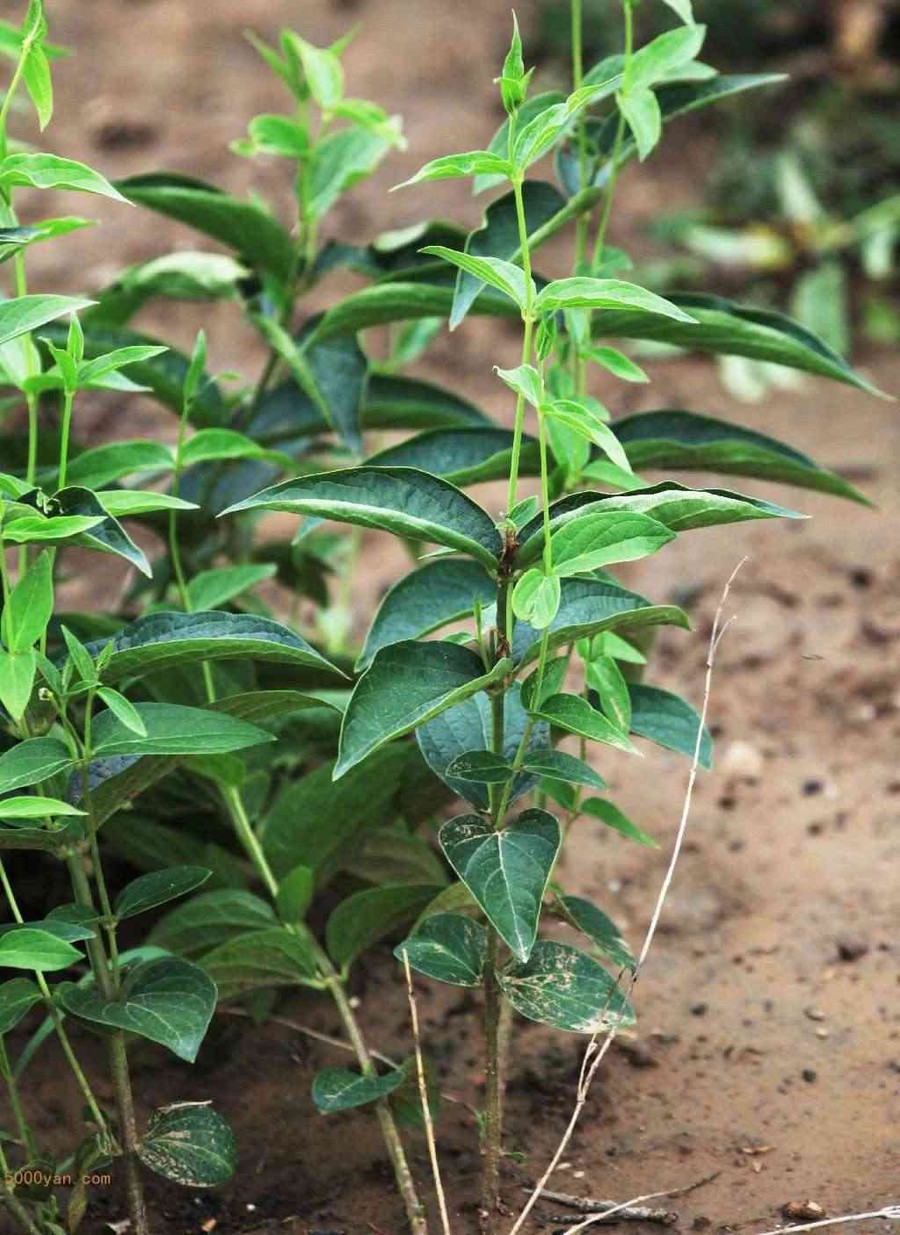
A perennial erect semi-shrub, 0.5-1 m tall. Rhizome horizontal or oblique, hollow inside like a goose feather tube; root system extremely developed, roots numerous and thin, fibrous, yellow-white or slightly reddish-brown. Stem cylindrical, surface gray-green, with 2 rows of soft hairs and fine ridges. Leaves opposite, leaf blade oblong or oblong-lanceolate, apex slightly obtuse, resembling the leaves of Wikstroemia indica, nearly sessile. Umbellate cymes axillary, with 3-8 flowers, numerous bracteoles; flowers relatively large; calyx 5-lobed to base, with few glands at base inside; corolla rotate, yellow-white, 5-lobed to base, lobes linear, with long soft hairs inside; corona lobes peltate, thick, shorter than anthers; stamens 5, united with pistil into a column, anthers 2-celled, each cell with a pale yellow pendulous pollen mass; stigma slightly prominent, enclosed in the anther membrane. Follicle solitary, narrow and long lanceolate. Seeds lanceolate, yellow-brown, apex with white silky hairs. Flowering period May-August, fruiting period September-October.
Habitat and Distribution
Born in stream beaches and riverbank sandy areas, sometimes half-submerged in water. Distributed in Jiangsu, Anhui, Zhejiang, Jiangxi, Fujian, Hubei, Hunan, Guangdong, Guangxi, Guizhou and other regions.
Harvesting and Processing
Harvest in autumn, dig out, wash clean, and sun-dry.
Medicinal Properties
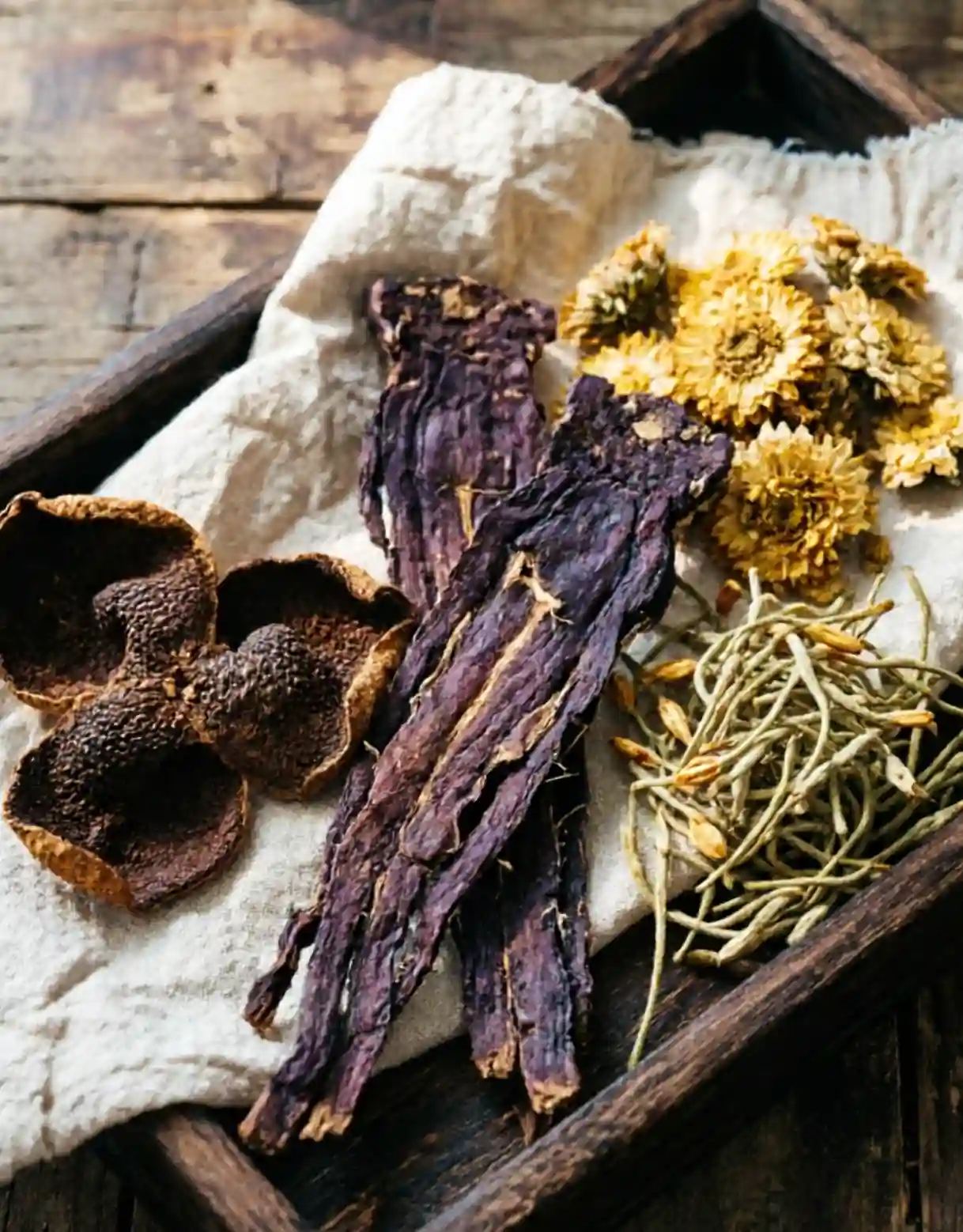
Rhizome relatively short and small or slightly lump-shaped; surface gray-green or gray-yellow, internodes 1-2 cm long. Texture relatively hard. Roots slightly curved, approximately 1 mm in diameter, with few branches.
Chemical Constituents
This product contains cynatratoside,β- sitosterol, quercetin-7-O-α-L- rhamnoside, succinic acid, glaucolide A, etc.
Pharmacology
Has antitussive, expectorant, antiasthmatic, and anti-inflammatory effects.
Properties and Channel Entry
Acrid, bitter, slightly warm. Enters the Lung channel.
Functions and Indications
Descends Qi, resolves Phlegm, and stops cough. Used for Lung Qi congestion, profuse cough with phlegm, chest fullness, and wheezing.
Dosage and Administration
Internal use: decoction, 3-10 g; or made into pills or powder.
Precautions and Contraindications
Caution should be used in patients with Lung deficiency and wheezing cough. Excessive dosage of the raw product may cause some irritation to the stomach.
Prescriptions
1. For hepatitis: fresh root of Cynanchum glaucescens 30 g, Solanum lyratum 30 g, Siphonostegia chinensis 15 g. Decoct in water and take orally. (Jiangxi "Handbook of Herbal Medicine") 2. For edema: fresh root of Cynanchum glaucescens 30 g, root of Lysimachia fortunei, root of Melastoma dodecandrum, and Juncus effusus 15 g each. Decoct in water, add appropriate amount of brown sugar and take. (Jiangxi "Handbook of Herbal Medicine") 3. For stomach pain: root of Cynanchum glaucescens and root of Clematis chinensis 15 g each, root of Urena procumbens 24 g. Decoct in water and take orally. (Fujian "Materia Medica") 4. For traumatic injury: root of Cynanchum glaucescens 15 g, one egg or dried razor clam 30 g; for rib pain add Cyperus rotundus 9 g and green tangerine peel 3 g. Decoct in water and take orally. (Fujian "Materia Medica") 5. For measles: Cynanchum glaucescens and Pueraria lobata 15 g each. Decoct in water and take orally. (Fujian "Materia Medica")