Pinyin: Xixin
Aliases
Shaoxin, Xicao, Duyecao.
Source
1. For pneumonia: Asarum 6 g, decoct in water and take orally.Asarum hetero-tropoidesFr.Schmidt var.mandshuricumThe dried root and rhizome of (Maxim.) Kitag.
Botanical Description
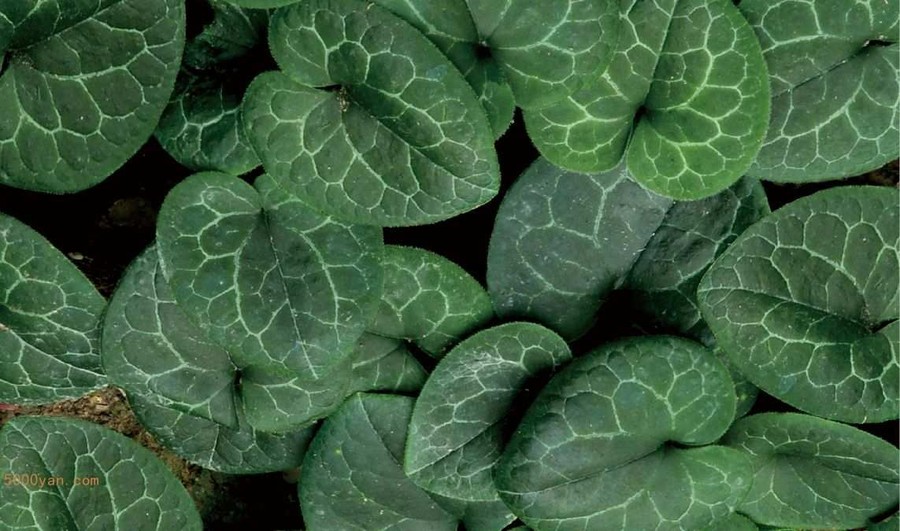
Perennial herb. Rhizome creeping. Leaves ovate-cordate or nearly reniform, 4-9 cm long, 5-13 cm wide, apex acute or obtuse, base cordate, with hairs on upper surface veins, sometimes sparsely short-hairy throughout, denser hairs on lower surface; bud leaf suborbicular. Flowers purplish-brown, rarely purplish-green; pedicel 3-5 cm long, bent at a right angle at the apex during flowering, erect during fruiting; perianth tube urceolate or hemispherical, throat slightly constricted, perianth lobes triangular-ovate, about 7 mm long, about 9 mm wide, reflexed from the base and appressed to the perianth tube; stamens inserted at the middle of the ovary, filaments usually slightly shorter than anthers, connective not exserted; ovary half-inferior or nearly superior, subglobose, styles 6, apex 2-lobed, stigmas lateral. Capsule hemispherical. Flowering in May, fruiting in June-July.
Habitat and Distribution
Grows under forests on slopes or in shady, moist, fertile areas of mountain valleys. Distributed in Northeast China, as well as Shanxi, Shaanxi, Shandong, and Henan.
Harvesting and Processing
Harvest during the fruit ripening period in summer or early autumn, remove all above-ground parts and sediment, and dry in the shade.
Medicinal Properties
This product is often curled into a clump. The rhizome is horizontal, irregularly cylindrical, with short branches, 1-10 cm long, 0.2-0.4 cm in diameter; the surface is gray-brown, rough, with annular nodes, internodes 0.2-0.3 cm long, and bowl-shaped stem scars at the tips of the branches. The roots are slender, densely growing on the nodes, 10-20 cm long, 0.1 cm in diameter; the surface is gray-yellow, smooth or with longitudinal wrinkles; with fibrous roots and root scars; brittle, easily broken, with a flat, yellowish-white or white fracture. Odor: pungent and aromatic; Taste: spicy, numbing on the tongue.
Chemical Constituents
This product mainly contains kaempferol and kaempferol 3-O-β-D-glucopyranoside,γ- Songyoulai (terpinene)β- Songyoulai (terpinene)α- Thujopsene, asarone, (-)-asarinin and other constituents.
Pharmacology
Has antipyretic and analgesic effects, and can lower the body temperature of normal animals below normal levels; anticonvulsant; possesses significant anti-inflammatory effects; has marked inhibitory effects on both cellular and humoral immunity; can be used for local anesthesia; counteracts morphine-induced respiratory depression and relaxes tracheal smooth muscle; improves cardiac function and lowers blood pressure; has antihistamine and anti-allergic effects; regulates smooth muscle function in the body. Has certain bacteriostatic effects, enhances lipid metabolism, and raises blood sugar levels.
Properties and Channel Entry
Pungent, warm. Enters the Heart, Lung, and Kidney channels.
Functions and Indications
Relieves the exterior and disperses Cold, expels Wind and alleviates pain, opens the nasal passages, warms the Lungs and transforms Phlegm-Fluid. Used for Wind-Cold common cold, headache, toothache, nasal congestion with runny nose, allergic rhinitis, sinusitis, Wind-Dampness Bi pain, and Phlegm-Fluid wheezing and coughing.
Dosage and Administration
Oral: decoct in water, 1
Precautions and Contraindications
Contraindicated in patients with Yin deficiency, Blood deficiency, Qi deficiency with excessive sweating, and rising Fire. Should not be used together with Lilu (Veratrum nigrum). Excessive dosage of this product may cause adverse reactions such as facial flushing, dizziness, excessive sweating, and even chest tightness, palpitations, nausea, and vomiting.
Prescriptions
1. For nasal congestion and loss of smell: Xixin (removed seedling leaves) and Guadi (melon pedicel) 0.3 g each. Grind the two ingredients into a powder, blow a small amount into the nose. (From *Shengji Zonglu*). 2. For persistent toothache: Xixin (removed seedling leaves) and Bibo (long pepper), equal parts, coarsely grind and sieve. Use 3 g each time with one cup of water, boil for ten-odd times, rinse warm and spit out when cold. (From *Shengji Zonglu*). 3. For toothache: Xixin and Penxiao (potassium nitrate) 3 g each, Xionghuang (realgar) 1.5 g, two Yacao (toothpick buds). Grind into powder. Use one clove of garlic, mix with the powder to form pills the size of Wutong seeds. Use one pill each time, wrap in cotton. For left toothache, plug into the left ear; for right toothache, plug into the right ear. (From *Waike Dacheng*). 4. For oral ulcers: Xixin and Huanglian (Coptis chinensis), equal parts, grind into powder. First wipe the affected area clean with a cloth, then apply the powder. Salivation indicates recovery. (From *Weisheng Yijian Fang*). 5. For halitosis: Xixin 30 g, Gancao (honey-fried, sliced) 30 g, Guixin (cinnamon bark) 30 g. Grind the above ingredients into a fine powder. Take 3 g with warm water at any time, without regard to meals. (From *Shenghui Fang*, Xixin Powder). 6. For pediatric mouth sores: Xixin powder, mix with vinegar, apply to the navel. (From *Weisheng Jiabao Fang*). 7. For snakebite: Xixin and Baizhi (Angelica dahurica) 15 g each, Xionghuang (realgar) 7.5 g, grind into powder, add a little Shexiang (musk). Take 6 g each time with warm wine. (From *Weisheng Yijian Fang*). 8. For neurodermatitis: Fresh Xixin, an appropriate amount, wash clean. Mash into a paste, apply to the affected area. Twice daily. (From *Shaan-Gan-Ning-Qing Zhongcaoyao Xuan*).